


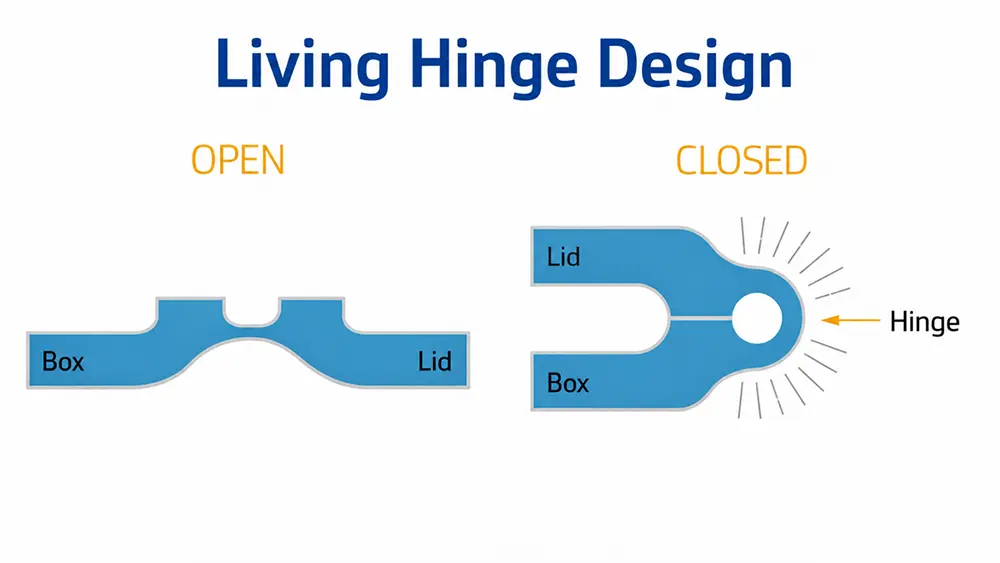
Although a living hinge may appear to be nothing more than a simple thin-wall connection, its actual service life is influenced by material properties, structural design, and the injection molding process. A poorly designed living hinge may function normally at first, but after extended use, it can develop whitening, cracks, or even complete failure.
For this reason, a reliable living hinge must be designed by considering the material, structure, and manufacturing process together.
What Is a Living Hinge?
A living hinge is an injection-molded feature that uses the flexibility of the plastic itself to allow repeated opening and closing. It usually connects two plastic sections through a thin-wall region, creating a one-piece structure without the need for a separate metal pin or additional assembled components.
Compared with conventional mechanical hinges, a living hinge can reduce part count and assembly operations, helping lower manufacturing costs. It is therefore widely used in flip-top caps, packaging boxes, medical packaging, plastic enclosures, and similar products.
Living Hinge Design Considerations
1. Material Selection
The material requirements for a living hinge are different from those of an ordinary injection-molded part. Conventional plastic products generally focus on strength, rigidity, and dimensional stability, whereas a living hinge depends more heavily on fatigue resistance because the hinge area must withstand repeated bending over a long period of time.
PP is currently the most widely used material for living hinges. It offers good toughness and fatigue resistance, and its molecular structure allows it to withstand a large number of repeated deformation cycles. For this reason, PP is commonly used in bottle caps, packaging boxes, and other products that require frequent opening and closing.
By comparison, engineering plastics such as ABS and PC may provide greater strength and rigidity, but they are more likely to develop stress concentrations and fatigue cracks under repeated bending. They are therefore generally not ideal choices for high-cycle living hinges.
PE also offers good flexibility and may be used as an alternative material in certain packaging applications.
Nylon, or PA, provides relatively high strength and wear resistance, but its moisture absorption and fatigue behavior must be carefully evaluated. It is not normally the first choice for living hinges that must withstand a high number of opening and closing cycles.
2. Structural Design
For many conventional plastic structures, increasing wall thickness may improve strength. A living hinge follows a completely different design principle. It relies on a carefully controlled thin-wall section so that deformation is concentrated within the hinge area.
① Properly Control Hinge Thickness
Thickness is one of the most important factors affecting living hinge life. Many designers assume that a thicker hinge will be stronger and therefore last longer. In practice, that is not necessarily true.
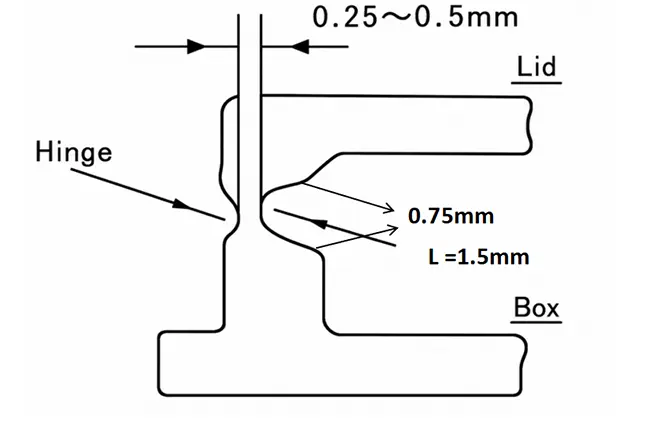
Living hinges are generally designed with a very thin cross-section. For commonly used PP materials, the hinge thickness is typically around 0.2–0.5 mm. The final dimension should be verified according to the product size, opening angle, material grade, and required service life.
If the hinge is too thin, it may not provide sufficient support. If it is too thick, its fatigue life may be reduced. The design therefore needs to strike a balance between flexibility and structural stability.
② Avoid Sharp Corners and Add Radiused Transitions
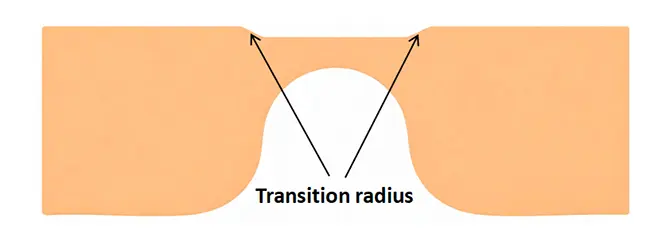
Sharp corners are typical stress-concentration points in plastic parts. The connection between the living hinge and the main body of the product should not contain sharp corners, as repeated opening and closing may cause stress to accumulate in these areas, leading to whitening or cracking.
Adding radii and making the thickness transition more gradual can reduce localized stress and improve hinge life. For a typical PP living hinge, the thin hinge land is often approximately 1.5 mm long, while the bend radius is commonly around 0.75 mm, as shown below. The hinge land creates a stable bending region, while the radius allows the hinge to deform more smoothly and reduces tensile strain during bending.

③ Add Smooth Transition Features
If the thin hinge section connects directly to a much thicker sidewall, deformation may not remain confined to the hinge itself. The nearby structure may also begin to carry part of the load, increasing the risk of fatigue damage.
For this reason, smooth transition areas should be designed on both sides of the hinge. This helps concentrate bending within the intended thin-wall region while reducing the effect on the main body of the part.

④ A Longer Hinge Is Not Always Better
If the thin hinge land is too short, bending strain becomes concentrated. Increasing its length can spread deformation over a larger area, but an excessively long hinge land may reduce the positional stability of the lid.
The appropriate length should therefore be determined according to the material, opening angle, and overall product structure, and then confirmed through prototype testing.
⑤ Hinge Width
The hinge width should be selected according to the size of the product and the loads it must withstand. For a relatively long flip-top structure, the hinge may be made wider, or several separate hinge sections may be used to distribute the load.
3. Mold Design
Because the hinge region is extremely thin, plastic flow behavior, molecular orientation, and weld-line location can directly affect its service life. Mold design and injection molding conditions therefore need to be considered early in the product development process.
① Plastic Flow Direction
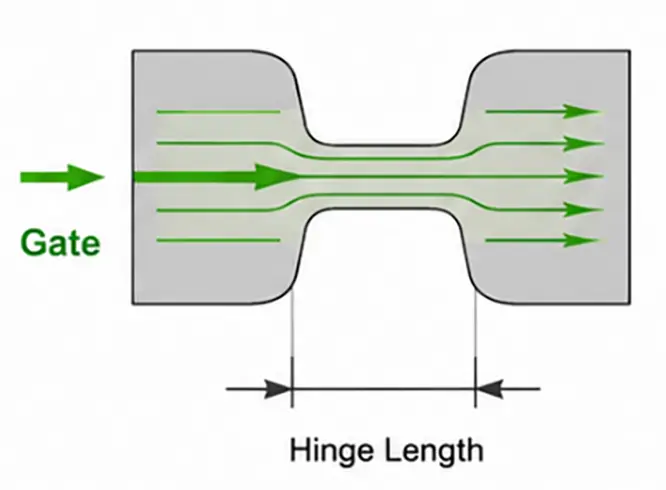
During injection molding, the molten plastic should, as far as possible, flow across the entire thin-wall hinge region in a direction perpendicular to the hinge length. In other words, the melt should pass from one side of the product, across the hinge, and into the other side, rather than flowing along the hinge.
This flow pattern promotes favorable molecular orientation in PP and improves the durability of the hinge under repeated bending.

② Molecular Orientation Determines Fatigue Performance
Plastic is not a completely uniform material. During injection molding, polymer molecules tend to align in the direction of flow.
When the molecular orientation is favorable for hinge bending, the product can withstand more opening and closing cycles. If the orientation is poorly controlled, fatigue failure may occur after a relatively small number of cycles.
③ Keep Weld Lines Away from the Hinge Area
Weld lines are a common risk in living hinge applications. In an ordinary plastic part, a weld line may mainly affect appearance. In a hinge that must bend repeatedly, however, it may become the starting point of a crack.
Gate and runner design should therefore prevent separate melt fronts from meeting within the hinge region.
④ Select the Gate Type According to Hinge Width
For a relatively wide living hinge, a fan gate or another wide-entry gate design may be considered. This allows the melt to pass through the thin-wall section more evenly.
The final gate type and location should still be determined according to the product geometry and, where appropriate, mold flow analysis.
⑤ Leave Room for Mold Adjustments
Living hinge performance is influenced by the material, hinge thickness, and operating conditions. The mold should therefore be designed with room for later adjustment.
This makes it possible to increase the hinge thickness by removing additional mold steel. By contrast, changing a hinge that is already too thick into a thinner one is usually much more difficult.
Design Case: PP Flip-Top Storage Box
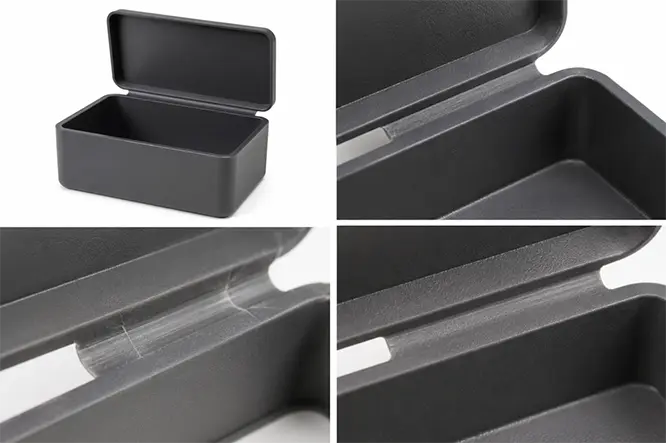
We once completed a project in which the customer wanted to use a PP living hinge to mold the storage box lid and body as one piece. The goal was to reduce assembly operations while ensuring that the product could withstand repeated opening and closing over an extended period. The customer insisted on retaining the original design, which used a 0.6 mm hinge thickness and a 1.5 mm hinge land.
As expected, after the first mold trial, the living hinge quickly developed whitening during continuous cycling tests, and cracks began to appear after approximately 500 cycles. Further analysis showed that the combination of the 0.6 mm hinge thickness and the relatively short hinge land caused bending strain to become concentrated, making it the main cause of the whitening and cracking.
We then recommended optimizing the hinge structure by increasing the hinge land from 1.5 mm to 2.0 mm and improving the root transition radius. We also adjusted the gate position. The final samples successfully completed more than 10,000 opening and closing cycles without cracking, while the whitening was significantly reduced. The product subsequently entered mass production.

Common Living Hinge Failure Modes and Causes
Living hinge failure is rarely caused by a single factor. In most cases, it results from a combination of material properties, structural design, and injection molding conditions. The following are some of the most common problems encountered in production:
| Failure Mode | Main Causes |
| Whitening | Excessive tensile stress in the hinge area causes microscopic material damage. Excessive hinge thickness or insufficient radii may also lead to whitening. |
| Cracking | Repeated bending causes material fatigue. Weld lines and stress-concentration areas may become crack initiation points. |
| Breakage | The material is unsuitable for repeated bending, or the hinge design exceeds the fatigue capability of the material. |
| Spring-Back | The hinge is too stiff to remain in the intended position. Excessive thickness or an unsuitable material may also contribute to this problem. |
| Lateral Twisting | Additional side loads are introduced during opening and closing, causing the hinge to experience torsion as well as bending. |
When Is a Living Hinge Not Suitable?
Although living hinges offer clear advantages in many plastic products, they are not the best solution for every hinged structure.
Products subjected to high mechanical loads:
For industrial equipment housings, large covers, or structures that are frequently exposed to impact, a conventional mechanical hinge is generally more reliable.
Products operating in high-temperature environments:
Plastic properties change as temperature increases. Higher temperatures may reduce material stiffness and make the hinge more susceptible to permanent deformation.
If the product will remain in a high-temperature environment for long periods, such as near an engine or in an industrial high-heat area, the material and structure must be evaluated again.
Applications requiring extremely long life, precise positioning, or high load capacity:
In these situations, a metal pin hinge may still provide better performance.
FAQ
Q1: Is PP Always the Best Material for a Living Hinge?
No. PP is currently the most commonly used material because it offers good flexibility and fatigue resistance. However, the final material should still be selected according to the required product life, operating environment, and performance requirements.
Q2: How Many Times Can a Living Hinge Be Bent?
There is no fixed number. Service life depends on the material, structural design, hinge thickness, and injection molding quality. A properly designed PP living hinge can usually withstand tens of thousands of opening and closing cycles, or even more.
Q3: Can a Living Hinge Be Made by 3D Printing?
Yes, 3D printing can be used for prototype validation. However, the properties of 3D-printed materials differ from those of injection-molded plastics. For products that require long-term repeated use, injection molding is generally more reliable.
Q4: Why Does a Living Hinge Turn White After It Has Been Used for Some Time?
Whitening usually occurs because the bending region is subjected to excessive stress, causing changes or microscopic damage within the material structure. Slight whitening does not necessarily mean immediate failure, but if it continues to worsen, the hinge design may need to be optimized.
Q5: Does a Living Hinge Require a Special Mold?
It does not require a completely different type of mold. However, the thin-wall hinge region places higher demands on gate location, flow direction, and filling stability, so these factors must be considered during the mold design stage.