



Plastic flowability affects whether a material can fill thin walls, ribs, snap fits, long flow paths, and complex details. But it is not a standalone parameter, and it cannot be judged only by one MFI/MFR value. Real material selection needs to consider the material, part structure, mold, and process together.
1. What Is Plastic Flowability?
Plastic flowability, simply put, is the ability of molten plastic to enter the mold, pass through narrow areas, and fill detailed features.
Materials with better flowability are more likely to fill thin walls, long flow paths, and small features. Materials with poor flowability are more likely to cause short shots, incomplete filling, flow marks, weld lines, or weak local areas under the same part structure.
One common misunderstanding is this: flowability is not about whether a material is “soft,” and it is not about whether a material is “strong.”
For example, PP usually flows more easily than PC, but that does not mean PP is more suitable than PC for every part. PC has poorer flowability, but it offers better impact strength, transparency, and heat resistance.
The Relationship Between Flowability and MFI/MFR
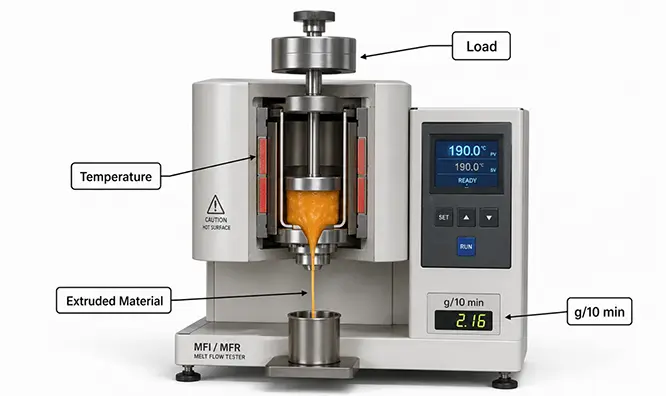
MFI/MFR is a common indicator used to judge the melt flow tendency of plastics. The unit is usually g/10 min. A higher value usually means more material flows out under a specified temperature and load, and the melt viscosity is relatively lower.
But MFI/MFR is measured under specific test conditions. ISO 1133 defines the test method for MFR/MVR of thermoplastics. It does not give every plastic material a fixed flowability value.

Why You Cannot Judge by One MFI Value
Because different materials use different test conditions.
For example, PP is commonly tested at 230°C / 2.16 kg, ABS at 220°C / 10 kg, and PC at 300°C / 1.2 kg. When the test temperature and load are different, the values cannot be compared directly.
So, MFI/MFR is more suitable for comparing different grades within the same material family, such as high-flow PP and standard PP. It should not be used to simply rank the MFR of PP against PC, POM, or PMMA.
2. Flowability Overview of Common Plastics
| Material | Common MFR/MFI Reference Range | Common Test Conditions | How to Understand the Value |
| PP | 3–80 g/10 min | 230°C / 2.16 kg | Grade variation is large. High-MFR grades are easier to fill. |
| LDPE | 0.3–50 g/10 min | 190°C / 2.16 kg | Usually flows relatively easily, but grades for different uses vary a lot. |
| HDPE | 0.1–30 g/10 min | 190°C / 2.16 kg | Lower MFR tends to favor strength; higher MFR favors mold filling. |
| PS | 5–30 g/10 min | 200°C / 5 kg | Usually flows easily and is relatively easy to mold. |
| ABS | 5–40 g/10 min | 220°C / 10 kg | Offers balanced performance, but flowability depends on the grade. |
| POM | 5–30 g/10 min | 190°C / 2.16 kg | Flow behavior is relatively stable. |
| PA6 | 10–80 g/10 min | Commonly 235°C / 2.16 kg | The value may be high, but moisture condition has a major effect. |
| PA66 | 10–60 g/10 min | Commonly 275°C / 2.16 kg | Good strength and heat resistance, but more sensitive in processing. |
| PC | 3–30 g/10 min | 300°C / 1.2 kg | Melt viscosity is high, so overall it is not an easy-flow material. |
| PMMA | 1–25 g/10 min | 230°C / 3.8 kg | Good transparency, but both flow and stress need to be controlled. |
| PBT | 10–60 g/10 min | Commonly 250°C / 2.16 kg | Unfilled grades usually flow well; reinforced grades change significantly. |
| PPS | 20–200 g/10 min | Commonly 316°C / 5 kg | Some grades have very high MFR, but they are usually high-temperature engineering materials. |
| PEEK | 2–40 g/10 min | Commonly 400°C / 2.16 kg | A high-performance material with a high processing threshold. |
MFR/MFI varies with material grade, additives, test temperature, and load. This table is only for material comparison reference. Actual projects should follow the supplier’s technical datasheet.
3. Factors That Affect Plastic Flowability
Material Grade
Within the same plastic family, flowability can vary greatly.
For example, PP can be a standard injection grade or a high-flow thin-wall grade. Both are called PP, but their actual filling behavior can be completely different.
Melt Temperature
As temperature increases, melt viscosity usually decreases, and the material becomes easier to flow.
But this cannot be treated as a universal fix. Many people want to increase melt temperature as soon as a part does not fill. That idea is too rough. Excessive temperature can cause degradation, silver streaks, gas marks, discoloration, dimensional instability, and even reduced material performance.
Mold Temperature
Mold temperature affects how quickly the material cools inside the cavity.
If the mold temperature is too low, the melt front cools too quickly. Before the material reaches the end, it may already become too viscous, making short shots more likely in thin walls and long flow paths. For materials such as PC, PMMA, PA, and PBT, mold temperature control is often more important than simply increasing melt temperature.
Wall Thickness and Flow Length
The same material may fill well in a thick-wall part, but struggle in a thin-wall part with a long flow path.
Flowability does not exist apart from structure. The thinner the wall, the longer the flow path, the finer the ribs, and the more local changes in geometry, the higher the requirement for material flowability.
Gate and Runner Design
Gate location, gate size, runner length, and runner balance all affect actual filling.
If the gate is too small or poorly located, filling problems can occur even when the material MFI is not low. On the other hand, if the gate and runner design is reasonable, some materials with only average flowability can still fill complex structures.
Additives and Reinforcements
Glass fiber, mineral fillers, flame retardants, and toughening agents all change the flow behavior of a material.
For glass-fiber-reinforced materials especially, MFR alone is not enough. Fiber orientation, shrinkage difference, warpage, surface fiber exposure, and dimensional stability are also involved. High flow does not mean easy control.
4. How Does Flowability Affect Product Structure?
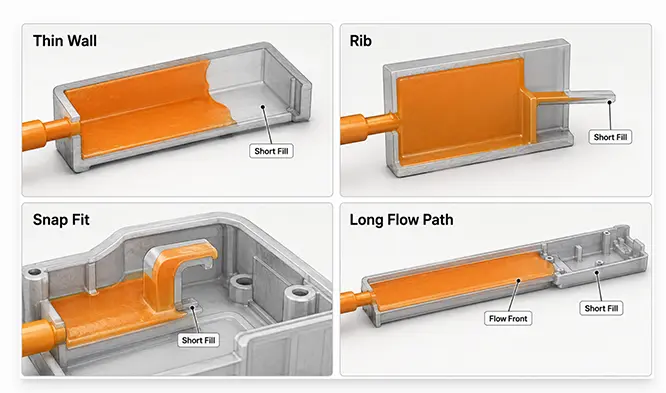

Thin-Wall Structures
Thin-wall parts test material flowability most directly.
If the material flowability is not enough, common problems include incomplete filling at the end, local whitening, obvious weld lines, or the need to increase pressure and speed just to fill the part, which may then cause flash, internal stress, or deformation.
Small Ribs, Snap Fits, and Bosses
Ribs, snap fits, narrow slots, and bosses are very sensitive to flowability.
If the material does not flow into these areas properly, the surface may only show slight short filling, but the function may already be affected. For example, if the root of a snap fit is not fully filled, it can break during assembly. If a small rib is not fully filled, the support strength will not be enough.
Large Housings
For large housings, the question is not only whether the part can be filled.
Flow marks, weld lines, sink marks, warpage, and internal stress also matter. High-flow materials can reduce filling pressure, but they may also bring new problems in dimensional stability, shrinkage, and appearance control.
Transparent Parts
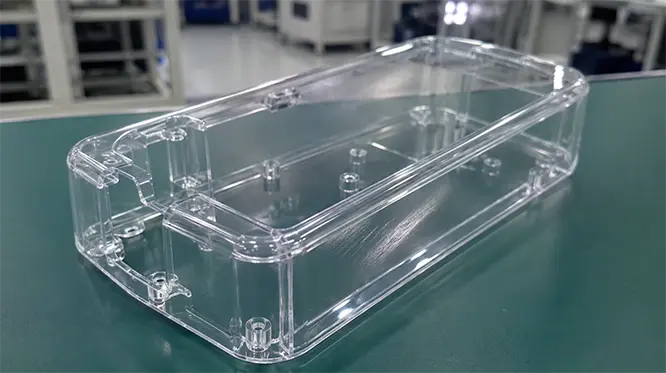
I think transparent parts are more troublesome. Materials such as PMMA and PC cannot be judged only by flowability. Filling the part does not mean the part is acceptable. Transparent parts expose stress marks, silver streaks, gas marks, and flow marks very clearly. For transparent parts, flowability is only the entry point. The real challenge is appearance and stress control.
This brings back another headache. We once worked on a transparent housing part. At first, the customer only cared about whether the part could be filled, and they also preferred PC. During the mold trial, the end of the part had slight incomplete filling, along with stress marks. We tried increasing melt temperature, increasing injection speed, and adjusting holding pressure. In the short term, the material did flow farther, but the stress marks in the transparent area became more obvious.
In the end, the real solution was not to keep increasing temperature and pressure, but to adjust the structure and gate. Many flowability problems are not really material problems. They are structure and mold design problems.

5. Why Plastic Flowability Matters in Material Selection
Flowability is not always the most important material property, but it is often the first one to block a project. It directly affects three things: whether the part can be made, whether production can remain stable, and whether the final performance can be maintained.
For the following types of parts, flowability must be considered early:
Thin-wall housings, long-flow housings, dense rib structures, snap-fit structures, transparent parts, connectors, precision small parts, and glass-fiber-reinforced parts.
FAQ
Q1: Are plastic flowability and melt flow index the same thing?
No. Plastic flowability is actual flow behavior. MFI/MFR is a laboratory test indicator.
Q2: Can materials with poor flowability still be used for complex parts?
Yes, but they cannot be forced into the design blindly. If the material itself has poor flowability, part structure, gate location, wall thickness uniformity, mold temperature control, and material grade all need to be handled more carefully.
Q3: Is a higher MFI always better?
Definitely not. A higher MFI usually means the material flows more easily, but it may sacrifice impact strength, toughness, heat resistance, or long-term stability.
Q4: Which plastics usually flow more easily?
PP, PS, and some PE grades usually flow more easily and are suitable for thin-wall parts or moderately complex structures. But this is only a general direction. The specific grade and test conditions still matter.
ABS, POM, and PA are common engineering choices with relatively balanced flowability and performance. PC, PMMA, and PEEK require more attention to structure and processing window.
Q5: For thin-wall parts, should high-flow materials be selected first?
Not necessarily. Thin-wall parts do need better flowability, but the part function also matters. If the part requires high impact strength, transparency, heat resistance, or dimensional stability, simply choosing a high-flow material may create new problems.