


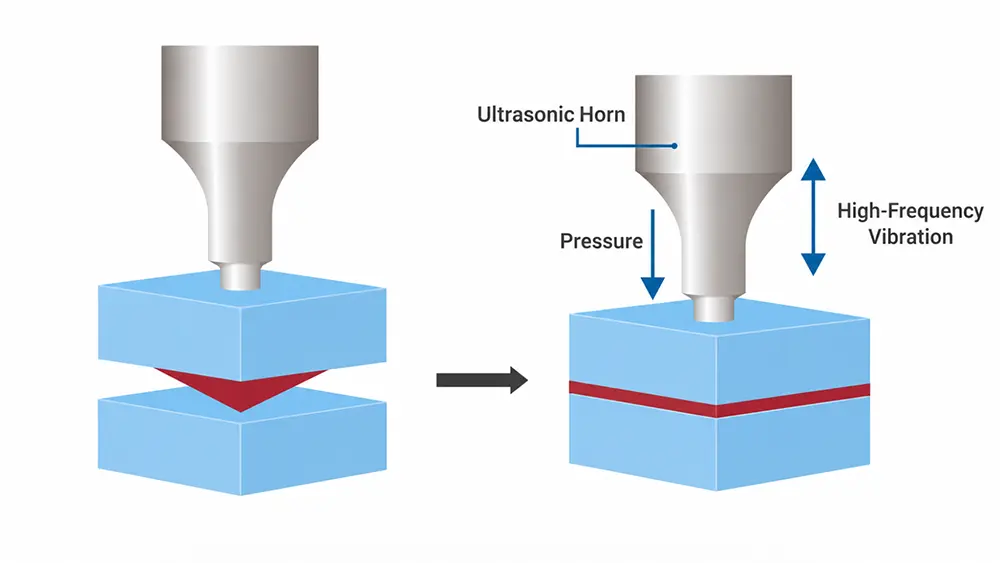
Ultrasonic welding is fast and easy to automate, making it widely used for assembling plastic parts. Weld quality depends not only on the equipment, but also on material selection, process parameters, and joint design. This article covers the key aspects of ultrasonic welding from the perspectives of process, materials, and design.
1. What Is Ultrasonic Welding?
Ultrasonic welding is a process that uses high-frequency mechanical vibration and pressure to join materials. When the vibration is transmitted to the interface between two parts, localized heat is generated, causing the material to melt and form a bond as it cools.
The process can be used for both thermoplastics and certain metals. This article focuses primarily on ultrasonic welding of thermoplastic parts.
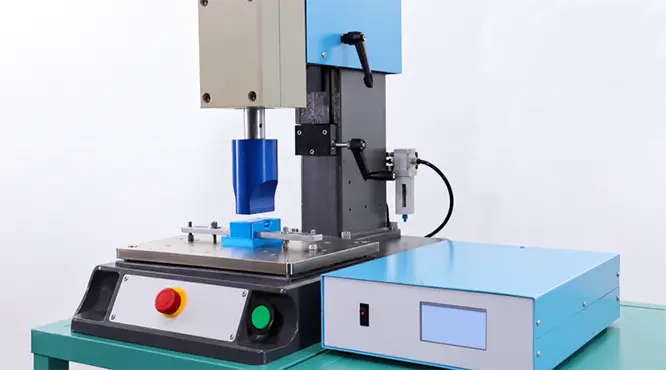

2. How Does Ultrasonic Welding Work?
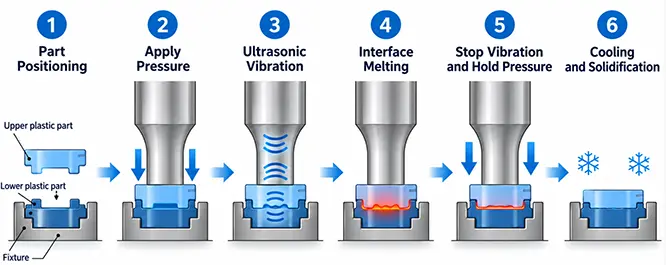
A typical ultrasonic welding process can be divided into the following steps:
Part positioning: Place the two parts to be welded into a fixture.
Horn clamping: The horn moves downward and applies pressure to the parts.
Ultrasonic vibration: High-frequency mechanical vibration is transmitted through the horn into the parts.
Interface melting: The weld area heats up rapidly, causing the plastic to melt locally.
Vibration stops and pressure is maintained: Once the preset welding condition is reached, the vibration stops while pressure continues to be applied.
Cooling and solidification: The molten plastic cools and solidifies, forming a stable welded joint.
The entire process is usually very fast, making it suitable for automated and high-volume production.

3. Which Plastics Are Suitable for Ultrasonic Welding?
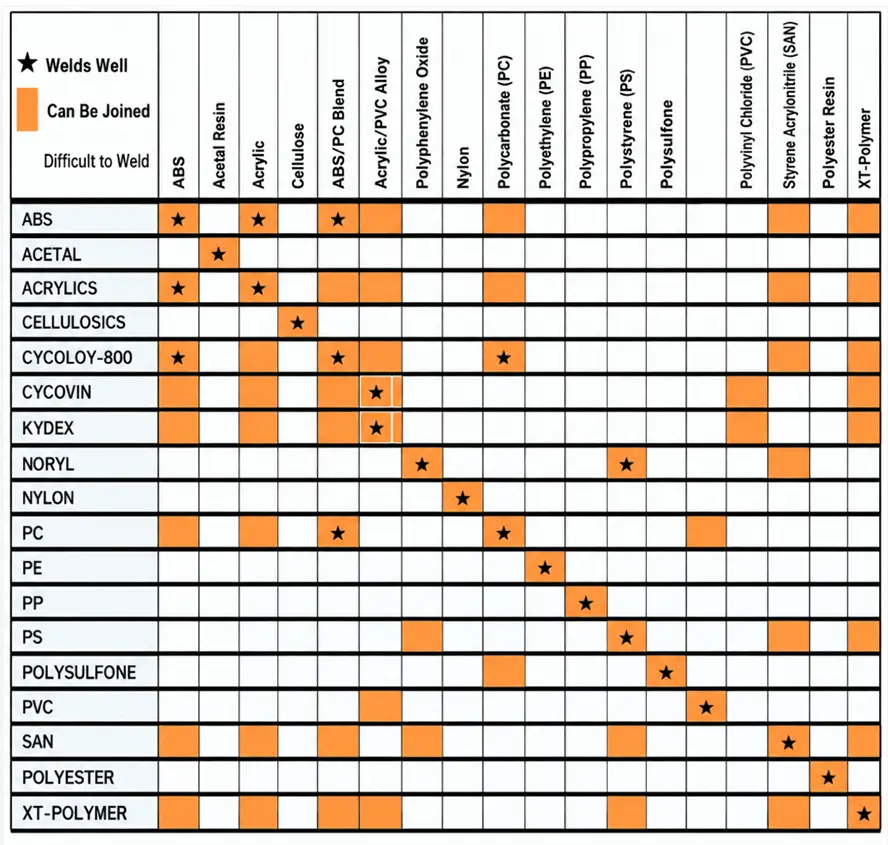
Different thermoplastics have different structures and melting characteristics, so their ultrasonic weldability can vary significantly.
Amorphous Plastics
Common materials include: ABS, PC, PMMA, PS, PVC
Amorphous plastics generally transmit vibration well and have a relatively predictable softening range, so they are typically easier to weld ultrasonically.
Semi-Crystalline Plastics
Common materials include: PP, PE, PA, POM, PBT
These materials can also be ultrasonically welded, but their energy transmission and melting behavior are more complex. As a result, they generally place greater demands on joint design, weld location, and process parameters.
When welding two different plastics, material compatibility must also be considered rather than evaluating each material independently.

4. Ultrasonic Welding Joint Design
Butt Joint
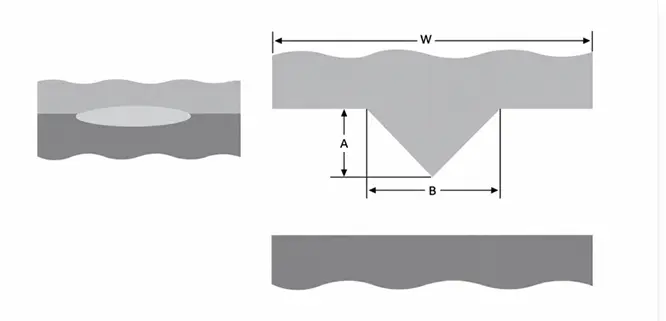
A butt joint typically uses an energy director on one of the mating surfaces. The main design considerations are the shape and dimensions of the energy director.
Triangular energy director: The most common design, typically featuring a pointed profile with an angle of about 60°–90° to concentrate ultrasonic energy.

Round energy director: A rounded profile is another option. Its molded dimensions are generally easier to keep consistent, although it is not suitable for every machine or application.
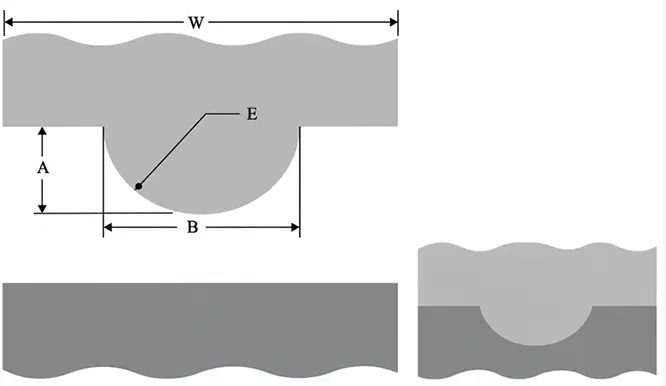

Design focus: The energy director should be positioned as closely as possible to the intended weld area and kept uniform in size to avoid uneven melting caused by local geometric variations.
Step Joint
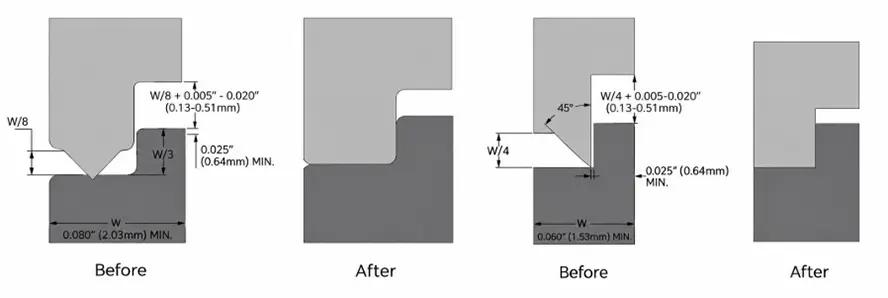
A step joint uses a stepped geometry between the upper and lower parts for self-alignment, usually with an energy director at the joining surface. Compared with a basic butt joint, it provides better part positioning while helping reduce the amount of molten plastic that flows toward the outside of the product.
Design considerations:
The part wall should provide enough space for the step geometry; reference designs commonly use wall thicknesses of ≥1.5 mm.
The height and width of the energy director should be adjusted according to the material, wall thickness, and part size.
An appropriate assembly clearance should be maintained between the steps to prevent excessive interference from affecting the weld.
The step sidewall can help contain molten material, improving weld appearance and providing a degree of sealing performance.

Tongue-and-Groove Joint
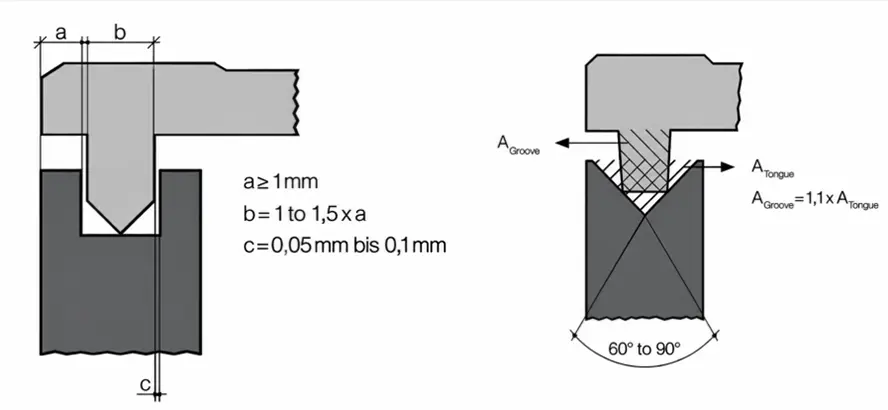
A tongue-and-groove joint consists of a projecting tongue that fits into a corresponding groove, providing good self-alignment, melt control, and sealing performance.
Design considerations:
A suitable and consistent assembly clearance should be maintained between the tongue and groove.
The energy director is usually located at the base of the tongue or within the joining area to concentrate melting in the intended region.
The groove sidewalls help contain molten plastic, improving weld appearance and sealing consistency.
For thin-wall parts, a simplified V-shaped groove design may be used.

Shear Joint
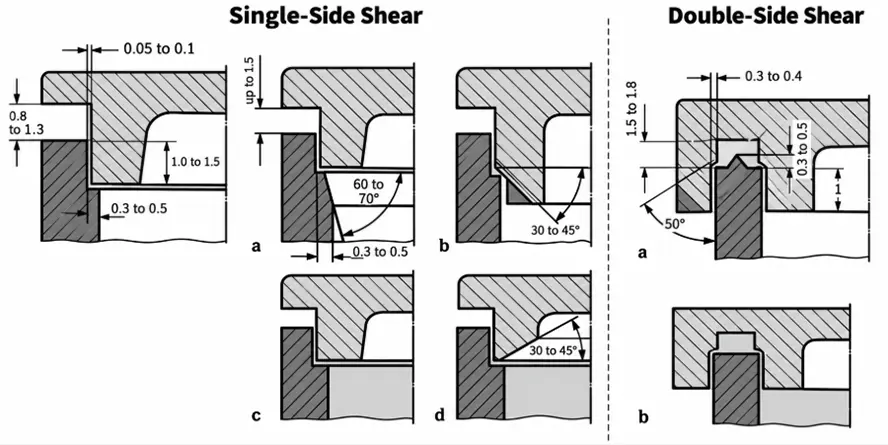
A shear joint uses an interference fit between the upper and lower parts to create a continuous fusion zone. It is particularly suitable for semi-crystalline plastics and for parts that require high weld strength and good sealing performance.
Design considerations:
A consistent amount of interference should be designed into the joint so that the parts progressively fuse during welding.
Sufficient weld depth is required; greater depth generally improves joint strength and sealing performance.
The part sidewalls should be sufficiently rigid, with tight dimensional and assembly control to prevent deformation from causing uneven shear engagement during welding.
This design is better suited to smaller parts with good structural rigidity. Large or easily deformed parts are more difficult to design with a shear joint.

5. Advantages of Ultrasonic Welding
Ultrasonic welding provides a fast and stable way to join thermoplastic parts, making it particularly suitable for high-volume production and automated assembly.
- Fast welding speed:Individual weld cycles are usually short, helping improve production efficiency.
- No adhesives or fasteners required: This reduces the need for additional materials and secondary assembly steps.
- Easy to automate:Ultrasonic welding equipment can be integrated into automated production lines, making it suitable for mass production.
- Clean weld appearance:With proper joint design, visible external joining features can be minimized.
- High strength and sealing performance can be achieved:With suitable materials and joint design, stable and reliable joints can be produced.
- Relatively low energy consumption:Heat is concentrated mainly in the weld area, so the entire part does not need to be heated.
6. Ultrasonic Welding Examples
Electric Toothbrush Handle Housing
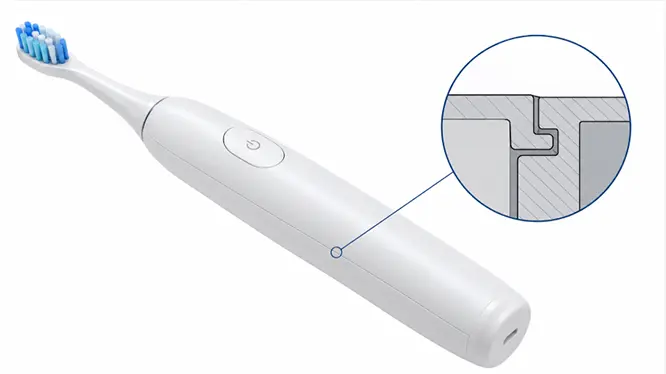
Electric toothbrush handles are typically made from upper and lower plastic housings that require good alignment and sealing performance. A tongue-and-groove joint is used here. The engagement between the tongue and groove improves assembly stability and helps control molten material during welding.

Remote Control Plastic Housing
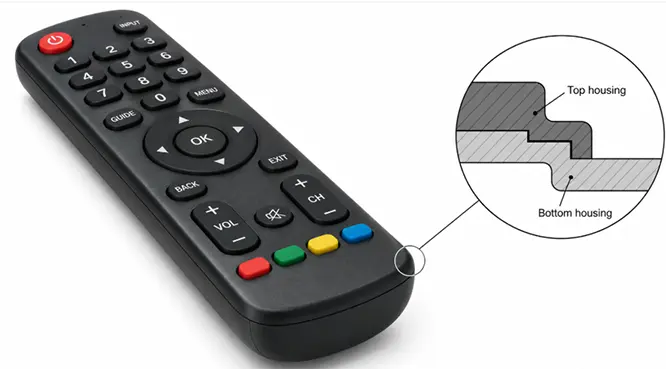
The upper and lower housings of a remote control have a relatively simple structure, but still require proper alignment and a clean appearance. A step joint is used here to help align the two housing halves and reduce misalignment during welding.

7. FAQ
Q1: Does ultrasonic welding require adhesive?
Usually not. It uses mechanical vibration and pressure to create a direct bond between the materials.
Q2: Can ultrasonically welded parts be taken apart?
They are generally not suitable for nondestructive disassembly because the two parts form a permanent joint after welding.
Q3: Is ultrasonic welding suitable for large plastic parts?
There are limitations. As part size increases, vibration transmission and control of the weld area generally become more difficult.
Q4: Can ultrasonic welding damage internal electronic components?
It can. For products containing sensitive internal components, vibration, pressure, and weld location must be carefully controlled.