


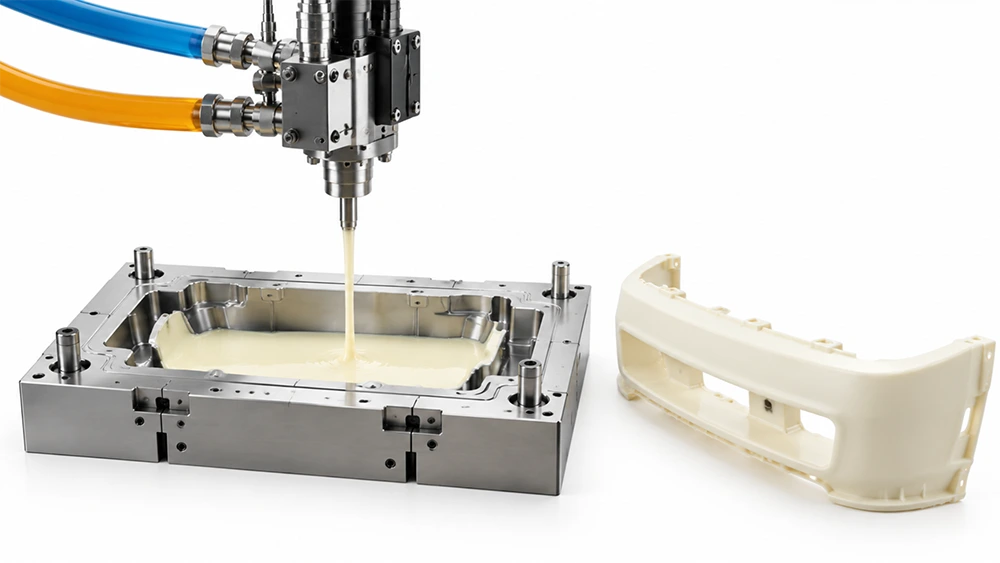
Reaction Injection Molding (RIM) is a plastic manufacturing process in which liquid reactive components undergo a chemical reaction and cure inside a mold. It is commonly used to produce large, lightweight polyurethane parts. Compared with conventional injection molding, RIM offers lower molding pressures and relatively lower tooling costs. This article covers how RIM works, the materials commonly used, its advantages and disadvantages, and how it compares with conventional injection molding.
1. What Is RIM?
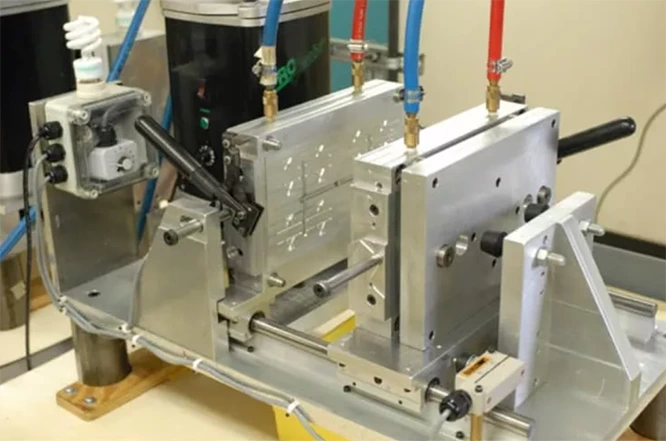
RIM is a manufacturing process in which two or more reactive liquid components are mixed, injected into a mold, and then undergo a chemical reaction to form a solid polymer part.
Polyurethane (PU) is one of the most commonly used material systems in RIM. Since the raw materials have relatively low viscosity during injection, the process can typically fill the mold at lower pressures, making it suitable for certain large plastic components.

2. How Does the RIM Process Work?
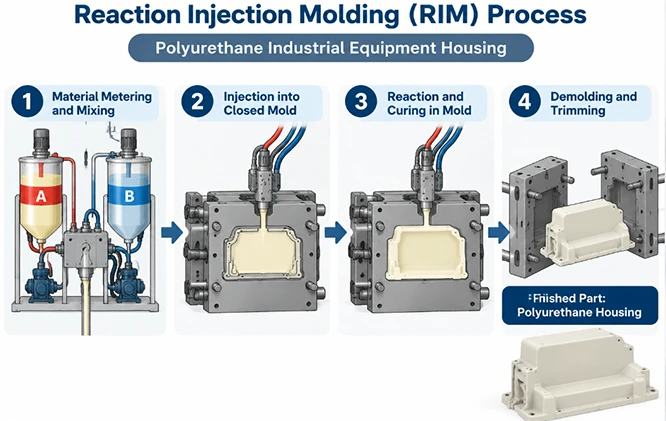
Let’s use a polyurethane protective housing for industrial equipment as an example to see how it is manufactured step by step.
Step 1: Metering and Mixing the Raw Materials
First, polyol and isocyanate are measured according to the specified formulation and rapidly mixed using specialized mixing equipment to ensure the components are thoroughly blended.
Step 2: Injecting the Material into the Mold
The mixed liquid material is injected into a prepared mold and gradually fills the cavity, forming the basic shape of the protective housing.
Step 3: Chemical Reaction and Curing
The material undergoes a chemical reaction inside the mold and gradually cures into its final form. The curing temperature and time must be properly controlled to meet the housing’s dimensional and mechanical performance requirements.
Step 4: Demolding and Post-Processing
Once the material has cured sufficiently, the housing is removed from the mold. Trimming, flash removal, and any necessary surface treatments are then carried out to produce a finished part that meets the design requirements.

3. What Materials Are Used in RIM, and What Are Their Applications?
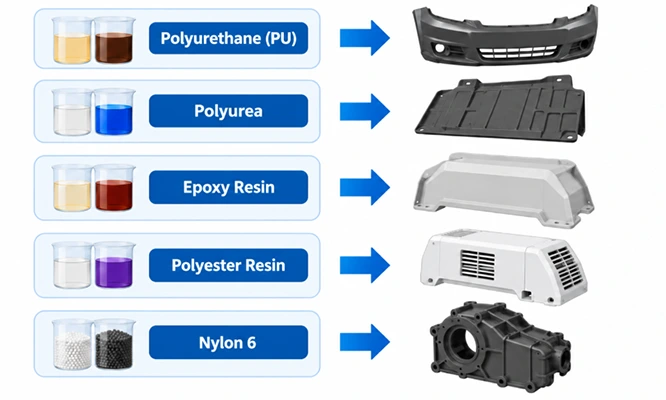
Polyurethane (PU) is the most commonly used material in RIM. Other material systems used in specific RIM processes include polyurea, epoxy resin, polyester resin, and Nylon 6, although their applications and processing requirements vary.
Polyurethane (PU)
The most widely used option. It can produce rigid parts, elastic components, and structural foam parts, and is commonly used for automotive bumpers, exterior body components, and industrial equipment housings.
Suitable for certain parts that require rapid curing, impact resistance, or specific chemical resistance. Its actual performance depends on the formulation.
Epoxy Resin:
Can be used in specialized reaction molding and reinforced structural applications, depending on the resin system and curing requirements.
Polyester Resin
Used in certain RIM systems, with specific applications depending on the formulation and processing conditions.
Nylon 6
Certain Nylon 6 systems can be processed through RIM. However, these should not be confused with conventional nylon grades designed for standard injection molding.
Beyond the base resins, RIM can also incorporate different reinforcement systems. For example, Reinforced Reaction Injection Molding (RRIM) adds materials such as glass fibers or mineral fillers to improve stiffness and dimensional stability.

4. What Are the Advantages and Disadvantages of RIM?
Advantages
Lower molding pressure: Reactive liquids have relatively low viscosity, allowing the mold cavity to be filled at lower pressures in many applications.
Relatively low tooling costs: Aluminum molds can be used for certain RIM projects, helping reduce the initial tooling investment for large parts.
Suitable for large parts: RIM can be used to manufacture large housings, automotive components, and other lightweight structural parts.
Adjustable material properties: Different levels of hardness, toughness, and elasticity can be achieved by adjusting the material formulation.
Disadvantages
Potentially longer production cycles: The material must undergo a chemical reaction and cure inside the mold, which can affect production throughput.
Requires careful process control: The component ratio, mixing quality, temperature, and curing conditions all affect the final part properties.
Limitations in dimensional accuracy: Shrinkage, the curing process, and material characteristics can affect dimensional stability.
Not suitable for every production volume: Conventional injection molding may be a better choice for parts requiring extremely high production volumes, rapid cycle times, or tight dimensional tolerances.
5. How Does RIM Compare with Conventional Injection Molding?
Both processes use molds to manufacture parts, but they differ significantly in material state, molding principles, pressure requirements, and production efficiency.
| Comparison Factor | RIM | Conventional Thermoplastic Injection Molding |
| Material State | Reactive liquid | Molten plastic |
| Molding Principle | Chemical reaction and curing | Cooling and solidification |
| Common Materials | Polyurethane (PU) | ABS, PP, PC, etc. |
| Mold Cavity Pressure | Approximately 0.4–1.1 MPa | Approximately 15–65 MPa for common materials |
| Cycle Time | Typically 1–5 minutes | Typically 10–120 seconds |
| Mold Complexity | Can use relatively lightweight molds, but proper design is still required | Generally requires molds capable of withstanding high pressure |
| Cost | Relatively low tooling costs; potentially higher cost per part | Higher initial tooling investment; lower cost per part at high production volumes |
| Energy Consumption | Can reduce the energy required for melt heating and high-pressure injection | Requires melt heating and relatively high injection pressures |
| Dimensional Accuracy | Generally lower; affected by shrinkage and material properties | Generally higher, with good repeatability |
| Clamping Force | Generally lower | Generally higher |
Note: The pressure values shown are approximate reference ranges for common processes, not fixed parameters applicable to every material and part. The RIM pressure range is based on low-pressure molding references. The actual mold cavity pressure in conventional injection molding varies with the material, part geometry, and processing parameters. Cycle time, dimensional accuracy, and energy consumption also depend on the specific project.
6. When Should You Consider RIM?
Large plastic components: Such as automotive bumpers, equipment housings, and large protective covers.
Lightweight structural parts: Components that need to balance weight with certain strength, stiffness, or impact resistance requirements.
Parts requiring specific material properties: For example, polyurethane components that need particular levels of hardness, elasticity, or impact resistance.
Low- to medium-volume production: Projects where controlling the initial tooling investment is important and the production volume is suitable for RIM.
The suitability of RIM ultimately depends on the part design, material performance requirements, and expected production volume.
Conclusion
With its low-pressure molding process and adjustable material properties, RIM offers an alternative for manufacturing large, lightweight plastic parts. As products increasingly demand lighter weight and better structural performance, I believe RIM will continue to have potential in a range of applications. The key will be finding the right balance between material performance, production efficiency, and manufacturing cost based on the needs of each product.