

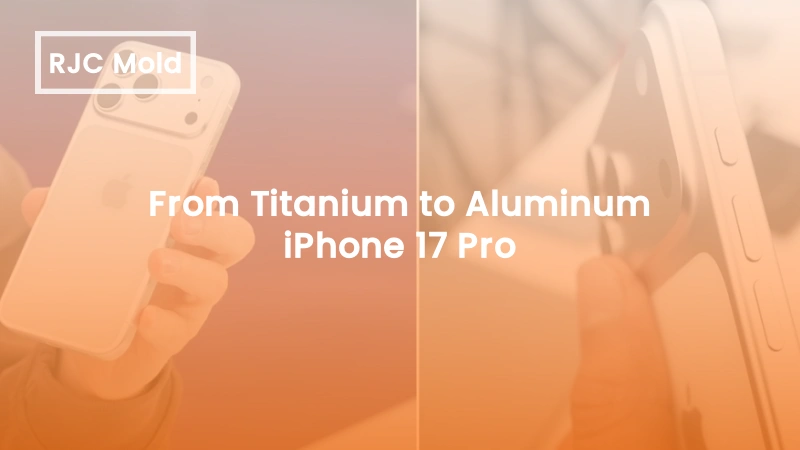

You may have already seen the news recently: Apple plans to abandon the titanium frame in the iPhone 17 Pro series and switch to a full aluminum unibody design. Many people like this change because it’s lighter, but a lot of folks are also worried about it getting bent out of shape.
Why would Apple replace a seemingly more premium material like titanium? Is this a downgrade? Or is there a deeper reason behind the change? Some view this as a move toward sustainability, while others believe it’s more about cost control and manufacturing efficiency.
In this article, I’ll break it down from a manufacturing and product design perspective.
1. Titanium: Strong, Yes. Practical? Not Quite.
The iPhone 15 Pro was Apple’s first major foray into titanium, most likely using the popular Ti-6Al-4V alloy. It’s strong, corrosion-resistant, and lighter than stainless steel — all great on paper. But from a machining standpoint? It’s a different story:
- Slow to machine: Titanium requires reduced feed rates and cutting speeds.
- Hard on tools: It wears down cutters fast due to poor heat dissipation.
- Low yield: Small mistakes can ruin parts, leading to higher scrap rates.
- High cost: Both the material itself and the labor to process it are expensive.
For niche or luxury products, these trade-offs might be acceptable. But Apple ships millions of units — and at that scale, titanium quickly becomes a bottleneck.
2. Why Aluminum Unibody Makes Sense
Apple’s reported switch to a fully integrated aluminum frame and back cover — a “unibody” structure — makes a lot of sense from an engineering and production standpoint. Here’s a side-by-side comparison:
| Attribute | Aluminum (6061/7075) | Titanium (Ti-6Al-4V) |
|---|---|---|
| Material cost | Lower | Higher |
| Machining speed | Faster | Slower |
| Tool wear | Minimal | Severe |
| Mass production yield | High | Risk of defects |
| Surface finish | Easy to anodize, polish | More complex and inconsistent |
Why the Unibody Structure Matters
- Fewer parts: Integrating the frame and back reduces complexity.
- More rigidity: A unibody is structurally more sound.
- Better yield control: Fewer assembly steps = fewer things to go wrong.
- Well-established: Apple has years of experience machining aluminum unibodies for MacBooks and iPads.
So, while it may not carry the “exotic” label of titanium, aluminum offers better predictability, better speed, and better cost management. It also may have a positive impact on the yield rate of iPhones at Indian factories.
On September 10, Apple officially unveiled the new iPhone 17 lineup.
As anticipated, the Pro models have indeed transitioned to a new hot-forged aluminum unibody design. The official image from Apple below shows the first real look at this structural change:
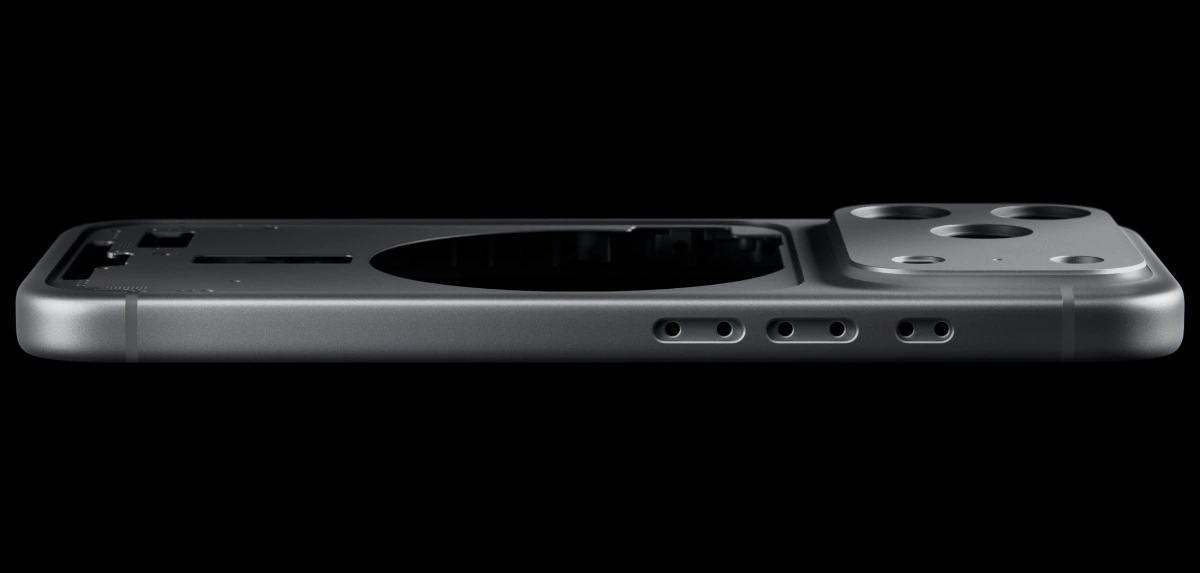

The new brushed aluminum unibody design is crafted with a lightweight aerospace-grade 7000-series aluminum alloy to deliver the best-ever thermal performance in an iPhone. On the back, the plateau creates additional space for internal components — making room for a larger battery. The antennas are integrated around the perimeter for the highest-performing antenna system ever in an iPhone. — Apple unveils iPhone 17 pro and iPhone 17 pro max
3. Sustainability vs. Strategy: Let’s Be Real
Publicly, Apple will likely emphasize carbon footprint, recyclability, and environmental responsibility. And to be fair, aluminum is highly recyclable and more energy-efficient to process than titanium.
But if we zoom out and consider the business context:
| Business Trend | Implication |
| China’s market share has seen consecutive quarterly declines | Pressure to lower flagship costs |
| Weak global smartphone demand | Need to protect margins |
| Titanium’s actual user impact is minimal | High cost, low return |
| Mature aluminum supply chains in Asia | Lower risk, faster turnaround |
| Simpler structure = faster production | Lower risk of delays |
It’s hard not to conclude that cost and manufacturing flexibility are the real drivers behind this change.
4. Is Aluminum a Downgrade? Not Really.
Switching from titanium to aluminum might sound like a downgrade on the surface. But in reality, Apple isn’t just swapping materials — they’re revisiting the entire structural strategy.
Aluminum is still a premium material when processed correctly. With unibody machining, Apple can:
- Boost structural strength through integrated geometry
- Improve thermal conductivity (a bonus for performance)
- Retain glass elements for wireless charging and signal pass-through
- Apply refined finishes with their advanced anodizing tech
So no, this isn’t a step back. It’s just a more efficient, scalable path forward.
Final Thoughts: Manufacturing Realities Drive Design
What seems like a simple materials change actually reflects a broader shift — not just for Apple, but for any company operating at the intersection of design, scale, and cost.
From where I sit as a CNC engineer, there are three big takeaways:
- Material selection is always a balance between aesthetics, function, and cost.
- Design for manufacturability (DFM) is crucial at the beginning, not the end.
- Simplifying structures and streamlining production is a competitive advantage.
If you’re working on complex metal enclosures, structural components, or precision parts, and facing trade-offs between material cost, manufacturability, and lead time, we’re here to help. Our team at RJC has over two decades of experience machining aluminum, titanium and stainless steel — from prototypes to production scale.
Learn more about our services: Custom CNC Machining