


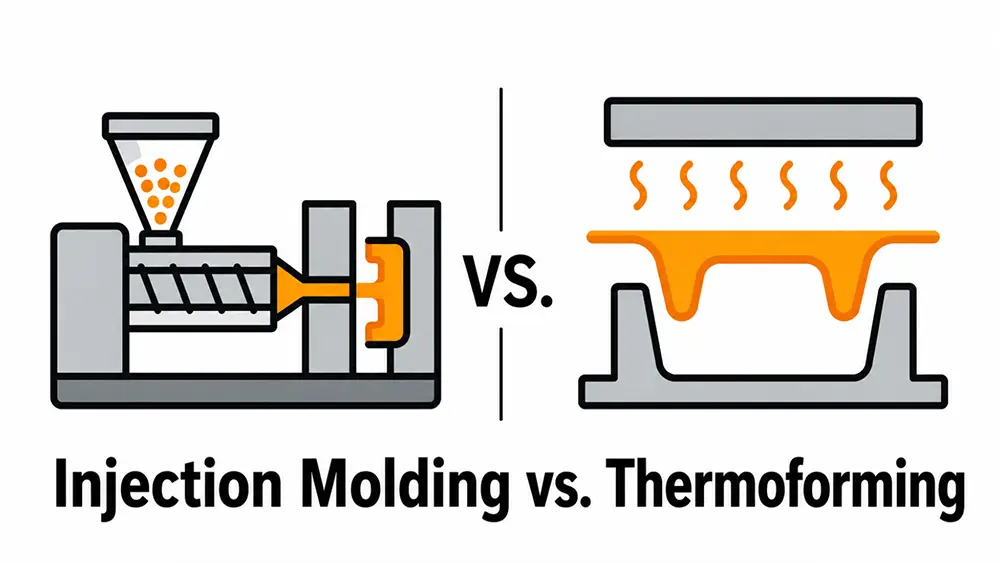
Injection molding and thermoforming are both widely used processes for manufacturing plastic parts, but they differ significantly in tooling cost, part size, geometric complexity, precision, and production volume. Neither process is inherently better than the other. The right choice depends on the part design, expected production volume, and overall project cost.
1. Quick Comparison: Injection Molding vs. Thermoforming
Before looking at each process in detail, the table below provides a quick overview of the main differences between injection molding and thermoforming.
| Comparison Factor | Injection Molding | Thermoforming |
| Raw material | Plastic pellets | Plastic sheets |
| Forming method | Molten plastic is injected under high pressure into a closed mold | Heated plastic sheet is formed against a mold using vacuum, pressure, or mechanical force |
| Mold structure | Usually includes a core and cavity and is relatively complex | Typically uses a single-sided mold with a simpler structure |
| Tooling cost | Higher | Lower |
| Part size | Suitable for small, medium, and some large parts | Especially suitable for large plastic parts |
| Geometric complexity | High; multiple functional features can be integrated | More limited; better suited for housings, covers, and panels |
| Wall thickness control | Better | Local thinning may occur during stretching |
| Dimensional accuracy | Higher | Usually lower than injection molding, though secondary machining can improve critical dimensions |
| Surface detail | Excellent detail reproduction | Good; pressure forming can provide better surface detail |
| Production volume | Strong advantage at medium to high volumes | Often more economical for low to medium volumes |
| Unit cost | Usually lower at high volumes | More affected by trimming and secondary operations |
| Tooling lead time | Longer | Usually shorter |
| Secondary operations | Relatively limited | Often requires trimming, drilling, or CNC machining |
| Design changes | Mold modifications can be costly later in the project | Tooling is generally easier to modify |
2. How Do Injection Molding and Thermoforming Work?
1) Injection Molding Process
For a detailed explanation of how injection molding works and its complete production process, see our previous article: What is plastic injection molding process? Step By Step.
2) Thermoforming Process
Thermoforming starts with a plastic sheet that has already been extruded to a specified thickness. The sheet is heated until it becomes soft and formable, then vacuum, air pressure, or mechanical force is used to shape it against the mold surface. After cooling, the formed part is removed from the mold and excess material is trimmed away.
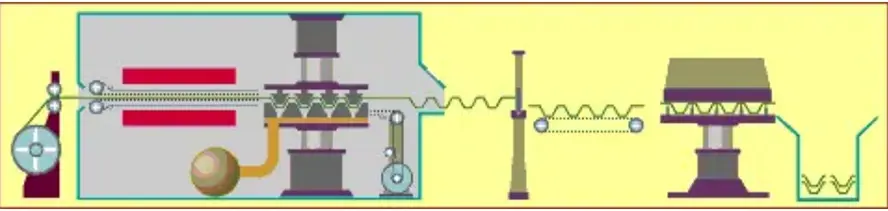

The basic process is: Plastic sheet → Heating → Forming → Cooling → Demolding → Trimming
Vacuum forming and pressure forming are two common types of thermoforming.
3. Part Design Capabilities
1) Part Size
Part size is an important factor when deciding between injection molding and thermoforming.
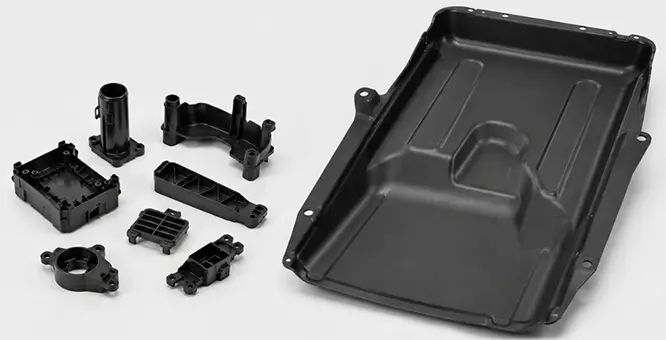
Injection molding generally has clear advantages for small and medium-sized precision plastic parts. However, as part size increases, so do the requirements for mold size, injection molding machine capacity, and clamping force. Large parts require not only larger molds but also higher-tonnage machines and greater shot capacity, which can quickly increase the initial investment.
2) Geometric Complexity
If a part requires many functional features, injection molding is usually the better option.
Injection molds can directly form complex features such as ribs, bosses, and snap-fits. These features can be integrated into a single plastic part, reducing the need for additional assembly.
Thermoforming is better suited to housings, covers, panels, and other relatively open structures. Because the plastic sheet must stretch over the mold surface, complex internal geometry, deep undercuts, and very small functional features are generally more difficult to produce.
3) Wall Thickness Control
The wall thickness of an injection-molded part is primarily defined by the mold cavity, allowing it to be controlled relatively accurately during the design stage.
Injection-molded parts still need reasonably uniform wall thickness to reduce the risk of sink marks, warpage, and excessive cooling time. Even so, wall thickness is generally easier to control than with thermoforming.
Thermoforming works differently. Although the original plastic sheet starts with a specified thickness, the material stretches during forming. The greater the stretch, the thinner the material usually becomes in those areas.
4) Precision and Repeatability
For parts that require precise assembly, injection molding generally provides better dimensional accuracy and batch-to-batch repeatability.
Because the mold cavity consistently defines the main dimensions of the part, injection molding is well suited to products with tight mating dimensions, small functional features, and high-volume consistency.
Thermoformed parts are more affected by sheet stretching, shrinkage, cooling, and trimming, so overall dimensional control is usually not as precise as injection molding.
That does not mean thermoformed parts cannot have accurate mounting features. CNC trimming, routing, and drilling are often used to machine edges, holes, and mounting surfaces to the required dimensions.

4. Materials and Surface Quality
1) Material Selection
Both injection molding and thermoforming can process a wide range of thermoplastics, but the material is supplied in different forms.
Injection molding uses plastic pellets. Common materials include ABS, PP, PE, PC, PA, POM, and TPE, as well as engineering plastics reinforced with glass fiber or filled with minerals.
Overall, injection molding offers greater flexibility when it comes to high-performance engineering plastics and modified materials.
Thermoforming requires plastics that can be produced as sheets and reheated for forming. Common options include ABS, HIPS, PET, PETG, PP, and PC.
2) Surface Quality
Injection molds can reproduce the texture of the cavity surface with high accuracy, making the process suitable for products that require fine finishes, textures, or detailed cosmetic features.
Thermoforming can also achieve good surface quality. Pressure forming, in particular, can reproduce more surface detail than conventional vacuum forming and is often used for large housings and equipment panels with higher appearance requirements.
However, deep-draw areas may experience material thinning, which can affect texture consistency. For very small lettering, fine textures, or complex details on both sides of a part, injection molding generally provides more consistent results.
5. Cost and Production Volume
1) Tooling Cost
One of the main economic advantages of thermoforming is its lower tooling investment.
Thermoforming molds usually require only the primary forming surface and have a relatively simple structure. As a result, they generally cost less to manufacture, can be produced faster, and are easier to modify later.
Injection molds normally require a complete core and cavity, along with a gate and runner system, cooling channels, an ejection system, venting, and, when necessary, sliders and lifters. For this reason, the initial tooling cost is typically much higher than for thermoforming.
2) Production Volume and Unit Cost
Because thermoforming tooling is relatively inexpensive, it is often easier to keep the initial investment under control for low- and medium-volume production.
Injection molding requires a higher upfront tooling investment. Once the mold is completed, however, shorter and more consistent cycle times, higher levels of automation, and fewer secondary operations can significantly reduce the unit cost.
3) Why Can’t Production Volume Alone Determine the Process?
Some process comparisons suggest rules such as “use thermoforming below 5,000 parts and injection molding above 10,000 parts.” In practice, these fixed thresholds do not apply to every project.
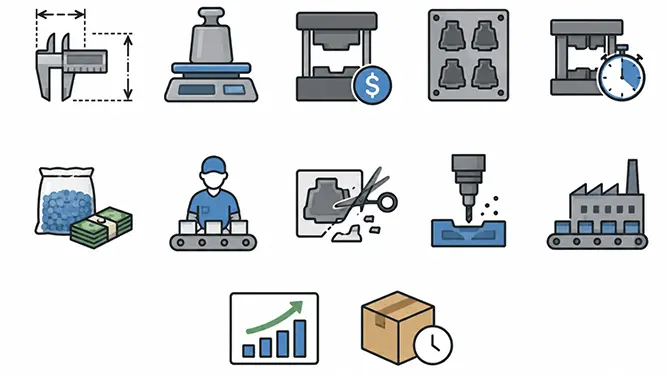
The actual break-even point depends on many factors, including:
- Part size
- Part weight
- Tooling cost
- Number of mold cavities
- Cycle time
- Material cost
- Labor cost
- Trimming cost
- Secondary operations
- Annual production volume
- Total product lifecycle volume

4) Secondary Operations and Material Utilization
Thermoformed parts are often not finished immediately after they come out of the mold. Additional operations may include trimming, CNC routing, drilling, cutting, bonding, insert installation, and final assembly.
Injection molding can form many functional features directly in the mold, which usually reduces the need for secondary processing. However, conventional cold-runner molds may still generate material waste from runners and sprues.
6. Injection Molding or Thermoforming: How Should You Choose?
1) When Thermoforming Is More Suitable
Thermoforming is often the better choice when a project has the following characteristics:
- Large part size
- Mainly housings, panels, or covers
- Relatively simple geometry
- Low to medium production volume
- Limited initial tooling budget
- A need for shorter tooling lead times
- The product design may still change later
2) When Injection Molding Is More Suitable
Injection molding is generally more suitable when the product requires:
- Complex part geometry
- Functional features such as ribs, bosses, and snap-fits
- Higher dimensional accuracy
- Good batch-to-batch repeatability
- Higher production volumes
- Fewer secondary operations and assembly steps
- Multiple functions integrated into a single plastic part
3) What If Both Processes Are Feasible?
Some parts can technically be produced by either injection molding or thermoforming. In that situation, comparing tooling quotations alone is not enough.
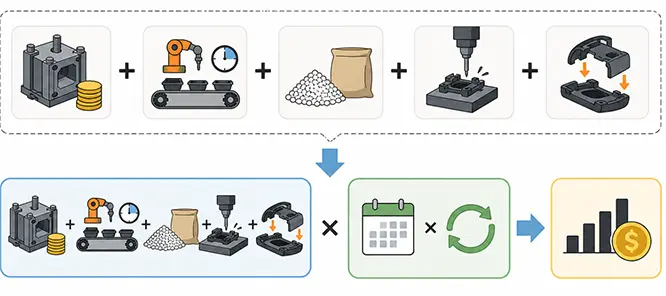
A better approach is to calculate:
Tooling investment + unit production cost + material cost + secondary processing + assembly cost
Then combine this with:
Expected annual volume × product lifecycle
to estimate the total manufacturing cost of the project.

FAQ
Q1: What is the difference between thermoforming and vacuum forming?
Thermoforming is a broad category of plastic sheet-forming processes, while vacuum forming is one type of thermoforming. Pressure forming is another common method.
Q2: Which is better for prototyping, injection molding or thermoforming?
Thermoforming is often better for large housing prototypes because tooling is cheaper and easier to modify. Rapid injection molding may be more suitable for small, complex functional parts.
Q3: Can metal inserts be added to thermoformed parts?
Yes. Metal inserts can be added through secondary processing, heat staking, or mechanical fastening, although these steps increase processing requirements.
Q4: Can recycled plastic be used for injection molding and thermoforming?
Yes, but the allowable recycled content depends on material properties, appearance requirements, and the final application.
Q5: Do thermoformed parts require draft angles?
Yes. Proper draft angles make demolding easier and help reduce part deformation and surface damage.