


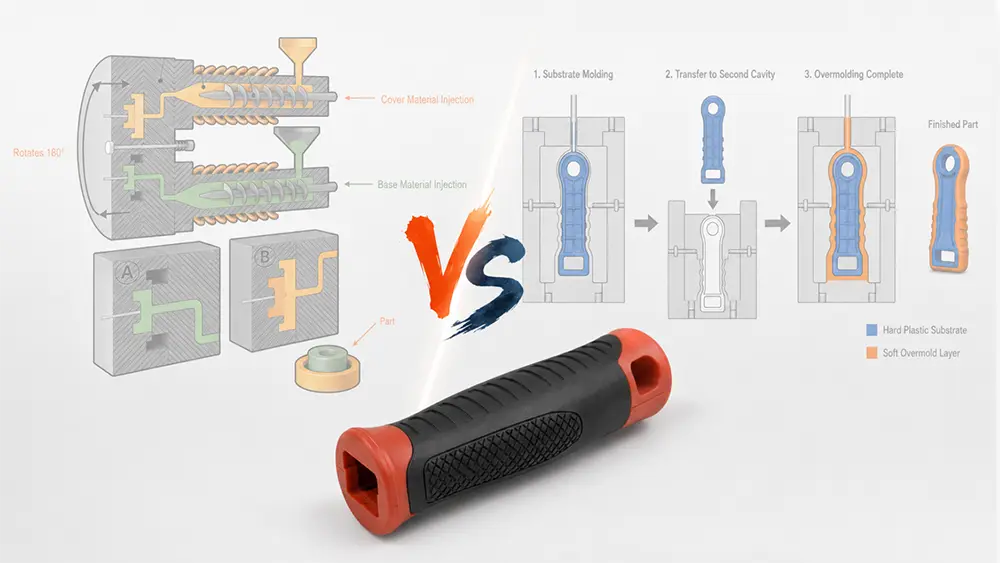
Does your product need to combine rigid plastic with a soft material, but you’re unsure whether to choose overmolding or two-shot injection molding?
Simply put, overmolding offers greater flexibility, making it easier to control upfront investment and accommodate design changes. Two-shot injection molding provides a higher level of automation and is generally better suited for mature designs with stable production demand. In this article, we’ll compare the two processes in terms of manufacturing, tooling, materials, cost, and part requirements to help you determine which option is right for your project.
1. Quick Comparison
| Comparison | Overmolding | Two-Shot Injection Molding |
| Manufacturing Process | The substrate is molded first, followed by a separate overmolding step | Two materials are injected sequentially within the same molding cycle |
| Injection Molding Equipment | Standard injection molding machine | Two-shot/dual-injection molding machine required |
| Tooling Requirements | Typically requires two molds or two separate molding operations | One two-shot mold with a more complex structure |
| Substrate Handling | The substrate must be transferred to the second mold | The substrate is automatically repositioned within the mold |
| Level of Automation | Moderate; manual or automated handling is possible | High; the entire process can be automated |
| Material Bonding | Chemical bonding or mechanical interlocking | Primarily chemical bonding, with mechanical interlocking also possible |
| Dimensional Consistency | Good, but can be affected by substrate repositioning | Higher, with more stable repeatability |
| Tooling Investment | Lower | Higher (typically about 1.5–3× that of a conventional mold) |
| Cost per Part | More cost-effective for low-to-medium volumes | Lower unit cost at high production volumes |
| Design Modification | Easier and more flexible | More difficult; changes to two-shot tooling can be costly |
| Recommended Production Volume | Thousands to hundreds of thousands of parts | Generally more advantageous for long-term production in the hundreds of thousands or more |
2. What Are the Differences Between Overmolding and Two-Shot Injection Molding?
1) Manufacturing Process — How Is the Second Material Molded?
The manufacturing process is the most fundamental difference between the two methods.
How Overmolding Works
Overmolding is completed in two separate molding steps.
First, the initial material is injection molded to form the substrate. The substrate is then placed into a second mold, where another material is injected over designated areas to create the finished part.
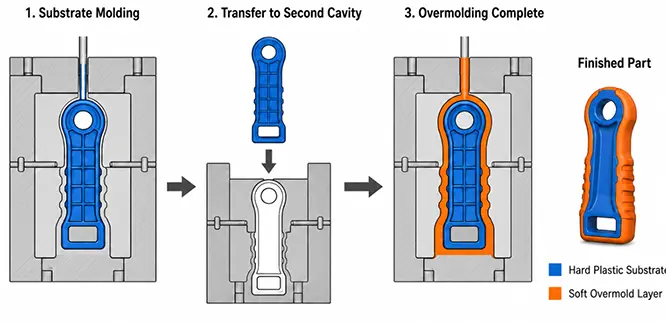

Because the substrate must be transferred between the two molding operations, positioning can be handled manually, with a robotic arm, or through an automated system depending on the project requirements.
How Two-Shot Injection Molding Works
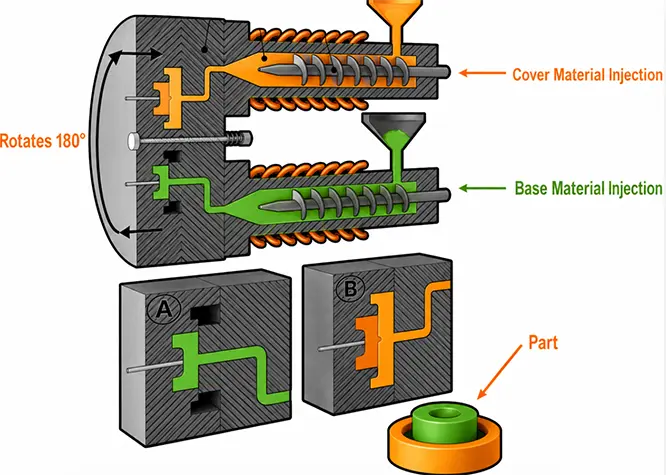
Two-shot injection molding, by contrast, performs both injection steps consecutively using a two-shot molding machine and a single integrated mold system.
After the first material is injected, the mold uses a rotating core, slide mechanism, rotary platen, or similar system to reposition the first-shot component into the second cavity. The second material is then injected immediately, without manually removing or reloading the part.

2) Tooling and Equipment Requirements
Overmolding can typically be performed using standard injection molding machines. Since the two injection steps are carried out separately, the equipment investment is relatively low, and manufacturers can often make use of their existing molding equipment.
Two-shot injection molding generally requires a dedicated two-shot molding machine paired with specialized tooling. The mold may also incorporate rotating platens, cores, slides, or other mechanisms. As a result, tooling development usually takes longer and costs significantly more.
3) Material Compatibility and Bonding
Many people assume that two-shot injection molding always produces a stronger bond than overmolding, but this is not necessarily the case.
Regardless of the process used, bond performance largely depends on several factors:
- Whether the two materials are chemically compatible;
- Whether the substrate surface temperature is suitable for the second molding step;
- Whether molding parameters such as melt temperature and injection pressure are properly controlled;
- Whether mechanical interlocks, undercuts, through-holes, or similar features are incorporated into the part design.
- With the right material selection and part design, overmolding can also achieve a strong and reliable bond.
Common compatible material combinations include:
PP + TPE
ABS + TPE
PC + TPU
PC/ABS + TPE
PA + TPE or TPU
However, even when the material types are the same, bonding performance can vary significantly between different grades. Before moving into production, material supplier data, sample testing, and actual molding conditions should therefore be evaluated together.
4) Design Flexibility
If a product is still in development and the design is likely to change, overmolding is generally easier to modify.
For example, if only the soft-touch coverage area needs to be changed, in many cases only the second mold needs to be modified rather than redeveloping an entire two-shot mold. This can reduce both development costs and project risk.
With two-shot injection molding, however, the two injection stages must work closely together. Changes involving material boundaries or part geometry may affect the overall mold design, making modifications more expensive.
Two-shot injection molding also has several important considerations that should be addressed early in the product design stage. We will cover these in more detail in our next article.
5) Production Volume and Cost
I’ve seen many articles simplify the decision to “choose overmolding for low volumes and two-shot injection molding for high volumes,” but the reality is not that absolute.
Production cost depends on more than volume. Other important factors include:
- Tooling investment;
- Level of automation;
- Cycle time;
- Part complexity;
- Whether an existing substrate is already available.
When other conditions are similar, overmolding generally requires a lower upfront investment, making it well suited for new product development, low-to-medium production volumes, or projects where the design may still change.
Two-shot injection molding requires a higher investment in both tooling and equipment. However, when the product design is stable, demand is consistent, and automation provides a meaningful efficiency advantage, shorter cycle times and lower labor requirements can help amortize the initial tooling investment and reduce long-term unit costs.
6) Dimensional Accuracy and Consistency
Because two-shot injection molding completes both injection steps within the same molding cycle, there is no need to manually transfer the substrate between molds. This generally results in more stable positioning and better consistency across large production runs.
Overmolding can still meet the dimensional requirements of most products. However, because the substrate must be repositioned for the second molding step, an inadequate locating method can introduce additional dimensional variation.
3. Can the Same Part Be Made Using Both Processes?
The answer is yes in many cases, but not every part can be freely converted from one process to the other.
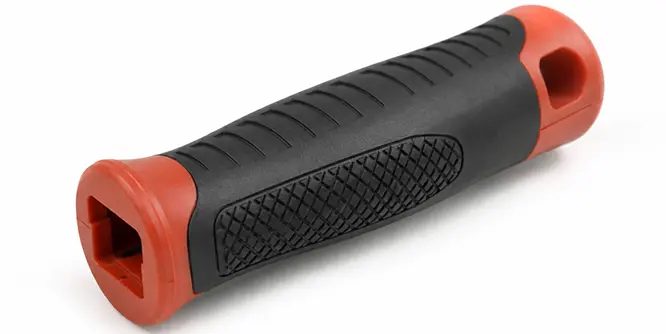
A common example is a rigid plastic handle with a TPE non-slip grip. The same functionality can often be achieved using either overmolding or two-shot injection molding.

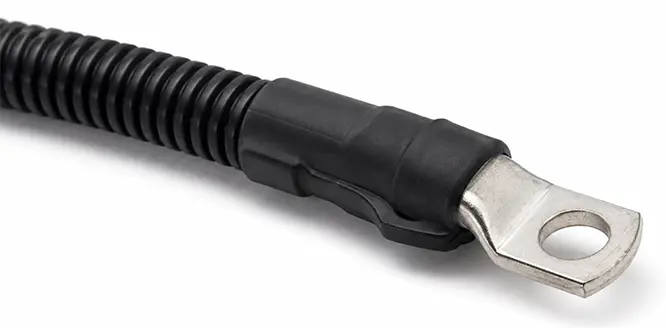
An automotive wire harness protective component, for example, where rubber is molded around metal terminals, would typically be produced through overmolding because the substrate is a metal or preassembled component.

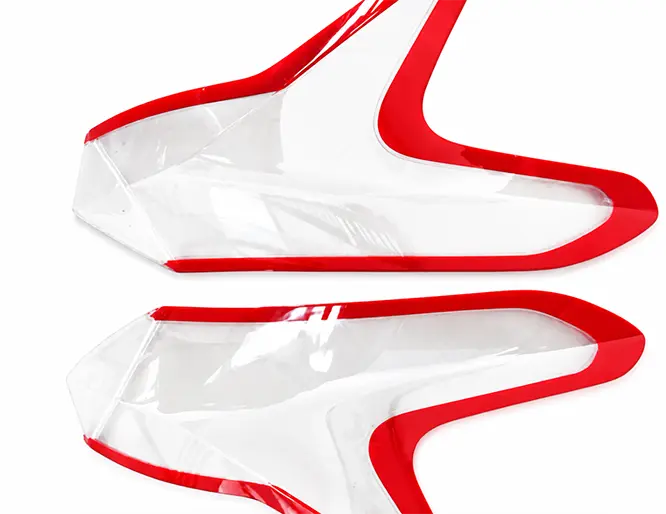
In contrast, products similar to transparent automotive taillight lenses are generally better suited to two-shot injection molding when precise material boundaries and visual alignment need to be achieved within a continuous molding cycle.

4. Which Process Is Right for Your Project?
When Should You Choose Overmolding?
Overmolding may be the better option when:
- Only specific areas of the part require non-slip, cushioning, sealing, insulation, or vibration-damping properties;
- The second material is mainly applied to the surface or localized areas and the overmold geometry is relatively simple;
- An overmold needs to be added to a pre-molded plastic part or another independent substrate;
- Through-holes, undercuts, wraparound features, or other mechanical interlocks are required to strengthen material retention;
- The product is still in development or validation and the overmolded area may change;
- Production volume is relatively low, or minimizing upfront tooling investment is important.
When Should You Choose Two-Shot Injection Molding?
Two-shot injection molding may be the better option when:
- The two materials have multiple complex interface areas;
- Material boundary position, appearance consistency, and repeatability are critical;
- The second material needs to cover multiple small areas or form complex rigid-soft material features;
- The product design is already stable and significant geometry changes are unlikely;
- Long-term, high-volume production is expected;
- Higher automation and production efficiency are required, allowing the higher tooling investment to be amortized over sustained production.
How Can We Help You Choose?
Our engineering team evaluates your part geometry, material combination, expected production volume, and budget to determine the most suitable manufacturing solution. Our goal is to meet your product performance requirements while keeping overall manufacturing costs under control. Contact us today!
5. Case Study
We once evaluated overmolding and two-shot injection molding for a handheld medical device housing. The product used ABS + TPE, with soft TPE running continuously along both sides and the bottom of the housing to provide grip and drop protection.
Annual demand was approximately 150,000 units. Because the TPE coverage was relatively extensive and the product required good material boundary definition and appearance consistency, two-shot injection molding initially looked very attractive.
However, during trial molding, we found that one deep side-overmold area required relatively high injection pressure. The corresponding PC/ABS substrate wall was only about 1.2 mm thick, making it susceptible to localized deformation during the second injection. With overmolding, we could allow the substrate to cool completely before the second molding operation and independently optimize its positioning and process parameters.
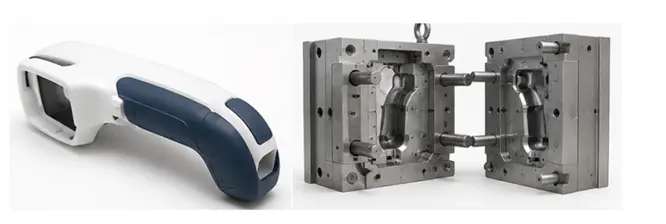

We ultimately chose overmolding. Although it added an extra production step, it prevented deformation of the thin-wall substrate and eliminated the need to increase the substrate wall thickness simply to accommodate the two-shot process.
The key factor in this project wasn’t production volume. It was how the second injection affected the stability of the thin-wall substrate.
FAQ
Q1. Can Overmolding and Two-Shot Injection Molding Use the Same Materials?
Yes, in some cases. The specific combination still needs to be evaluated based on material compatibility, product performance, and processing requirements, as not every material is suitable for both processes.
Q2. Is Overmolding Only Used for Plastic Parts?
No. In addition to plastic substrates, metals, electronic components, and other inserts can also be overmolded, although the specific process depends on the part design.
Q3. What Should Be Considered During the Product Design Stage?
Key considerations include material compatibility, overmold coverage, demolding requirements, mechanical interlock features, and the likelihood of future design changes. All of these can affect the final process selection.
Q4. How Do the Two Processes Affect Part Appearance?
Both processes can produce high-quality surfaces. However, two-shot injection molding generally offers better consistency in material boundary definition and appearance across large production runs.
Q5. Which Process Is Better for TPE, TPU, or Silicone?
There is no single answer. The right choice depends on the substrate material, material compatibility, product application, and production requirements, so each project should be evaluated individually.