


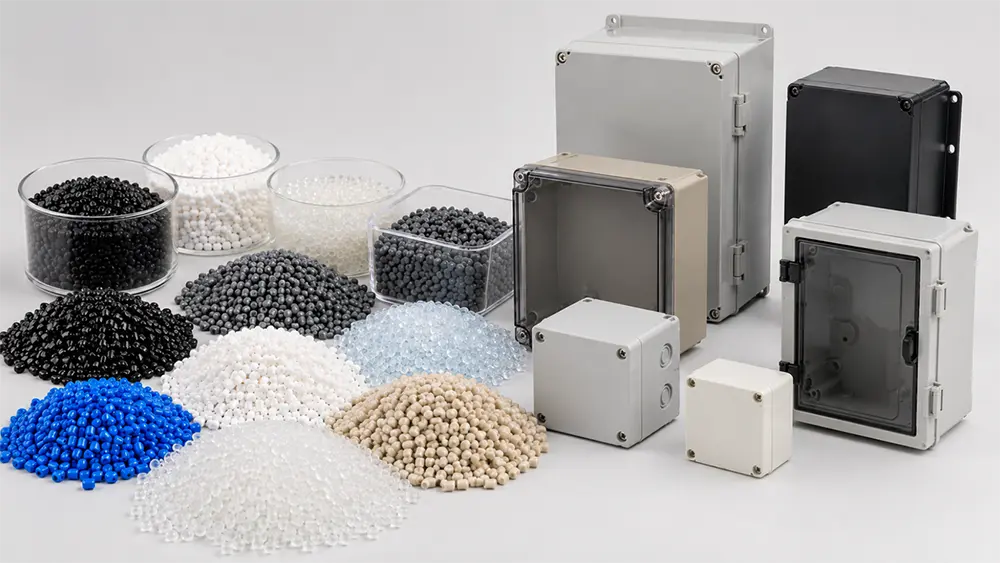
Electrical enclosures need to strike a balance between electrical insulation, flame resistance, heat resistance, impact strength, and environmental durability. ABS, PC, PC/ABS, ASA, and other engineering plastics are all common options, but no single material is suitable for every application. The final choice should be based on the operating environment, safety requirements, and manufacturing cost.
1. Common Plastic Materials for Electrical Enclosures
Different plastics vary significantly in mechanical properties, heat resistance, and environmental durability. The following table provides a quick comparison of several common materials used for electrical enclosures.
| Material | Main Advantages | Main Limitations | Impact Resistance | Heat Resistance | Weather Resistance | Flame-Retardant Options |
| ABS | Low cost, easy to process, good surface finish | Standard grades have limited UV and heat resistance | ●●●○○ | ●●●○○ | ●●○○○ | Flame-retardant grades available |
| PC | Excellent impact resistance and good heat resistance | Higher cost and more demanding processing requirements | ●●●●● | ●●●●○ | ●●●○○* | Flame-retardant grades available |
| PC/ABS | Balanced overall performance and good moldability | Outdoor performance depends on the specific grade | ●●●●○ | ●●●●○ | ●●●○○ | Flame-retardant grades available |
| ASA | Excellent UV and weather resistance | More expensive than standard ABS | ●●●○○ | ●●●○○ | ●●●●● | Flame-retardant grades available |
| ASA/PC | Combines weather resistance, heat resistance, and impact strength | Higher cost | ●●●●○ | ●●●●○ | ●●●●● | Flame-retardant grades available |
| PBT | Good heat resistance, dimensional stability, and electrical properties | Impact resistance is generally lower than PC | ●●●○○ | ●●●●○ | ●●●○○ | Flame-retardant grades available |
| PA | High strength, good wear resistance, and heat resistance | Moisture absorption can affect dimensions and properties | ●●●●○ | ●●●●○ | ●●●○○ | Flame-retardant grades available |
It is important to note that flame-retardant performance depends on the specific material grade rather than the polymer family alone.
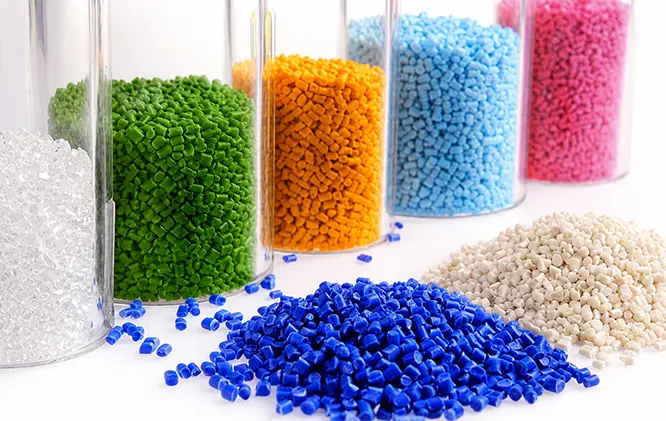

1) ABS
ABS is relatively low-cost and easy to injection mold, with good rigidity, dimensional stability, and surface quality. It is well suited for electrical enclosures that include features such as ribs, bosses, and snap-fits.
It is commonly used for indoor control equipment, consumer electronics, and power supply housings. Standard ABS has limited UV resistance and is generally not suitable for long-term outdoor use.
2) PC
PC offers excellent impact resistance along with good heat resistance and dimensional stability, making it suitable for electrical enclosures that may be exposed to drops, impacts, or significant mechanical loads.
It can also be used for transparent enclosures. However, PC usually costs more than ABS, requires tighter molding control, and must be properly dried before processing.
3) PC/ABS
PC/ABS combines the characteristics of PC and ABS, providing a good balance of impact resistance, heat resistance, processability, and surface quality.
It is commonly used for controllers, communication equipment, consumer electronics, and other indoor electrical enclosures that require both good mechanical performance and appearance.
4) ASA
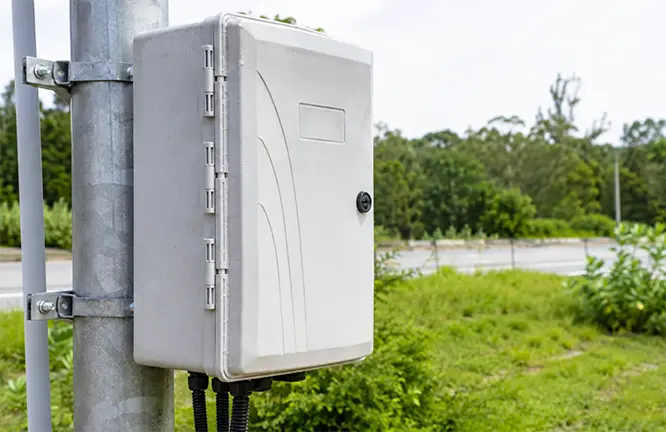
The main advantage of ASA is its good UV and weather resistance. Compared with standard ABS, it is better able to retain its color, surface condition, and mechanical properties during long-term outdoor exposure.
For this reason, ASA is commonly used for outdoor control equipment, communication devices, charging equipment, and other enclosures exposed to sunlight and weather.
5) ASA/PC
ASA/PC combines the weather resistance of ASA with the impact strength and heat resistance of PC, making it better suited than ASA alone for outdoor applications with higher mechanical requirements.
It can be used for outdoor communication equipment, charging infrastructure, industrial control equipment, and other enclosures that require both weather resistance and mechanical strength.
6) PBT
PBT provides good electrical insulation, heat resistance, chemical resistance, and dimensional stability, making it suitable for higher-temperature electrical applications or products with tighter dimensional requirements.
In addition to certain enclosure applications, it is also widely used for connectors, switches, and internal electrical structural components.
7) PA
PA offers high strength, toughness, wear resistance, and heat resistance. Glass-fiber-reinforced grades can further improve rigidity.
It is suitable for industrial electrical enclosures and structural parts that need to withstand mechanical loads, although moisture absorption and the resulting dimensional or property changes need to be considered.
2. What to Consider When Choosing Plastic for an Electrical Enclosure
Determining whether a plastic is suitable for an electrical enclosure requires more than comparing material strength. Safety requirements, the operating environment, and manufacturing conditions are often just as important.
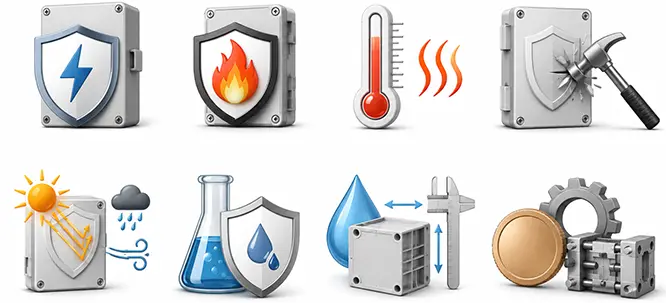

1) Electrical Insulation
Electrical enclosures usually need to isolate live components from users or surrounding structures, so the material must provide insulation performance suitable for the application.
In addition to basic properties such as volume resistivity and dielectric strength, some products also need to consider tracking resistance and creepage distance. In high-voltage, high-humidity, or contaminated environments, it is not enough to select a material simply because it is generally considered electrically insulating.
2) Flame Resistance
Electrical equipment may be exposed to short circuits, overheating, or electrical arcs, so many enclosures have specific flame-resistance requirements.
UL 94 is a commonly used plastics flammability testing system, and V-0, V-1, and V-2 are among the most frequently referenced vertical burning classifications. Keep in mind that a flame rating is tied to the specific material grade and tested thickness.
3) Operating Temperature
An enclosure is exposed not only to ambient temperature, but also to heat generated by internal power supplies, PCBs, motors, or other electronic components.
Material selection should distinguish between short-term temperature resistance and long-term operating temperature, and the final decision should be based on the technical data for the actual material grade.
4) Impact Resistance
Portable devices, industrial control boxes, and equipment installed in public areas may be subjected to drops, impacts, or shocks during transportation.
For these applications, the final impact performance depends not only on the material itself but also on wall thickness, corner radii, ribs, and fastening structures.
5) UV and Weather Resistance
Outdoor use involves more than UV exposure. Temperature cycling, rain, humidity, and long-term aging also need to be considered, so the final material grade should be selected according to the actual service environment.

6) Chemical Resistance
Industrial electrical enclosures may come into contact with cleaning agents, lubricants, fuels, weak acids and alkalis, or other chemicals.
Different plastics can respond very differently to chemical exposure. Higher temperatures, mechanical stress, and prolonged contact may further accelerate material degradation. For applications with known chemical exposure, material selection should be based on the specific chemical medium rather than a general claim of “good chemical resistance.”
7) Moisture Absorption and Dimensional Stability
Moisture absorption can affect part dimensions, stiffness, and assembly fit. If an enclosure uses snap-fits, precision locating features, or tight mating structures, these dimensional changes need to be considered during design.
For precision assemblies, material shrinkage, temperature variation, and long-term environmental exposure should also be evaluated together.
8) Cost and Manufacturability
Material price is only one part of the total cost. Actual material selection should also consider drying requirements, melt flow, mold temperature, cycle time, scrap rate, and mold design.
A material whose performance far exceeds the actual requirements is not necessarily the better choice. As long as the product requirements are met, achieving the right balance between performance and manufacturing cost is usually more important.
3. Which Plastics Are Best for Different Electrical Enclosure Applications?
In actual projects, the application environment can first be used to narrow down the material options, after which the final choice can be confirmed based on product standards and specific material grades.
| Application | Common Candidate Materials | Key Selection Factors |
| Indoor electrical enclosures | ABS, PC/ABS, PC | Cost, appearance, heat resistance, mechanical performance |
| Outdoor electrical enclosures | ASA, ASA/PC, UV-stabilized PC | UV resistance, weather resistance, temperature changes |
| High-impact enclosures | PC, PC/ABS | Toughness and impact resistance |
| Flame-retardant electrical enclosures | FR ABS, FR PC, FR PC/ABS, FR PBT, etc. | Required flammability rating and tested thickness |
| High-temperature electrical enclosures | PC, PBT, and other heat-resistant engineering plastics | Long-term operating temperature and dimensional stability |
4. How Plastic Selection Affects Injection-Molded Electrical Enclosure Design
Changing the enclosure material is not as simple as replacing one resin with another. Different plastics vary in shrinkage, flow behavior, moisture absorption, and mechanical properties, which means material selection directly affects both part design and mold design.
1) Wall Thickness Design
Different plastics have different flow characteristics and recommended wall thickness ranges. For more details, see our article “Injection Molded Part Wall Thickness: Design Rules and Best Practices”.
Excessive wall thickness can increase sink marks, internal stress, and molding cycle time, while walls that are too thin may lead to incomplete filling, insufficient strength, or weld-line issues.
2) Shrinkage and Dimensional Tolerances
Different materials have different molding shrinkage rates, and glass-fiber-reinforced materials may also show significant directional shrinkage.
If the material is changed without adjusting the mold dimensions, the final part size, hole locations, and assembly clearances may shift. This is particularly important for upper and lower housing fits, connector openings, button positions, and sealing structures.
3) Boss, Rib, and Snap-Fit Design
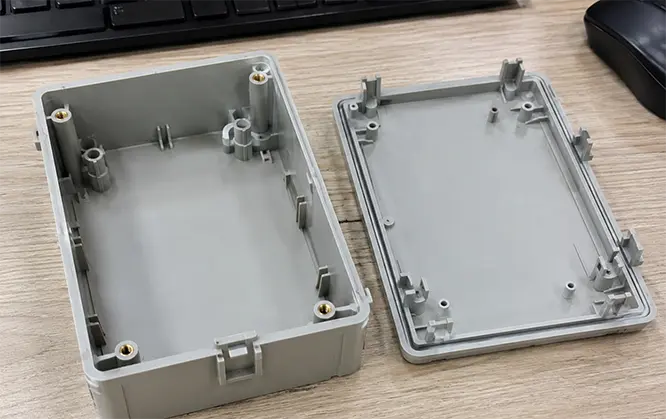
Electrical enclosures often include bosses, ribs, and snap-fits, all of which are highly sensitive to material properties.
A high-rigidity material may reduce structural deformation, but poor design can also increase stress concentration and the risk of cracking. Tougher materials, on the other hand, are often better suited for snap-fit features that need to flex repeatedly.

4) Material Drying Requirements
If a material is not dried properly, moisture can cause degradation during high-temperature processing, leading to splay, bubbles, reduced mechanical properties, or surface defects.
5) How Flame-Retardant Grades Affect Molding
Flame-retardant additives can change material flow, thermal stability, mechanical properties, and the overall processing window. Some formulations are also more sensitive to processing temperature and residence time.
When switching from a standard material to a flame-retardant grade, the injection molding parameters should be revalidated rather than simply reusing the original settings.
FAQ
Q1: Can recycled plastics be used for electrical enclosures?
Yes, provided that the material properties, flame rating, and relevant certifications still meet the product requirements. Safety-critical applications usually require tighter control over material sources.
Q2: Are glass-fiber-reinforced plastics suitable for electrical enclosures?
Yes, for some high-rigidity or heat-resistant applications. However, surface quality, anisotropic shrinkage, and warpage need to be considered.
Q3: What plastic is commonly used for transparent electrical enclosures?
PC is a common choice because it combines transparency with high impact resistance.
Q4: Can plastic enclosures provide EMI shielding?
Yes, but ordinary plastics have limited shielding capability. Conductive coatings, plating, or conductive fillers are usually required.
Q5: Can plastic enclosures achieve an IP rating?
Yes. IP performance mainly depends on enclosure design, sealing, and assembly quality rather than the plastic material alone.