


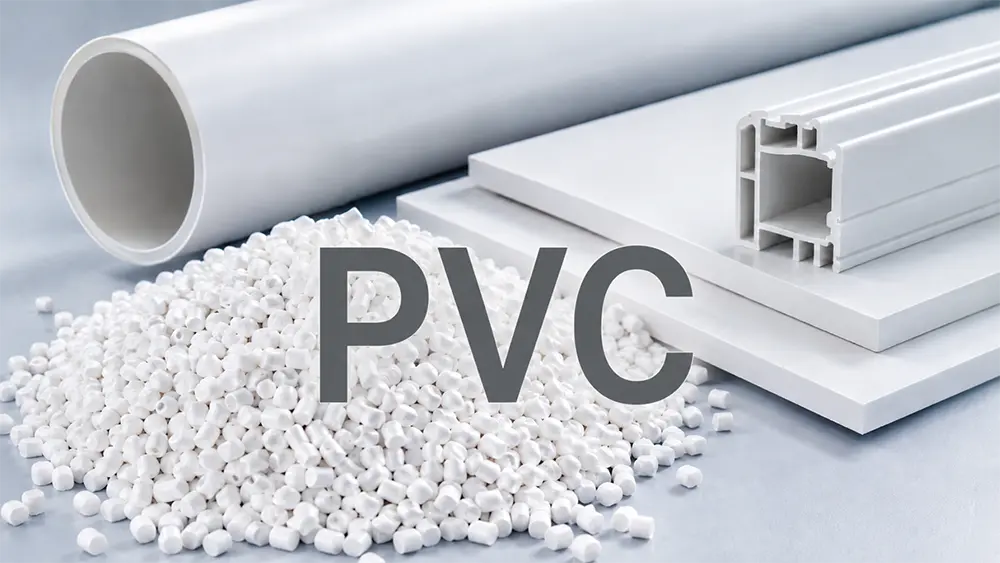
You might not expect that the drain pipes at home, corner wire channels, cable jackets, clear packaging boxes, hoses, and even some flooring and medical tubing may all be made from the same material—PVC. So why can it be used in so many different fields? Below, let’s look at this common but not-so-simple plastic material from the aspects of melting point, density, properties, types, and uses.
1. What Is PVC?
PVC is a thermoplastic material made by polymerizing vinyl chloride monomer. Its molecular structure contains a large amount of chlorine. By weight, PVC contains about 57% chlorine. This chlorine-containing structure gives PVC better flame resistance and chemical resistance than many ordinary plastics.
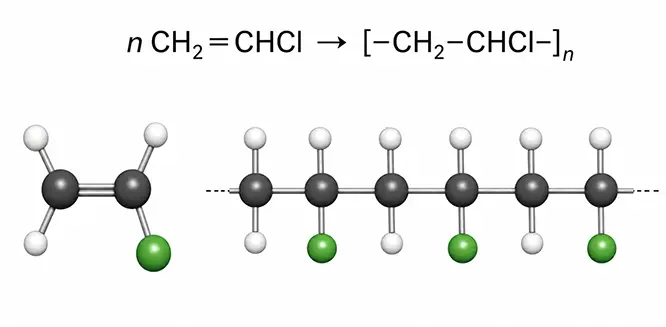

PVC production usually starts with obtaining vinyl chloride monomer from salt and petroleum/natural gas feedstocks. The monomer is then polymerized into PVC resin. The resin itself is usually hard. Stabilizers, plasticizers, fillers, impact modifiers, and other additives are then added to produce PVC materials with different hardness, flexibility, and uses.
2. PVC Melting Point: Does PVC Have a Clear Melting Point?
1) Why Can’t PVC Be Simply Understood as Having a Fixed Melting Point?
PVC is not suitable to be described with a single fixed melting point like PP, PE, or ABS.
From a material behavior perspective, PVC does not have a clear, single melting point. Some sources may list the melting or plasticizing temperature of PVC at around 160–220°C, but this is closer to a processing temperature range rather than a clear melting point like that of crystalline plastics. The reason is that PVC may already face thermal decomposition risks before it reaches a fully molten state.
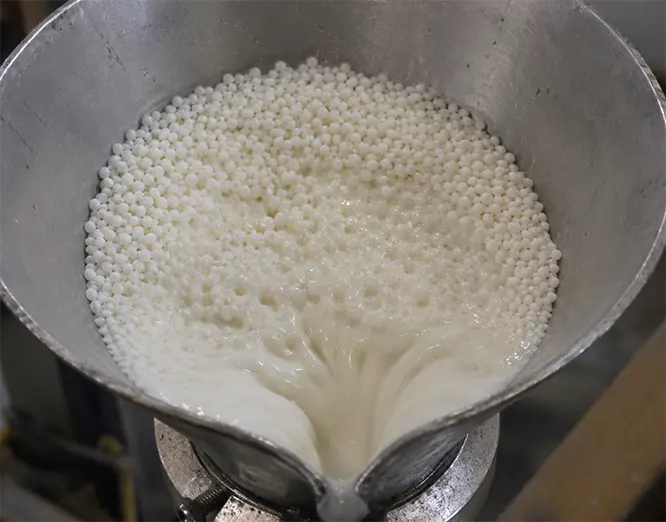

Therefore, when discussing PVC melting point, a more reasonable approach is to explain PVC Temperature Range at the same time, including glass transition temperature, softening temperature, processing temperature, and thermal decomposition risk. For example, the glass transition temperature of PVC is usually about 70–80°C, while the Vicat softening temperature of rigid PVC is approximately 65–100°C.
2) Which Temperatures Should Be Considered for PVC?
Glass Transition Temperature Tg
Around this temperature range, PVC changes from a harder and more brittle state to a state where molecular movement becomes easier.
Vicat Softening Temperature
This is used to evaluate the temperature at which the material begins to soften noticeably under heat and load.
Heat Deflection Temperature
This is used to evaluate the material’s ability to maintain its shape under heat while bearing a certain load.
Processing Temperature
This is the actual temperature range that needs to be controlled during extrusion, injection molding, calendaring, and other processing methods.
Thermal Decomposition Temperature
This is the temperature range where PVC may begin to degrade, discolor, and release irritating odors when overheated.
3. PVC Density and Key Material Properties
1) What Is the Density of PVC?
The density of PVC is usually higher than that of general-purpose plastics such as PP and PE. Common PVC density is about 1.1–1.45 g/cm³, depending on material type, plasticizers, fillers, and formulation.
Rigid PVC usually has a higher density, often around 1.3–1.45 g/cm³. Flexible PVC contains plasticizers, so its density and hardness vary with the formulation. For example, because CPVC has a higher chlorine content, its density may be close to 1.45–1.60 g/cm³.
2) Main Properties of PVC
Different PVC grades vary significantly. The following values are common reference ranges.
| Property | Rigid PVC / PVC-U | Flexible PVC | CPVC | Foamed PVC |
| Density | About 1.30–1.45 g/cm³ | About 1.10–1.35 g/cm³ | About 1.45–1.60 g/cm³ | About 0.40–0.90 g/cm³ |
| Glass Transition Temperature | About 70–80°C | Usually lower than rigid PVC, affected by plasticizers | Usually higher than ordinary PVC | Close to rigid PVC, but affected by the foamed structure |
| Vicat Softening Temperature | About 51–99°C | Usually lower than rigid PVC | Usually higher than ordinary PVC | Usually lower than solid rigid PVC |
| Heat Deflection Temperature | About 18–86°C, 1.8 MPa | Lower, greatly affected by formulation | Higher than ordinary PVC | Lower, with limited load-bearing capacity |
| Chemical Resistance | Good | Good, but affected by plasticizers | Good to excellent | Good |
| Flame Resistance | Good | Good, but affected by formulation | Good | Good |
| Rigidity | High | Low | High | Medium |
| Flexibility | Low | High | Low to medium | Medium |
| Weather Resistance | Medium to good | Greatly affected by formulation | Good | Medium |
| Transparency | Can be transparent | Can be transparent | Usually low | Usually opaque |
| Electrical Insulation | Good | Good | Good | Good |
The characteristics of PVC do not come from one extremely outstanding property. Instead, PVC offers a balanced combination of low cost, good chemical resistance, good flame resistance, adjustable hardness and flexibility, and compatibility with multiple processing methods.
4. Common Types of PVC Material
1) Rigid PVC
Rigid PVC usually contains no plasticizer or only a small amount of plasticizer. It has higher rigidity, better dimensional stability, and hardness and strength closer to structural plastics.
Its limitation is limited flexibility. Under low-temperature or impact conditions, it may become brittle, so impact modification is sometimes used to improve toughness.
2) Flexible PVC
Flexible PVC obtains softness by adding plasticizers. It focuses more on flexibility, bend resistance, conformability, and elasticity rather than rigidity.
Its properties are strongly affected by the type and amount of plasticizer. The more plasticizer added, the softer the material usually becomes. However, strength, heat resistance, migration risk, and long-term stability also need to be considered.
3) PVC-U
PVC-U is unplasticized PVC. It can be understood as a rigid system that does not rely on plasticizers to obtain flexibility.
It has good rigidity, dimensional stability, and chemical resistance, but limited flexibility. Compared with flexible PVC, it emphasizes stability and hardness more.
4) CPVC
CPVC is PVC modified by chlorination.
Compared with ordinary PVC, CPVC usually has better heat resistance and corrosion resistance. Its key difference is a higher temperature resistance level, making the material more suitable for higher-temperature or harsher environments.
5) PVC-O
PVC-O is oriented PVC.
Its focus is not to change properties by heavily changing the formulation, but to improve strength, toughness, and fatigue resistance through molecular orientation.
6) PVC-M
PVC-M is also modified PVC.
Its main purpose is to improve the toughness and impact resistance of ordinary PVC, making the material perform more steadily under impact or pressure changes.
7) Foamed PVC
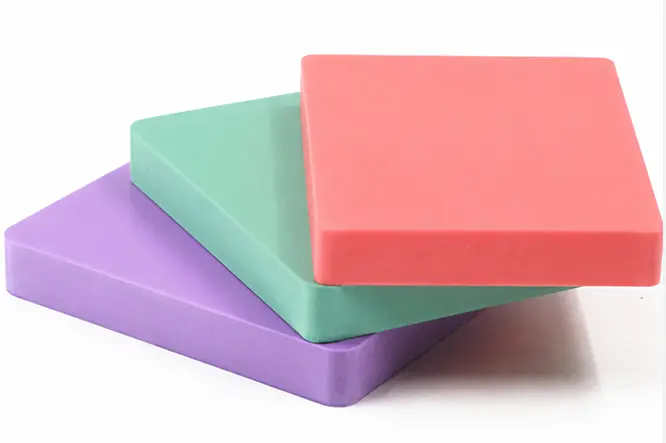

It reduces material weight through a cellular structure and forms a lightweight structure. It is lighter, easy to cut, and easy to process, but its load-bearing ability cannot simply be considered the same as solid PVC.
5. Common Uses of PVC Material
PVC is one of the most widely used plastic materials in the world. According to the PVC industry roadmap report by Global Efficiency Intelligence, global PVC production is about 44 million tons per year.
1) PVC Pipes and Fittings
PVC pipes and fittings are among the most important applications of PVC. PVC pipes can be found in many building, drainage, electrical protection, and industrial fluid systems.
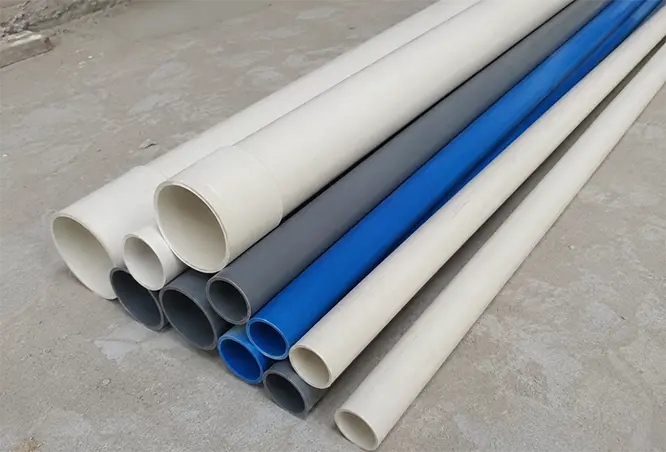

PVC is suitable for pipes mainly because it has several clear advantages:
Corrosion resistance: Compared with metal pipes, PVC is less likely to be corroded by water, salts, and many common chemical media, so it is widely used in drainage, irrigation, chemical transfer, and some industrial systems.
Light weight: PVC pipes are lighter than metal pipes, making them easier to move, cut, and install. Construction costs are also easier to control.
Relatively smooth inner wall: This helps fluid pass through and reduces internal deposits and resistance inside the pipe.
Low cost and stable supply: PVC is a mature commodity plastic material. Pipe and fitting systems are complete, and supporting parts such as elbows, tees, connectors, and valve connection fittings are also widely available.
For pipes, the value of PVC is not only that the material is cheap. It also provides a good balance between corrosion resistance, installation efficiency, weight, cost, and long-term maintenance.
2) Housing, Building, and Construction
PVC is widely used in the building field, including window frames, door frames, wall panels, flooring, roofing materials, wire channels, baseboards, and decorative profiles.
These applications usually take advantage of PVC’s weather resistance, corrosion resistance, flame resistance, dimensional stability, and cost benefits. For outdoor building components, stabilizers and UV-resistant systems in the formulation are very important.
3) Electrical and Cable Applications
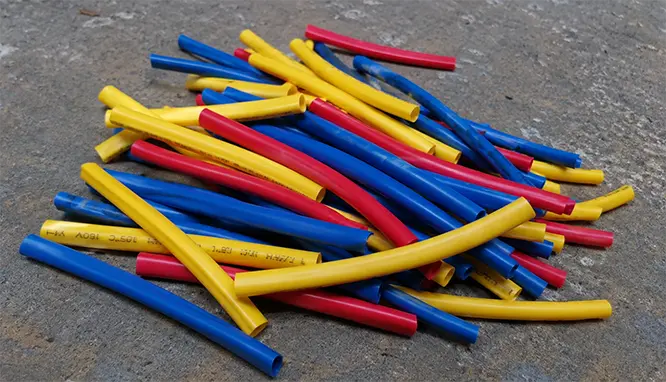
PVC is commonly used for wire and cable jackets, insulation layers, electrical channels, and protective conduits.
It is suitable for these applications mainly because it has good electrical insulation, good flame resistance, mature processing, and adjustable softness and bend resistance through formulation.

4) Medical Applications
Flexible PVC can be used for medical tubing, infusion tubes, catheters, blood bags, oxygen masks, and other products.
Medical applications require special formulations that meet relevant regulations and testing requirements. Ordinary industrial-grade PVC cannot directly replace medical-grade materials.

5) Packaging
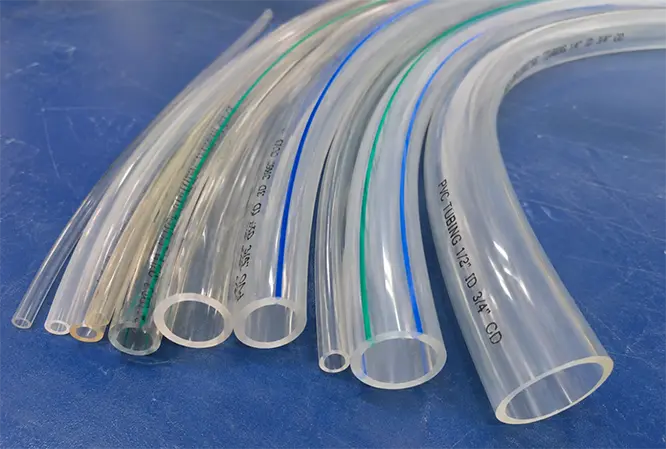
PVC can be used for clear packaging, films, shrink films, thermoformed sheets, and some protective packaging.
These applications usually value transparency, formability, flexibility, and cost. For food, medical, or child-related packaging, formulation and regulatory requirements need to be considered.
6) Industrial Parts
PVC can be used for chemical-resistant sheets, valves, connectors, insulating parts, fixtures, tanks, covers, and some corrosion-resistant parts.
7) Consumer Products
PVC is also commonly found in raincoats, floor mats, table mats, hoses, stationery, cards, synthetic leather, inflatable products, and storage items.
These products usually take advantage of PVC’s water resistance, flexibility, low cost, and easy forming.
FAQ
Q1: Is PVC toxic?
It cannot simply be described as toxic or non-toxic. Compliant PVC products can be used safely, but high-temperature decomposition, non-compliant additives, or incorrect applications may bring risks.
Q2: Can PVC be recycled?
Yes. The recycling code for PVC is #3, but recycling difficulty depends on formulation, contamination level, and product structure.
Q3: Is PVC suitable for injection molding?
It is suitable for some products, but the processing window is narrow. Temperature, residence time, and venting need to be controlled.
Q4: What Is the Difference Between PVC and CPVC?
CPVC usually has better heat resistance and corrosion resistance than ordinary PVC.
Q5: Is PVC a Hard Plastic or a Soft Plastic?
It can be both. With little or no plasticizer, it tends to be hard. With more plasticizer, it can become soft.
Conclusion
PVC is widely used because it offers a good balance of cost, chemical resistance, flame resistance, processability, and formulation flexibility. If you are evaluating PVC or other plastic materials for a new project, feel free to contact RJC Mold. We can provide material selection, DFM analysis, mold manufacturing, and injection molding suggestions based on your product application, operating environment, performance requirements, and production volume, helping your project move more smoothly from design to production.