


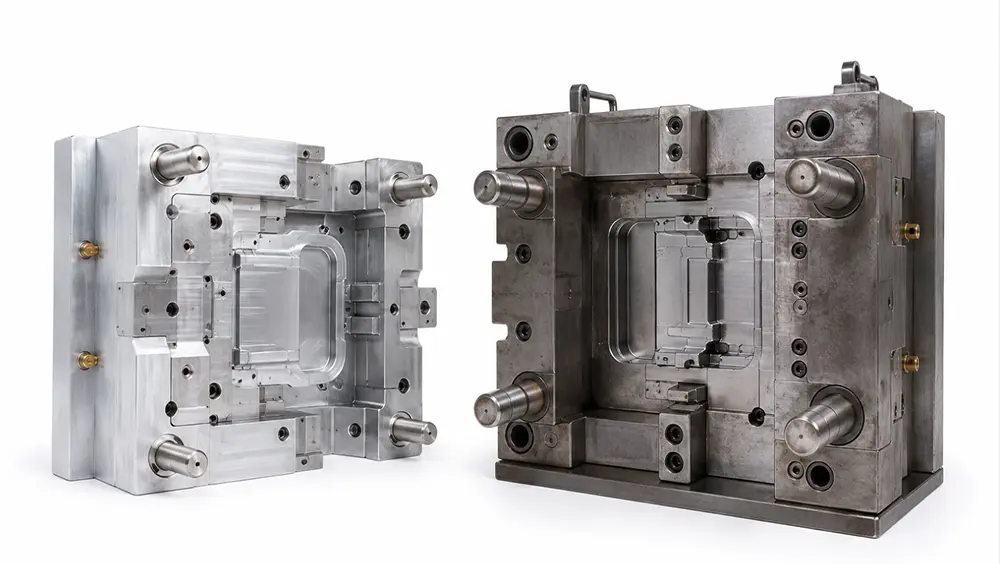
Have you often seen this advice: choose an aluminum mold for low-volume production and a steel mold for high-volume production?
There is some truth to that, but production volume is not the only factor that matters. Design maturity, plastic material, part geometry, and future order plans can all directly affect the choice of mold material. Below, we’ll look at how to choose between aluminum and steel molds from a practical project perspective.
1. Quick Comparison: Aluminum vs. Steel Molds
| Factor | Aluminum Mold | Steel Mold |
| Initial cost | Usually lower | Usually higher |
| Lead time | Shorter | Longer |
| Mold life | Relatively shorter | Better suited for long-term production |
| Thermal conductivity | Better | Relatively lower |
| Wear resistance | Lower | Higher |
| Typical production volume | Prototypes, low-volume, bridge production | Medium- to high-volume, continuous production |
| Suitable materials | Common thermoplastics | Glass-filled and abrasive materials |
| Ease of modification | Usually easier | Depends on the steel grade and mold structure |
These are only general guidelines. A fixed production quantity should not be used as the sole dividing line between aluminum and steel molds.
2.How to Choose Between Aluminum and Steel Injection Molds


When choosing a mold, don’t start by asking, “How many parts do I need?” Instead, consider the following three questions first.
Is the product design already stable?
① If the product is still in the testing stage and dimensions, snap fits, wall thicknesses, or assembly features may still change, an aluminum mold usually offers more flexibility. Aluminum is faster to machine and relatively easy to modify locally, making it well suited for product validation, low-volume trial production, and bridge production.
② If the product design has already been frozen and further changes are unlikely, a steel mold is generally a better choice for long-term production. The initial investment is higher, but it can reduce the risks associated with mold wear, replacement tooling, and production downtime.
Are the plastic and part geometry likely to wear the mold?
Common materials such as PP, PE, and ABS usually cause relatively little mold wear, so simple parts are often suitable for aluminum molds. However, plastics containing glass fiber, mineral fillers, or other abrasive additives can accelerate wear on the mold cavity, gate, and small cores.
Steel molds are generally preferred when:
- Glass-fiber-reinforced or mineral-filled materials are used
- The part contains long, slender cores
- The mold includes complex slides or lifters
- Dimensional stability is critical
- Fine textures or consistent surface quality are required
For this reason, even a low-volume project may require a steel mold. Production quantity alone is not enough to make the decision.
Is this a one-time order or a recurring production program?
For a one-time, low-volume order, initial tooling cost and delivery speed usually matter more, which often gives aluminum molds an advantage.
But if the first order is relatively small and additional orders are expected every quarter or every year, the long-term tooling cost becomes more important. A steel mold costs more upfront, but it can withstand more production cycles and reduce the likelihood of maintenance, downtime, or replacement tooling.
What you really need to compare is not just the initial mold quote, but also:
- Future maintenance costs
- Replacement mold costs
- Delivery losses caused by mold downtime
- Modification costs if the product is redesigned
- The actual tooling cost allocated to each molded part
3. Aluminum or Steel Mold: How Do You Make the Final Decision?


Based on my years of experience in the industry, before deciding on a mold material, you can start by answering three questions:
① Is the product design already stable?
② Are the plastic material and part geometry likely to cause significant mold wear?
③ Is this a one-time order or a long-term repeat production program?
The decision can be simplified as follows:
Unstable design, tight lead time, and demand that has not yet been fully validated: lean toward aluminum.
Stable design, abrasive material, and ongoing production requirements: lean toward steel.
But what if your project falls somewhere in between? How should you choose? Let’s look at the following real case study.
4. Case Study: When Neither Aluminum Nor Steel Fully Met the Requirements
One of our previous customers needed an industrial structural component made from PA66 with 30% glass fiber. The initial order was 8,000 parts, with total demand expected to reach approximately 40,000 parts over the following two years. The part included one side-action slide and two long, slender cores.
Based on the part geometry and production plan, we initially proposed two options:
| Option | Mold Cost | Lead Time | Main Consideration |
| Full aluminum mold | Approx. $13,500 | 3 weeks | Lower cost and shorter lead time, but glass fiber could accelerate wear around the gate, slide, and slender cores |
| P20 steel mold | Approx. $21,000 | 5 weeks | Better wear resistance and more suitable for continued production, but with higher upfront cost and a longer lead time |
The customer felt that the price and lead time of the aluminum mold were acceptable, but was concerned that it might not reliably support future orders. The P20 steel mold offered better durability, but the $21,000 tooling cost exceeded the project budget, while the five-week lead time would also delay the trial production schedule.
After further discussion, we proposed an aluminum mold with steel inserts in critical areas. Most of the mold remained aluminum, while P20 steel inserts were used at high-wear or high-stress locations such as the gate, slide, and slender cores.
The final mold cost was approximately $17,000, with a lead time of about four weeks. Compared with a full P20 steel mold, the customer saved around $4,000. Compared with the full aluminum option, the tooling cost increased by $3,500, but the critical areas gained better wear resistance, reducing the risk of future repairs and replacement tooling.
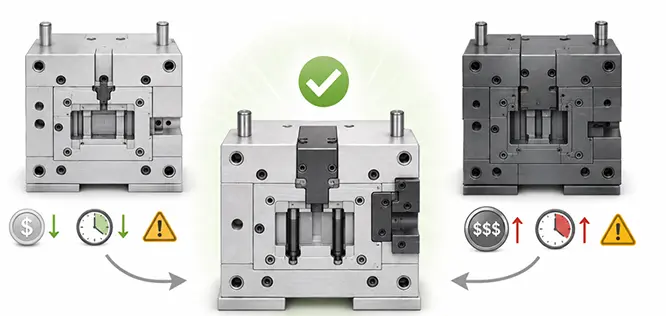

This case shows that when both aluminum and steel molds come with clear limitations, reinforcing only the areas that truly need additional durability can provide a better balance between upfront cost and long-term production needs.
Still not sure whether you should choose an aluminum or steel mold? Contact us and send your part drawings, plastic material, and expected production volume. We can help evaluate the most suitable tooling solution based on cost, lead time, and production risk.
FAQ
Q1: Can aluminum molds produce high-precision parts?
Yes, but it depends on the aluminum grade, mold structure, part dimensions, and tolerance requirements. Projects requiring very tight tolerances or long-term dimensional consistency are generally better suited to steel molds.
Q2: Can aluminum molds be textured?
Yes, certain textures can be applied to aluminum molds. However, deep textures, complex etched patterns, or applications requiring consistent cosmetic quality over long production runs are generally better suited to steel molds.
Q3: Why do steel molds usually take longer to manufacture?
Steel is generally more difficult to machine, and some steel grades also require additional processes such as heat treatment, grinding, polishing, or other finishing operations. As a result, the overall mold manufacturing lead time is often longer.
Q4: Can an aluminum mold be repaired if it is damaged?
In some cases, yes. Local wear or damage can sometimes be repaired by replacing inserts, welding, or remachining the affected area. However, repairability depends on the location of the damage, the aluminum grade, and the mold structure.
Q5: Can aluminum molds be used for multi-cavity tooling?
Yes, but the decision should be based on part size, structural complexity, and expected production volume.