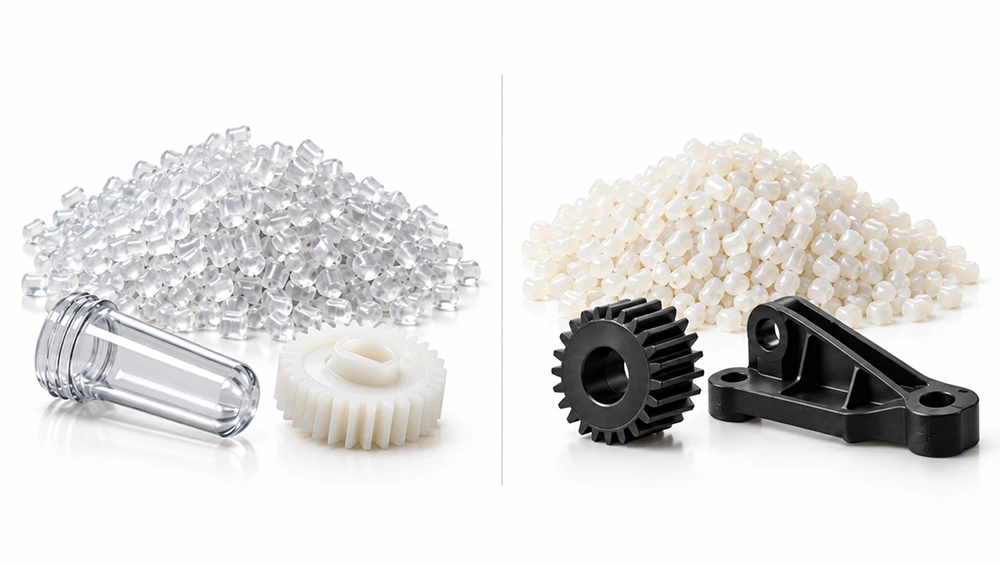
Glass-filled plastics are reinforced materials made by adding a certain percentage of glass fiber to conventional plastics. Compared with unfilled plastics, they generally offer higher strength, stiffness, heat resistance, and dimensional stability, which makes them widely used in automotive, electrical and electronic, industrial equipment, and high-strength structural applications. However, glass fiber can also increase brittleness, reduce surface quality, and accelerate mold wear, so the material should be selected according to the actual requirements of the part.
1. What Are Glass-Filled Plastics?
Glass-filled plastics are typically made by incorporating short glass fibers into a thermoplastic resin. The glass fibers act as the reinforcing phase, while the plastic resin serves as the matrix. The fibers help the material carry greater loads and restrict deformation when the plastic is subjected to mechanical stress or heat.
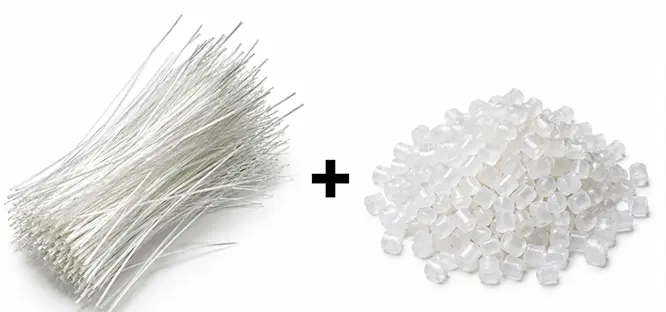
Common base resins include PA, PP, PBT, PC, PPS, and PEEK.
These materials are usually identified by the percentage of glass fiber they contain. For example:
PA66-GF30: PA66 containing approximately 30% glass fiber;PP-GF20: PP containing approximately 20% glass fiber
Here, GF stands for Glass Fiber, while the number generally indicates the glass fiber content by weight.
2. Why Is Glass Fiber Added to Plastics?
Glass fiber is mainly added to plastics to improve load-bearing capability and structural stability. The fibers can carry part of the applied load and restrict resin deformation during loading, heating, and cooling. As a result, glass fiber can increase strength and stiffness, reduce molding shrinkage and long-term creep, and improve dimensional stability at elevated temperatures. These improvements, however, may come with trade-offs such as lower toughness and poorer surface quality.
3. What Are the Main Properties of Glass-Filled Plastics?
1) Mechanical Properties
Glass fiber can significantly improve the tensile strength, flexural strength, and stiffness of plastics while reducing creep under long-term loading. Fatigue performance may also improve in some materials, although the actual result depends on the base resin, glass fiber content, and fiber orientation.
2) Thermal Properties
After glass fiber is added, plastics generally have a higher heat deflection temperature and greater stiffness at elevated temperatures. Their coefficient of thermal expansion is also reduced, helping the material maintain better structural stability under changing temperature conditions.
3) Dimensional Stability
Glass fiber restricts dimensional changes in the resin during cooling and heating, resulting in lower overall shrinkage and better long-term dimensional stability. However, because shrinkage differs between directions, glass-filled parts can still be susceptible to warpage.
4) Surface Properties
Glass fiber can affect the surface quality of molded parts. As glass fiber content increases, surfaces may become rougher and may show exposed fibers, reduced gloss, or uneven texture. For this reason, highly glass-filled materials are generally less suitable for parts with demanding cosmetic requirements.
5) Anisotropy
Glass-filled plastics exhibit noticeable anisotropy. During injection molding, glass fibers tend to align with the direction of melt flow, meaning the material does not perform equally in every direction.
Strength and stiffness are usually higher along the primary fiber direction and lower across it. Shrinkage also varies by direction, which is one of the main reasons glass-filled injection-molded parts can warp.
4. Common Glass-Filled Plastics and Their Applications
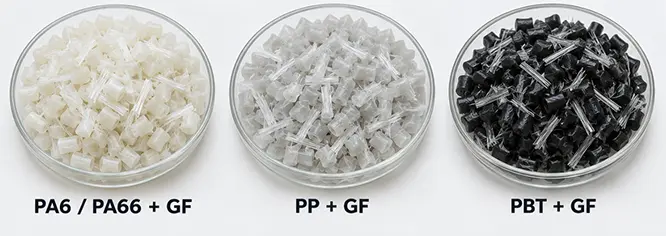
1) PA6 / PA66 + GF
Glass-filled nylon is one of the most widely used types of glass-filled plastic. Adding glass fiber significantly improves the strength, stiffness, heat resistance, and dimensional stability of PA6 and PA66, with PA66-GF30 being particularly common. However, nylon is hygroscopic, so the effect of moisture absorption on dimensions and performance still needs to be considered.
Applications: Automotive structural parts, engine-compartment components, gears, mechanical brackets, power tools, and electrical components.
2) PP + GF
PP is lightweight, chemically resistant, and relatively inexpensive, but its stiffness and heat resistance are limited. Adding glass fiber can significantly improve its mechanical strength, stiffness, and dimensional stability while allowing it to retain a relatively low density.
Applications: Automotive interior and exterior structural parts, instrument panel supports, appliance frames, fan components, and industrial support parts.
3) PBT + GF
PBT provides good dimensional stability, electrical insulation, and relatively low moisture absorption. Glass fiber reinforcement further improves its stiffness, mechanical strength, and heat resistance, making it particularly suitable for electrical and precision structural components with tight dimensional requirements.
Applications: Electrical connectors, relay housings, switch components, automotive electronics, and precision structural parts.
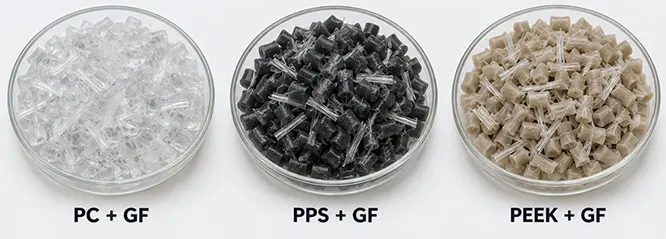
4) PC + GF
PC offers good toughness and heat resistance. Adding glass fiber further increases its stiffness, strength, and dimensional stability. However, glass fiber eliminates the transparency of PC and may also reduce surface quality.
Applications: Electrical housings, equipment supports, industrial structural parts, power tool components, and mechanical parts.
5) PPS + GF
PPS already provides excellent high-temperature resistance, chemical resistance, and dimensional stability. Glass fiber reinforcement further improves its stiffness and high-temperature mechanical performance, making it suitable for parts that must operate for long periods in high-temperature or chemically demanding environments.
Applications: High-temperature automotive components, pump and valve parts, electrical connectors, industrial equipment, and electronic components.
6) PEEK + GF
PEEK is a high-performance engineering plastic with excellent heat resistance, chemical resistance, and mechanical properties. Glass fiber reinforcement can further improve its stiffness, dimensional stability, and load-bearing capability at elevated temperatures, although the material cost is relatively high.
Applications: Aerospace components, high-performance automotive parts, industrial equipment, semiconductor equipment, and high-temperature structural components.
5. What Are the Disadvantages of Glass-Filled Plastics?
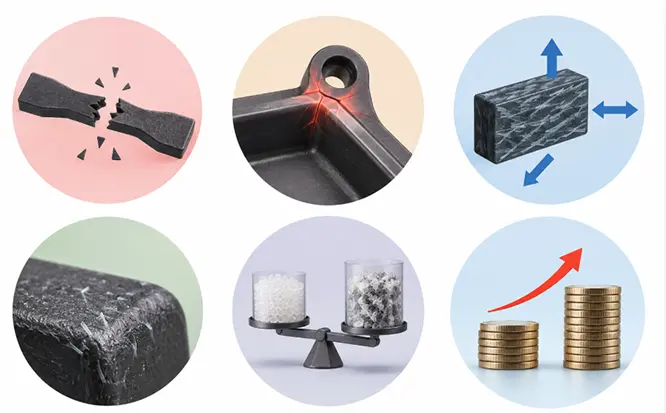
Glass fiber improves the stiffness and strength of plastics, but it also introduces several clear limitations.
Lower toughness and greater susceptibility to brittle failure: Adding glass fiber generally reduces elongation at break and limits the amount of plastic deformation the material can withstand. As a result, parts may be more likely to crack under drops, impacts, or concentrated loads.
Greater sensitivity to notches and stress concentrations: Holes, sharp corners, thread roots, and sudden changes in cross-section can create stress concentrations and may become initiation points for cracks.
Direction-dependent properties: Glass fibers have a preferred orientation, so strength, stiffness, and shrinkage can vary significantly depending on direction.
Poorer surface quality: Glass fibers may become visible at the surface, creating a rougher appearance or uneven gloss. This effect generally becomes more noticeable as glass fiber content increases.
Higher material density: Glass fiber is denser than most plastic resins, so adding it generally increases the weight of a part of the same volume.
Higher material cost in many cases: Compared with the corresponding unfilled grade of the same resin, glass-filled materials are generally more expensive. If a part does not require higher structural performance, the added cost may be unnecessary.
6. Glass-Filled Plastics vs. Unfilled Plastics
| Property | Unfilled Plastics | Glass-Filled Plastics |
| Tensile strength | Relatively lower | Generally higher |
| Stiffness | Lower | Significantly higher |
| Elongation | Generally higher | Generally lower |
| Creep resistance | Lower | Generally better |
| Heat resistance | Depends on the base resin | Generally improved |
| Molding shrinkage | Generally higher | Generally lower |
| Dimensional stability | Moderate | Generally better |
| Anisotropy | Less pronounced | More pronounced |
| Surface quality | Generally better | May show exposed fibers and a rougher surface |
| Warpage | Mainly influenced by part geometry and shrinkage | Also strongly influenced by fiber orientation |
| Mold wear | Lower | Higher |
| Material cost | Generally lower | Generally higher |
Glass-filled plastics therefore should not simply be viewed as an “upgraded” version of conventional plastics. In practice, they trade some toughness, appearance, and processing convenience for higher stiffness, strength, and dimensional stability.
7. What Should Be Considered When Injection Molding Glass-Filled Plastics?
1) Fiber Orientation
Glass fibers align with the direction of melt flow, and this orientation directly affects part strength, shrinkage, and warpage. For this reason, gate location and flow path are not only filling considerations; they also influence the structural performance of the molded part.
2) Gate Location
A well-positioned gate can improve filling behavior and fiber distribution while reducing unfavorable weld lines. If a weld line forms in a highly loaded area, the actual strength of the part may be significantly reduced.
3) Warpage
Glass-filled materials generally have lower overall shrinkage, but the difference in shrinkage between directions can be more pronounced. Long parts, large flat surfaces, and asymmetrical structures therefore require particular attention to the relationship between fiber orientation and part geometry.
4) Wall Thickness and Radii
Wall thickness should be kept as uniform as possible, and abrupt thickness transitions should be avoided. Appropriate radii should also be used around corners and highly stressed areas to reduce stress concentration. Sharp internal corners are especially undesirable when working with relatively brittle glass-filled materials.
5) Surface Quality
If a part requires both glass fiber reinforcement and good appearance, several factors may need to be optimized together, including material grade, mold temperature, injection speed, gate design, and mold surface finish.
6) Mold Wear Resistance
When molding materials with high glass fiber content, the wear resistance of the mold steel, gate areas, screw, and barrel should be considered. In high-volume production, this can directly affect mold life and long-term manufacturing costs.
8. When Should You Choose Glass-Filled Plastics?
Glass-filled plastics are usually worth considering when a part requires greater stiffness, mechanical strength, heat resistance, or dimensional stability than an unfilled plastic can provide.
They are particularly suitable for:
- Structural parts subjected to continuous mechanical loads
- Thin-walled parts that require higher stiffness
- Parts requiring low shrinkage and long-term dimensional stability
- Plastic components operating at elevated temperatures
- Products that need weight reduction and may replace metal components
- Functional structural parts used in automotive, electrical, and mechanical equipment
However, if transparency, high-gloss appearance, flexibility, or high elongation at break is especially important, a glass-filled material may not be the best choice.
Conclusion
Glass-filled plastics use glass fiber reinforcement to enable conventional plastics to meet higher structural, temperature, and dimensional stability requirements. These improvements, however, come with trade-offs such as greater anisotropy, increased brittleness, poorer surface quality, and more demanding processing conditions.
For this reason, selecting a glass-filled plastic should not be based on glass fiber percentage alone. The base resin, part design, fiber orientation, appearance requirements, and actual service environment all need to be considered together.