


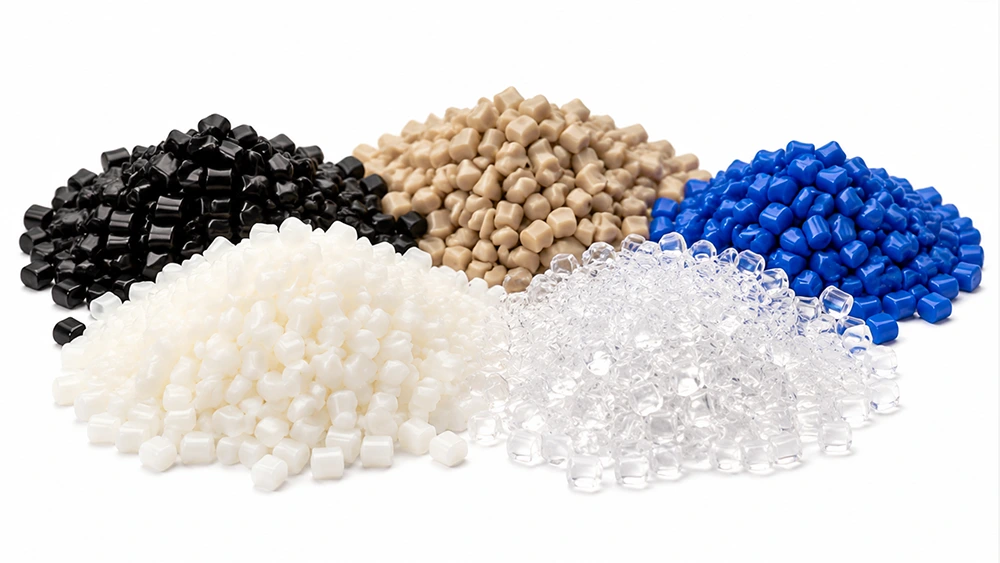
Engineering plastics include common materials such as ABS, PC, nylon (PA), POM, and PBT, as well as high-performance materials such as PEEK, PPS, and PEI. Each offers distinct advantages in mechanical strength, heat resistance, wear resistance, and dimensional stability, making them suitable for applications ranging from gears and precision structural components to electrical connectors and high-temperature parts. This article compares the properties of major engineering plastics and explains how to select the right material for specific part requirements.
1. What Are Engineering Plastics?
Engineering plastics are a class of plastics that offer the mechanical properties, heat resistance, and dimensional stability required for functional industrial components.
Compared with commodity plastics, engineering plastics generally provide better overall mechanical performance, heat resistance, or wear resistance. However, they may also involve higher material costs and more demanding processing requirements. The specific differences depend on the material type, grade, and modification method.
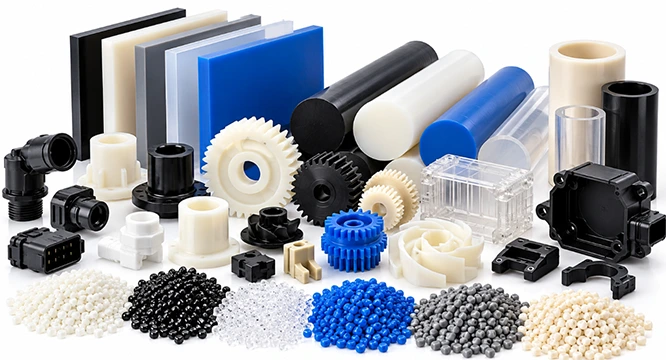

2. Types and Properties of Common Engineering Plastics
| Material | Tensile Strength (Reference, MPa) | Heat Resistance | Wear Resistance | Moisture Absorption (Reference) | Relative Cost |
| ABS | 40–50 | ★★ | ★★ | Low, approx. 0.2–0.3% | $ |
| PC | 60–70 | ★★★ | ★★ | Low, approx. 0.1–0.3% | $$ |
| PA6 | 70–90 | ★★★ | ★★★★ | High, approx. 1.5–2.5% | $$ |
| PA66 | 75–90 | ★★★ | ★★★★ | High, approx. 1.5–2.5% | $$ |
| PA12 | 45–55 | ★★ | ★★★ | Relatively low, approx. 0.2–0.5% | $$$ |
| POM | 60–75 | ★★ | ★★★★ | Low, approx. 0.2–0.5% | $$ |
| PBT | 50–80 | ★★★ | ★★★ | Low, approx. 0.1–0.2% | $$ |
| PET | 70–90 | ★★★ | ★★★ | Low, approx. 0.02–0.05% | $$ |
| PPE / Modified PPE | 50–70 | ★★★ | ★★ | Very low, approx. 0.05–0.1% | $$$ |
| PC/ABS Alloy | 45–65 | ★★★ | ★★ | Low, approx. 0.2–0.3% | $$ |
Note: Tensile strength and moisture absorption values are typical references. Actual values vary with material grade, test conditions, and modification methods. Heat resistance and wear resistance are rated on a relative scale, while cost represents relative market pricing. These ratings are intended for preliminary material selection only.
3. Types and Properties of Specialty Engineering Plastics
Specialty engineering plastics generally offer higher heat resistance, mechanical performance, or chemical resistance, making them suitable for demanding conditions that common engineering plastics may not withstand. This article covers representative materials, including PPS, PEEK, PEI, polysulfones, LCP, PI, and PAI. Classification may vary across different references and industry standards.
| Material | Tensile Strength (Reference, MPa) | Heat Resistance | Wear Resistance | Moisture Absorption (Reference) | Relative Cost |
| PPS | 70–100 | ★★★★ | ★★★ | Very low, approx. 0.01–0.05% | $$$ |
| PEEK | 90–110 | ★★★★★ | ★★★★ | Very low, approx. 0.02–0.1% | $$$$ |
| PEI | 100–130 | ★★★★ | ★★★ | Low, approx. 0.2–0.3% | $$$$ |
| PSU | 80–90 | ★★★★ | ★★ | Moderate, approx. 0.3–0.5% | $$$ |
| PPSU | 80–85 | ★★★★ | ★★ | Low to moderate, approx. 0.1–0.4% | $$$$ |
| PES | 75–90 | ★★★★ | ★★ | Moderate, approx. 0.3–0.5% | $$$$ |
| LCP | 100–200 | ★★★★ | ★★★ | Very low | $$$$ |
| PI | Depends on product form | ★★★★★ | ★★★★ | Depends on grade | $$$$ |
| PAI | Depends on grade | ★★★★★ | ★★★★ | Moderate; depends on grade | $$$$ |
4. Typical Applications of Engineering Plastics
The applications of engineering plastics depend on part function, operating environment, and performance requirements. Common applications include:
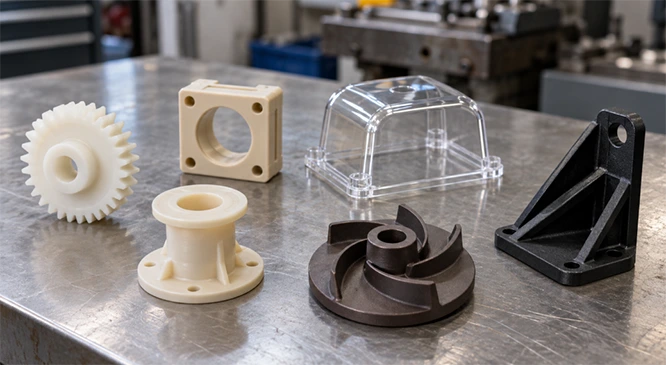
Load-bearing and transmission components: POM and PA are commonly used for gears, bushings, sliders, and other mechanical components that require a combination of wear resistance and mechanical performance.
Precision structural components: POM and PBT are suitable for positioning parts and precision components that require dimensional stability.
Transparent protective components: PC offers excellent impact resistance and good transparency, making it suitable for viewing windows and protective covers.
Electrical insulation and heat-resistant components: PBT, PPS, and PEI are commonly used in connectors, insulating supports, and heat-resistant functional parts.
Chemical-resistant and high-temperature components: PPS and PEEK are suitable for certain applications involving chemical exposure, elevated temperatures, and demanding operating conditions.
Metal replacement and lightweight components: PA and PEEK can replace metal in selected structural and moving components, helping reduce weight and improve corrosion resistance.
The final material choice should account for actual loads, operating temperatures, chemical exposure, and expected service life.
5. How to Choose the Right Engineering Plastic
When selecting a material, start by identifying potential failure risks and evaluating the requirements of the part rather than simply choosing the lowest-cost or highest-strength option.
①Define the operating conditions: Determine the loads, operating temperature, type of motion, and contact media.
②Identify the critical properties: Decide whether strength, impact resistance, wear resistance, dimensional stability, or chemical resistance is the primary concern.
③Check the specific material grade: Review the technical data sheet for mechanical properties, moisture absorption, thermal performance, and compliance requirements.
④Consider manufacturing and total cost: Evaluate raw material costs, processing difficulty, tooling investment, scrap risk, and service life.
⑤Validate actual performance: Test critical dimensions, assembly fit, load capacity, and performance under the intended operating conditions.
A Real Project Case Sharing
We have helped many customers balance material performance and cost when selecting engineering plastics. In one case, a customer planned to mass-produce industrial equipment housings and initially considered PEEK. However, after receiving our quotation, the customer found that the material cost exceeded the project budget due to the large production volume. We evaluated the operating temperature, mechanical strength, and actual service environment, then recommended switching to a PC/ABS alloy. This alternative met the required strength, impact resistance, and performance requirements while reducing material costs. For an order of 10,000 units, the change saved approximately $25,000.
6. Processing Methods for Engineering Plastics
Injection molding: ABS, PC, PA, POM, PBT, PPS, PEEK, and other engineering plastics can be injection molded. Material flowability, shrinkage, moisture absorption, and processing temperature must be considered.
CNC machining: POM, PA, PEEK, and other engineering plastics are commonly machined to produce precision components. Dimensional stability, stiffness, and the risk of post-machining deformation should be considered during material selection.
3D printing: PA, PC, and certain high-performance materials can be used for prototyping and functional testing. Material selection depends on equipment capabilities, material form, and part performance requirements.

FAQs
Q1: Can Engineering Plastics Replace Metal?
Yes. Engineering plastics can replace metal in selected applications where weight reduction, corrosion resistance, or complex geometries are important. However, load capacity, heat resistance, creep, and service life must be validated.
Q2: Can Engineering Plastics Be Recycled?
Most thermoplastic engineering plastics can be recycled and reprocessed using appropriate methods, although repeated processing may affect their properties. Thermosetting plastics are generally more difficult to recycle through conventional melting processes.
Q3: How Much Do Engineering Plastics Cost?
Prices depend on material type, specific grade, reinforcement or modification, order quantity, and supplier. ABS and PA are generally much more economical than PEEK, while specialty materials such as PEEK can cost several times more.
Q4: Can Engineering Plastics Be Used for 3D Printing?
Yes. Nylon and PC are commonly used for functional prototypes, while PEEK and PEI can also be printed using certain high-temperature 3D printing systems. However, high-performance materials often require specialized equipment and precise temperature control.
Q5: Which Engineering Plastic Has the Highest Strength?
There is no single material that is strongest in every respect. PEEK, PEI, and LCP can offer high mechanical performance, while glass-fiber or carbon-fiber reinforcement can further increase strength or stiffness. The appropriate choice depends on tensile strength, impact strength, stiffness, and actual operating conditions.