What comes to mind when you think of plastic recycling? Can recycled plastics only be used for low-end products? Not necessarily. In the new Audi A5 launched in 2024, recycled plastics are used in door trim, carpeting, luggage compartment side panels, underbody components, and even some bumper structures and crash-related front-end parts.
These applications depend on reliable sorting, material processing, and quality validation. The same applies to our injection molding factory. This article explains how we handle production waste.
1. What Types of Plastic Waste Does Injection Molding Produce?
Sprues and Cold Runners
Cold-runner molds produce sprues and runners during every molding cycle. Because this scrap is normally made from the same material as the molded part and is generated under relatively stable conditions, it may be suitable for reuse as long as it remains clean and is not mixed with other plastics.
Rejected Parts and Parts That Fail Inspection
Parts with dimensional deviations, unacceptable appearance, short shots, flash, sink marks, or warpage cannot be shipped as qualified products.
Trial Molding, Machine Setup, and Startup Waste
New mold trials, machine setup, and process adjustments usually produce a certain number of trial parts and unstable parts before production becomes consistent.
Color Change, Material Change, and Purging Waste
When changing colors or materials, two different materials may remain in the barrel and screw at the same time. Material discharged during purging may also contain mixed colors, overheated resin, or materials with uncertain composition.
2. How Do We Sort Plastic Waste in Our Factory?
Sorting by Plastic Material
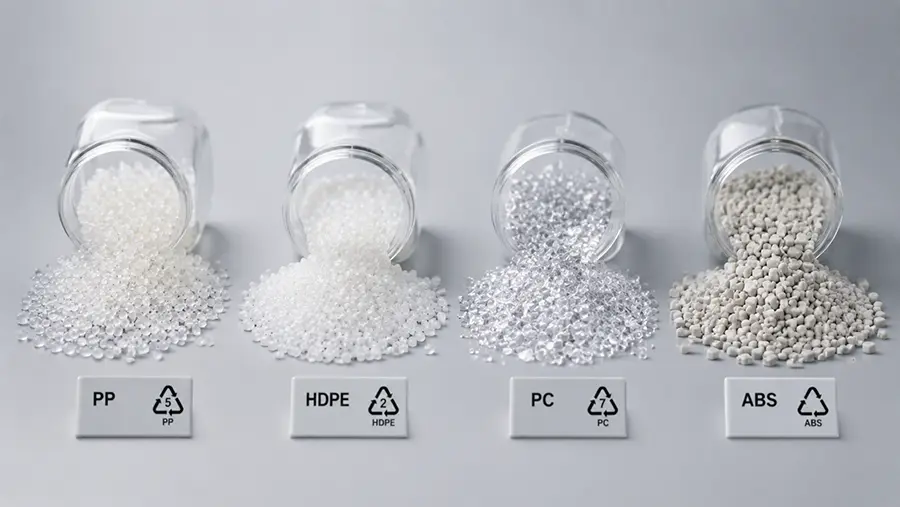
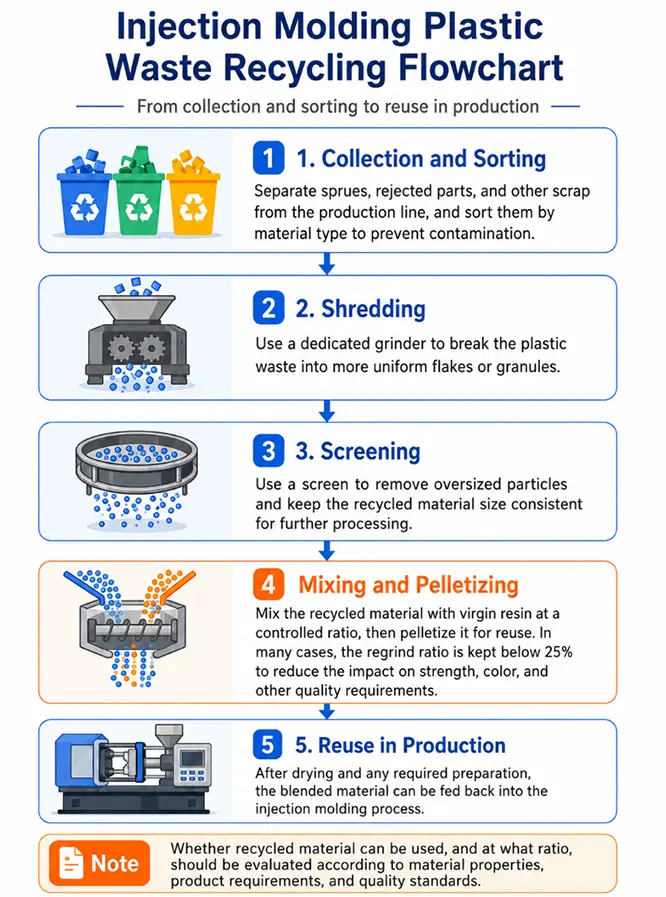
We first sort the waste by material type and grade. PP, ABS, PC, PA, POM, and other materials cannot be placed in the same scrap container. Even when they appear to be the same color, they cannot be treated as the same recycled material.
Different grades may also have different flow properties, shrinkage rates, flame-retardant ratings, and mechanical properties. We therefore retain the specific material grade and project source whenever possible.
Sorting by Color
Different colors of the same material are also stored separately. Transparent, white, and light-colored plastics are more sensitive to color variation, black specks, and contamination, so they cannot be mixed with dark-colored waste.
Managing Reinforced Materials Separately
Glass-fiber-reinforced plastics, flame-retardant materials, and plastics containing special fillers or additives must be managed separately.
For example, standard PA and glass-fiber-reinforced PA cannot be mixed simply because they use the same base resin. Flame-retardant materials must not be added to non-flame-retardant projects without authorization, as this may change the flow behavior, appearance, and certification status of the molded parts.
Keeping Waste Clean and Clearly Labeled
We collect waste in designated containers and label it with the material, color, project, and batch information. The waste must be kept away from oil, metal chips, paper, dust, and other foreign matter.
Once the label is lost or the material source can no longer be confirmed, the material will not be reused directly in customer products. Sorting must take place when the waste is generated, not after different materials have already been mixed together.
3. How Do We Grind and Reuse Clean Production Waste?
Collecting Waste and Confirming Its Source
Before waste enters the grinding process, we reconfirm the material grade, color, project source, and contamination status. Waste with an unknown source, metal inserts, oil contamination, or severe burning is removed from the reusable material stream.
Grinding Sprues and Rejected Parts into Regrind
Suitable sprues, cold runners, and rejected parts are processed in dedicated grinders to produce relatively uniform regrind.
The ground material is then screened to remove oversized pieces, dust, and foreign matter. More consistent particle sizes make conveying, blending, and plasticizing easier to control. Whether further pelletizing is required depends on the material condition and project requirements.
Drying According to Material Requirements
Grinding does not remove moisture already absorbed by the material. Hygroscopic plastics such as PC, PA, and PET still need to be dried according to the material supplier’s requirements before reuse.
We do not judge moisture content simply by checking whether the material surface appears dry. Drying conditions are determined according to the material grade, storage time, and processing requirements to reduce the risk of splay, bubbles, brittleness, and performance loss.
Mixing Regrind with Virgin Resin at a Controlled Ratio
We blend regrind with virgin resin at a fixed ratio and normally keep the regrind content below 25%. UL states that when the regrind comes from sprues, runners, or in-house scrap of the same material grade and is mixed with the same virgin resin, the regrind content may reach 25%.
Confirming Reuse Through Mold Trials and Inspection
Before regular production, we conduct mold trials to confirm that plasticizing, filling, and molding remain stable, and we inspect the resulting part quality. The regrind plan only enters normal production after the test results meet the project standards.
4. Can All Injection Molding Waste Be Reused?
Waste Suitable for In-House Reuse
Thermoplastic sprues, rejected parts, and some setup waste may be suitable for reuse when their source is known, the material is consistent, the color is uniform, and no contamination is present.
Waste Unsuitable for Direct Reuse
Mixed materials, heavily contaminated waste, severely degraded material, color-change waste, purging waste, and waste with an unknown source normally cannot be returned to regular production.
Some Projects Do Not Allow Recycled Material
Medical parts, food-contact products, transparent parts, high-appearance products, and projects with strict requirements for strength, flame resistance, or dimensional stability may prohibit or tightly restrict the use of recycled material.
How Do We Handle Waste That Cannot Be Reused?
Plastic waste that cannot be reused in-house is sorted and stored separately, then transferred to a qualified professional recycling company rather than being discarded with general waste.
5. How Do We Control Part Quality When Using Recycled Material?
Obtaining Customer Approval
When customer drawings, material specifications, or purchasing requirements specify 100% virgin resin, we do not add sprues or other recycled material without authorization.
Controlling the Regrind Ratio
Once the ratio has been established, we keep it consistent during production and record the blending of virgin resin and regrind.
Limiting the Number of Reprocessing Cycles
Every time plastic goes through melting, shearing, and cooling, its molecular structure and additives may be affected. We therefore do not grind and reuse material indefinitely after multiple processing cycles. When the number of cycles cannot be confirmed, the material is not used for parts with defined performance requirements.
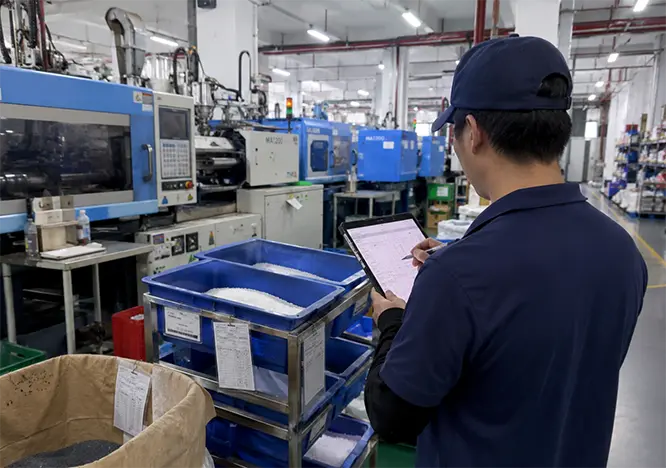
Inspecting Appearance, Dimensions, and Performance
After introducing regrind, we focus on color variation, black specks, splay, brittleness, warpage, changes in shrinkage, and loss of strength.
Maintaining Batch Records and Traceability
We record the waste source, material batch, grinding time, addition ratio, and project in which the material is used. If a product issue occurs, we can trace which batch of material was used and how it was processed.
Final Thought: Reducing Waste Is More Important Than Recycling It
Recycling deals with waste that has already been generated, but reducing waste at the source is more effective. If your project plans to use recycled plastics or aims to reduce production waste without compromising part quality, contact RJC Mold. Through DFM, well-designed runners and gates, suitable hot-runner systems, stable molding parameters, and continuous defect reduction, we can help reduce material waste.