


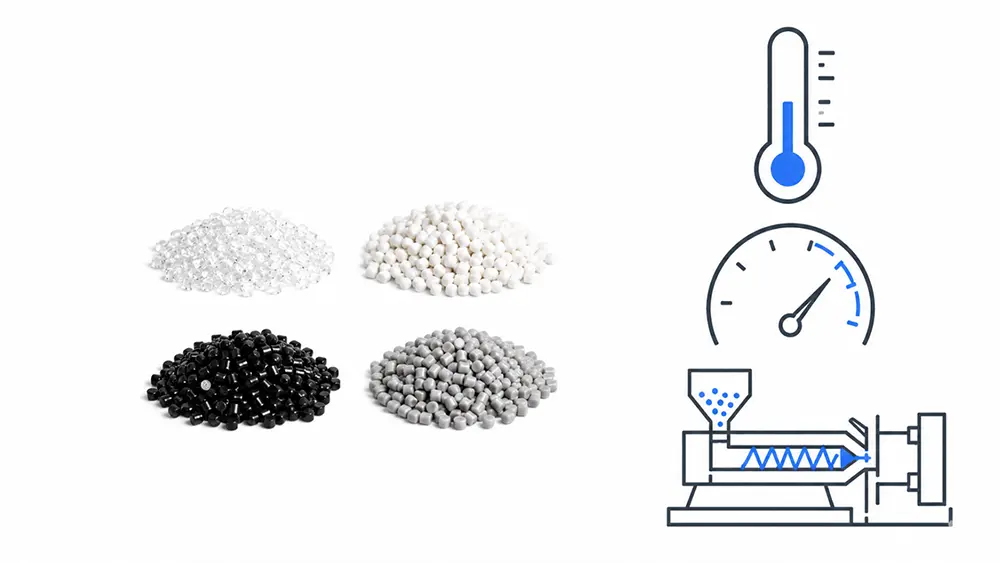
Different plastics exhibit very different melting behaviors, so there is no single universal “melting point of plastic.” At the same time, melting point and actual processing temperature are not the same thing: semi-crystalline plastics generally have a distinct melting point, while amorphous plastics such as ABS and PC do not have a true melting point in the strict sense. The following sections compare the thermal properties and processing temperatures of common plastics and explain how these temperatures affect injection molding.
1. Melting Points and Processing Temperatures of Common Plastics
| Plastic | Material Type | Glass Transition Temperature (Tg) | Melting Point (Tm) / Thermal Behavior | Typical Injection Molding Temperature |
| LDPE | Semi-crystalline | -110 to -100°C | 105 to 115°C | 220 to 245°C |
| HDPE | Semi-crystalline | -120 to -100°C | 125 to 135°C | 190 to 230°C |
| PP | Semi-crystalline | -20 to -10°C | 160 to 170°C | 200 to 240°C |
| ABS | Amorphous | 100 to 105°C | No distinct Tm; softens gradually | 220 to 260°C |
| PS | Amorphous | 95 to 105°C | No distinct Tm; softens gradually | 180 to 260°C |
| PMMA | Amorphous | 105 to 120°C | No distinct Tm; softens gradually | 220 to 260°C |
| PC | Amorphous | 145°C | No distinct Tm; softens gradually | 280 to 320°C |
| PVC | Primarily amorphous | 75 to 85°C | No distinct Tm; may decompose if overheated | 190 to 200°C |
| PA6 | Semi-crystalline | 45 to 55°C | 215 to 225°C | 240 to 280°C |
| PA66 | Semi-crystalline | 45 to 60°C | 255 to 265°C | 280 to 300°C |
| POM | Semi-crystalline | -60°C | 165 to 175°C | 180 to 210°C |
| PET | Semi-crystalline | 70 to 80°C | 245 to 260°C | 270 to 300°C |
| PBT | Semi-crystalline | 50 to 70°C | 220 to 230°C | 250 to 280°C |
| PPS | Semi-crystalline | 85 to 90°C | 280 to 290°C | 300 to 330°C |
| PEEK | Semi-crystalline | 143°C | 343°C | 360 to 400°C |
| TPU | Depends on formulation | Varies by formulation | No single fixed Tm | 180 to 230°C |
The values above are reference ranges for common unmodified materials or typical grades and do not represent every resin grade. Copolymer composition, fillers, glass fiber content, and material supplier can all cause variations.
2. Why Do Some Plastics Not Have a True Melting Point?
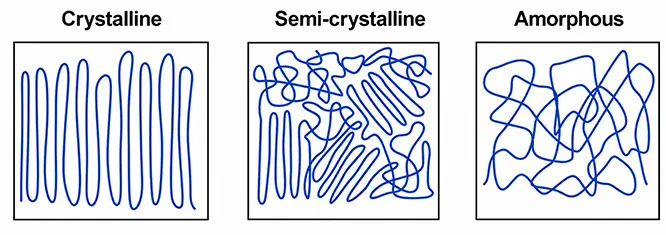

To understand plastic melting points, it is important to distinguish between semi-crystalline plastics and amorphous plastics.
Semi-Crystalline Plastics
Materials such as PP, PE, PA, POM, PBT, and PEEK contain both ordered crystalline regions and amorphous regions.
As the temperature rises, the crystalline regions eventually break down, producing a relatively distinct melting temperature.
Amorphous Plastics
Materials such as ABS, PC, PMMA, and PS do not have a well-defined crystalline structure, so they do not undergo a sharp melting transition like PP.
As temperature increases, they generally move through the following states:
Glassy state → Softening → High-viscosity flow
For amorphous plastics, it is therefore usually more useful to consider their glass transition temperature (Tg), softening temperature, and actual processing temperature.
3. What Is the Difference Between Plastic Melting Point and Processing Temperature?
What Is Melting Point?
Melting point, or Tm, is the temperature at which the crystalline regions of a semi-crystalline plastic transition from an ordered structure into a molten state. It mainly reflects an intrinsic thermal property of the material.
What Is Processing Temperature?
Processing temperature is the actual melt temperature used during processes such as injection molding and extrusion to give the plastic sufficient flowability.
The processing temperature is generally higher than the melting point of a semi-crystalline plastic.
For example, PA66 has a melting point of about 260°C, while the recommended injection molding melt temperature for a typical BASF PA66 grade is 280 to 300°C.
4. Melting Points and Processing Temperatures of Common Plastics
1) PP
PP is a typical semi-crystalline plastic with a melting point of 160 to 170°C. During injection molding, however, the melt temperature usually needs to be raised to 200 to 240°C to achieve sufficient flow.
If the temperature is too low, PP becomes more viscous, making long-flow or thin-wall parts more prone to incomplete filling. If the temperature is too high, the risk of material degradation may increase, and cycle times can become longer.
2) PE
The melting point of PE is closely related to its density and molecular structure.
LDPE has more highly branched molecular chains and a less orderly crystalline structure, giving it a melting point of 105 to 115°C.
HDPE has a more regular molecular structure and typically higher crystallinity, so its melting point increases to 125 to 135°C. Some ExxonMobil HDPE grades have a peak melting temperature of about 135°C. Actual injection molding temperatures are substantially higher than the melting point, with recommended processing temperatures for HDPE injection grades typically around 190 to 230°C.
3) ABS
ABS is an amorphous plastic and therefore does not have a true melting point, Tm, in the strict sense.
Once it reaches its glass transition region, it gradually softens. As the temperature continues to rise, it enters a high-viscosity flow state suitable for processing.
The Tg of ABS is typically around 100°C, while its actual injection molding melt temperature is generally 220 to 260°C.
4) PC
PC is also an amorphous plastic and does not have a distinct crystalline melting point.
Its Tg is relatively high, with a typical value of about 145°C, which contributes to its good dimensional stability at elevated temperatures. However, PC also has a relatively high melt viscosity, so injection molding temperatures typically need to reach 280 to 320°C. If the temperature is too low, mold filling becomes more difficult; if it is too high, or if the material remains at high temperature for too long, the risk of degradation increases.
5) PA6 and PA66 (Nylon)
PA6 and PA66 are both semi-crystalline polyamides, but their melting points are different.
PA6 generally melts at 215 to 225°C, while PA66 melts at 255 to 265°C. As a result, PA66 also typically requires a higher processing temperature, with a recommended melt temperature of 280 to 300°C.
Nylon is also highly hygroscopic. Excess moisture can cause hydrolysis during high-temperature processing, so proper drying before molding is equally important.
6) POM
POM typically has a melting point of 165 to 175°C, while its actual processing temperature is generally 180 to 210°C.
Its processing window is relatively narrow, so continuously increasing the temperature is not a good way to improve flow. Excessive temperature or prolonged residence time may cause the material to decompose.
7) PET and PBT
PET and PBT are both semi-crystalline polyester materials.
PET generally has a melting point of 245 to 260°C, while PBT typically melts at 220 to 230°C. PET has a typical melting temperature of around 250°C, compared with about 225°C for PBT.
Both materials require careful moisture control during high-temperature processing. Insufficient drying can cause hydrolysis, reducing molecular weight and ultimately affecting mechanical properties.
8) PEEK
PEEK is a high-temperature semi-crystalline engineering plastic with a melting point of about 343°C and a glass transition temperature of about 143°C.
Because of its high melting point, actual injection molding temperatures typically need to reach 360 to 400°C, and mold temperatures are also significantly higher than those used for ordinary engineering plastics. PEEK therefore places greater demands on injection molding machine temperature control, mold heating, and overall process stability.
5. What Factors Affect the Melting Temperature of Plastics?
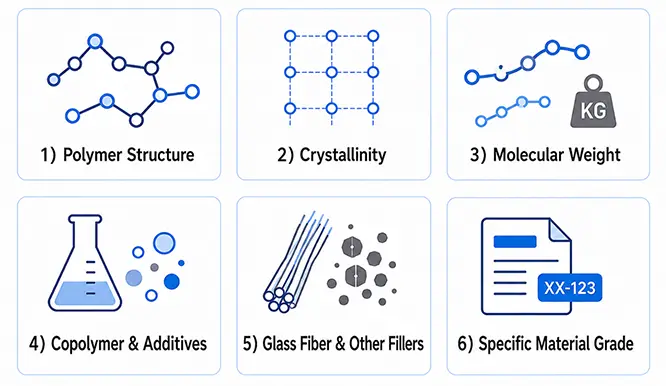

Polymer Structure
The regularity of molecular chains, degree of branching, and intermolecular forces all influence crystal formation and stability. For example, HDPE has a more regular structure than LDPE, so it generally has higher crystallinity and a higher melting point.
Crystallinity
Melting point is closely related to crystalline regions. In general, the more stable the crystalline structure, the more heat is required to disrupt it.
Molecular Weight
Molecular weight and molecular weight distribution can affect the thermal behavior of a polymer. They also have a significant influence on melt viscosity and processing performance.
Copolymerization and Additives
Comonomers, plasticizers, flame retardants, and other modifiers can alter molecular-chain arrangement or softening behavior. As a result, different formulations of the same plastic family may have different thermal properties.
Glass Fiber and Other Fillers
Glass fiber and mineral fillers do not simply cause a large increase in the Tm of the base resin. However, they can affect flow behavior, thermal conductivity, crystallization, and actual processing conditions.
Specific Material Grade
Different grades can vary in molecular weight, flow characteristics, additives, and reinforcement systems.
A general melting point chart is useful for preliminary material comparisons, but actual injection molding settings should still be based on the TDS and Processing Guide provided for the specific resin grade.
6. How Does Melt Temperature Affect Injection Molding Quality?
During injection molding, the melt temperature needs to stay within an appropriate processing window. Temperatures that are either too high or too low can lead to molding defects.
| Melt Temperature | Effect on Injection Molding | Common Problems |
| Too low | Melt viscosity increases, flow resistance rises, and cavity filling becomes more difficult | Short shots, pronounced weld lines, poor surface replication, higher injection pressure |
| Too high | Viscosity decreases, but thermal stress and the risk of material degradation increase | Discoloration, burn marks, gas generation, flash, reduced mechanical properties, longer cycle times |
Increasing the melt temperature can improve material flow, but it is not a solution to every filling problem. Gate size, wall thickness, injection speed, mold temperature, and material grade also need to be considered together.
FAQ
Q1: At What Temperature Does Plastic Melt?
There is no single melting temperature for all plastics. Common semi-crystalline plastics have melting points ranging from around 100°C to more than 340°C, depending on the material.
Q2: Which Common Plastic Has the Lowest Melting Point?
Among common semi-crystalline commodity plastics, LDPE has a relatively low melting point, typically 105 to 115°C.
Q3: How Do You Choose a Plastic Based on Its Melting Point?
Do not rely on melting point alone. Operating temperature, Tg, HDT, long-term heat resistance, mechanical properties, and processing conditions should all be considered.
Q4: Does a Higher Melting Point Always Mean Better Heat Resistance?
Not necessarily. Melting point mainly describes crystalline melting behavior. A part’s actual heat resistance also depends on factors such as Tg, HDT, applied load, and long-term service temperature.
Q5: How Is the Melting Point of Plastic Measured?
A common method is Differential Scanning Calorimetry (DSC). It measures changes in heat flow as the material is heated to identify thermal transitions such as melting peaks and glass transition.