


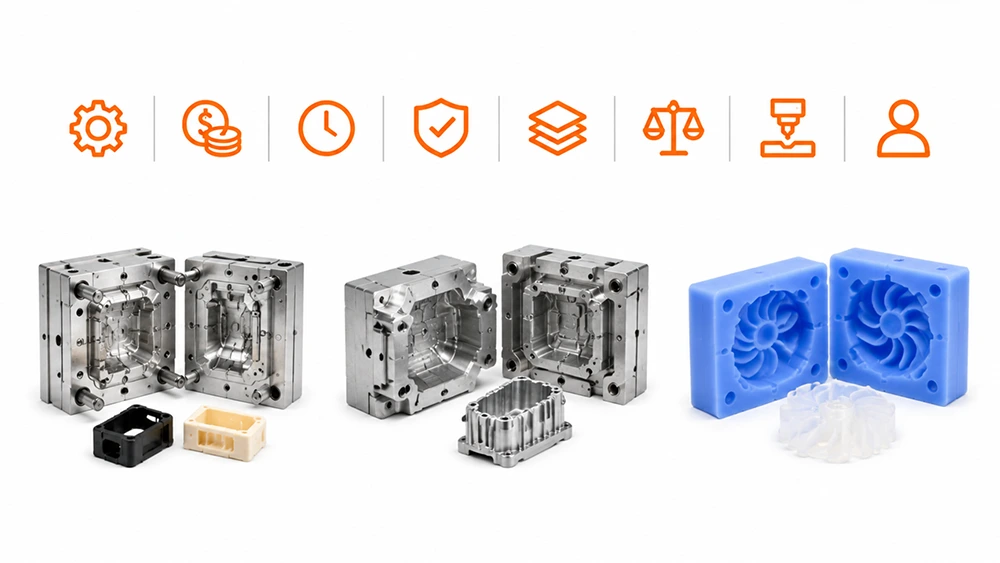
Rapid tooling involves several important considerations, including applications, tooling costs, lead times, mold life, material selection, comparisons with conventional tooling, manufacturing methods, and engineering decisions.
This article explores these eight key areas to help you evaluate the capabilities, cost-effectiveness, and suitability of rapid tooling for your project.
1. What Can Rapid Tooling Do?
Rapid tooling is not limited to plastic injection molding. It can also be used in metal die casting, sheet metal forming, composite molding, and thermoforming. By accelerating the production of molds and tooling inserts, it helps manufacturers shorten product development and trial production cycles.
Common applications include:
| Tooling Type | Corresponding Process |
| Rapid injection molding tooling | Plastic injection molding |
| Rapid die casting tooling | Aluminum and zinc alloy die casting |
| Rapid sheet metal tooling | Stamping, bending, and deep drawing |
| Rapid composite tooling | Carbon fiber and fiberglass molding |
| Rapid thermoforming tooling | Vacuum forming and pressure forming |
Parts produced with rapid tooling can be used in finished products, provided they meet the required dimensional, mechanical, and quality standards.

2. How Much Does Rapid Tooling Cost?
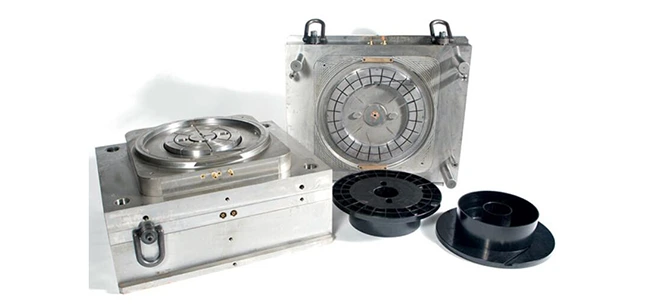
Rapid tooling costs vary considerably. Simple prototype tooling may cost around $1,000–$5,000, while common rapid injection molding projects typically range from $3,000–$15,000. Larger or more complex molds can cost over $20,000. These figures are intended as preliminary budget estimates; actual quotes depend on the part design and manufacturing requirements.
The main cost factors include mold size, structural complexity, material, manufacturing method, and expected production volume.
Consider a plastic injection molding project with two tooling options for the same part:
| Cost Item | Aluminum Rapid Tooling | Steel Production Tooling |
| Tooling cost | $5,000 | $15,000 |
| Cost per part | $3.00 | $1.50 |
| Total cost for 1,000 parts | $8,000 | $16,500 |
| Total cost for 10,000 parts | $35,000 | $30,000 |
Calculation: Total Cost = Tooling Cost + (Unit Production Cost × Production Volume)
This example shows that aluminum rapid tooling is more economical for 1,000 parts, while steel tooling becomes more cost-effective at 10,000 parts.
Actual projects should also account for mold life, maintenance, rework, and production lead times.
3. How Long Does Rapid Tooling Take?
Simple rapid tooling projects typically take around 1–3 weeks, while more complex projects may require 3–6 weeks or longer.
The actual lead time depends on design review, mold complexity, material availability, manufacturing methods, and mold trial requirements.
CNC-machined aluminum molds generally have shorter manufacturing lead times, while complex steel molds require additional machining and heat treatment. Although 3D printing can speed up mold production, post-processing and actual molding trials still take time.
4. How Many Parts Can Rapid Tooling Produce?
The production capacity of rapid tooling varies depending on the manufacturing process, mold material, and design. The following figures provide general estimates for common rapid tooling solutions:
| Tooling Type | Approximate Production Volume |
| Silicone molds (vacuum casting) | 15–30 parts |
| 3D-printed resin injection molds | 10–50 parts |
| Aluminum rapid injection molds | 500–10,000 parts |
| Steel rapid injection molds | 10,000–100,000+ parts |
| Rapid die casting tooling | Depends on mold design and casting conditions |
| Rapid sheet metal tooling | Depends on the stamping process and tool design |
The figures above refer to approximate molding or production cycles a mold can withstand, not a guaranteed service life. Actual output varies with mold wear, maintenance, and part geometry.

5. What Materials Should You Choose for Rapid Tooling?
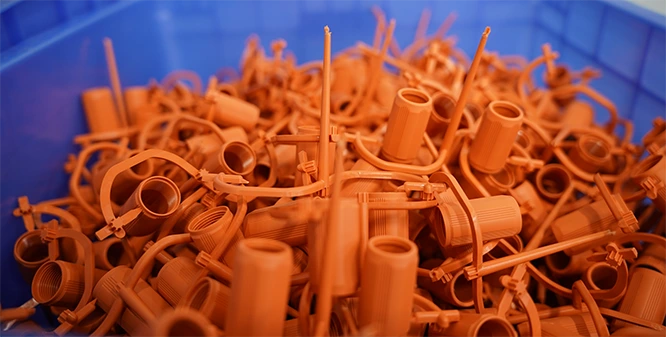
Mold materials should be selected based on the forming process, part material, production volume, and required mold life. Aluminum is easy to machine and offers good thermal conductivity, but it is not suitable for every application.
Common tooling materials include:
| Mold Material | Key Characteristics | Typical Applications |
| Aluminum | Easy to machine, good thermal conductivity | Rapid injection molds |
| P20 tool steel | Good overall mechanical properties | Injection molds |
| H13 tool steel | Heat-resistant, good thermal fatigue resistance | Die casting and demanding tooling applications |
| Stainless steel | Good corrosion resistance | Specialized molds and tooling |
| 3D-printed resin | Fast to produce, suitable for complex geometries | Prototype molds |
Plastic part materials include ABS, PP, PC, PA6, PA66, POM, TPU, and TPE, as well as high-performance plastics such as PEEK, PPSU, and PEI.
Metal parts are commonly made from aluminum alloys (such as ADC12 and A380), zinc alloys (such as Zamak), and magnesium alloys (such as AZ-series alloys).
6. Rapid Tooling vs. Conventional Tooling: What’s the Difference?
Rapid tooling generally offers lower upfront costs and shorter manufacturing lead times, while conventional production tooling is better suited to long-term, high-volume manufacturing.
| Comparison | Rapid Tooling | Conventional Production Tooling |
| Initial cost | Lower | Higher |
| Manufacturing lead time | Shorter | Longer |
| Mold life | Generally shorter | Generally longer |
| Material options | More flexible | Primarily tool steel |
| Production volume | Commonly used for prototypes and small batches | Commonly used for medium- to high-volume production |
| Long-term production cost | Can be higher | Generally more economical |
When it comes to dimensional accuracy, conventional tooling is not automatically superior. A well-made CNC-machined rapid mold can also achieve tight dimensional tolerances.

7. CNC Machining vs. 3D Printing: Which Is Better for Rapid Tooling?
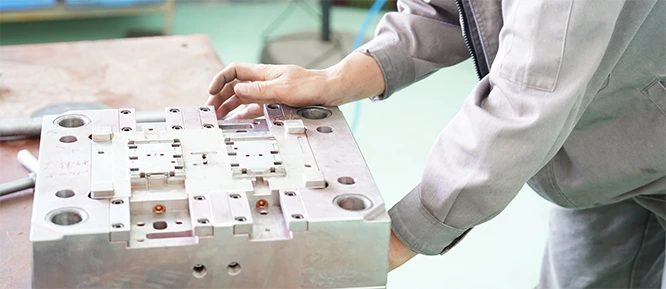
CNC machining is better suited to producing aluminum and steel rapid molds, while 3D printing works well for complex geometries, prototype molds, and certain low-volume applications. The right choice depends on the material, accuracy, heat resistance, and production volume requirements.
| Comparison | CNC Machining | 3D Printing |
| Common materials | Aluminum, steel | Resin, metal |
| Dimensional accuracy | Generally high | Depends on the printing process |
| Complex internal structures | Limited by tool accessibility | Greater design flexibility |
| Surface finish | Can be improved through precision finishing | Usually requires post-processing |
| Mold durability | Depends on the metal used | Resin molds generally have more limitations |
8. When Should You Choose Rapid Tooling?
Consider the following situations when deciding whether rapid tooling is suitable for your project:
Design still under development: Use prototypes or rapid tooling to validate the design before investing in expensive production molds.
Expected production volume of hundreds to several thousand parts: Consider aluminum rapid tooling to reduce upfront investment.
Need to get parts to market quickly: Use rapid tooling for bridge production while the final production mold is being manufactured.
Long-term, high-volume production: Prioritize steel production tooling and compare the total cost over the entire production cycle.
High-temperature or reinforced plastics: Verify mold material compatibility, heat resistance, and wear resistance before selecting a tooling solution. Do not base the decision on price alone.
Conclusion: Making the Right Tooling Decision
When choosing rapid tooling, start by identifying the part material, expected production volume, and product life cycle. Then compare tooling investment, unit production cost, and lead time. If the product design is still likely to change significantly, investing in expensive production tooling too early is unwise. For mature products with stable demand, long-term production costs should be a major consideration.