


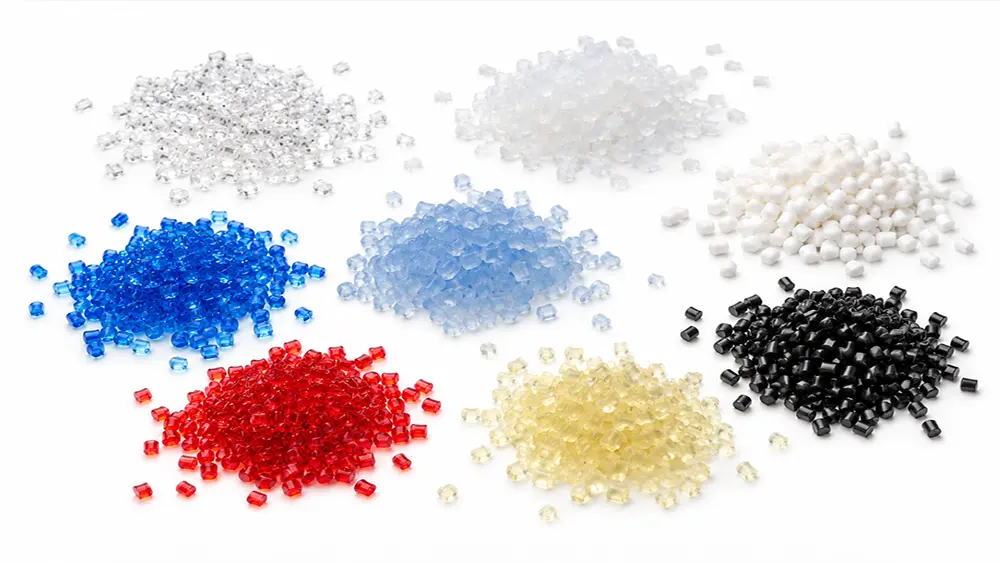
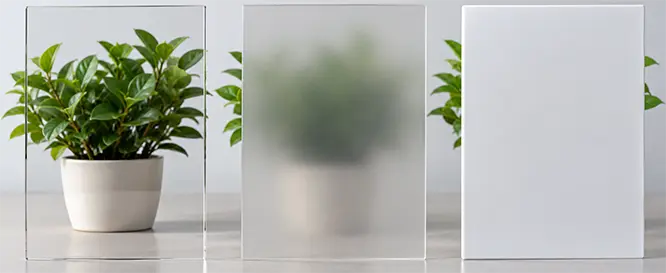
The key difference between transparent, translucent, and opaque plastics lies in whether light can pass through the material and how much it is scattered after transmission. Transparent plastics can be seen through clearly, translucent plastics allow light to pass through but do not provide a clear view of objects behind them, while opaque plastics generally prevent visibility through the material.
The sections below explain these differences in terms of optical behavior, material properties, and the factors that can affect appearance during injection molding.
1. Transparent vs. Translucent vs. Opaque Plastics at a Glance
| Comparison | Transparent Plastics | Translucent Plastics | Opaque Plastics |
| Light transmission | A large amount of light can pass through | Some or a large amount of light can pass through | Very little or no light passes through |
| Light scattering | Low | High | Light is mainly absorbed or reflected |
| Can objects behind the material be seen clearly? | Yes, clearly | Only blurred shapes or outlines are visible | No |
| Typical appearance | Clear, transparent | Milky, hazy, frosted | Solid-colored, non-see-through |
| Common applications | Clear covers, viewing windows, lenses, fluid reservoirs | Light covers, diffusers, illuminated buttons, privacy panels | Electronic housings, structural parts, equipment enclosures |
Transparent, translucent, and opaque are not necessarily fixed properties of a particular plastic. The same plastic can exhibit different optical appearances depending on its grade, formulation, or processing method.

2. What Is Transparent Plastic?
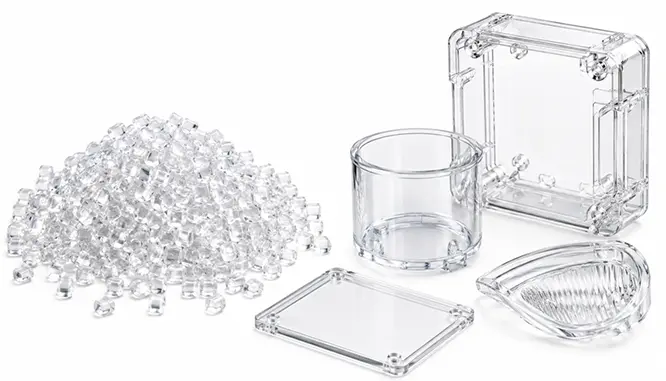
Transparent plastic allows most visible light to pass through with relatively little scattering, so objects behind the material can be seen fairly clearly.
Transparent plastics are commonly used for parts that require visibility of internal structures, light transmission, or a clear visual appearance.
Common transparent plastics include:
PMMA (Acrylic): Offers high transparency and is commonly used for clear covers, panels, and optical components.
PC (Polycarbonate): Combines transparency with relatively high impact resistance.
PETG: Provides good transparency and is often used for clear housings, display components, and packaging.
PS (Polystyrene): Certain grades offer good transparency.
Actual transparency can vary significantly between different grades and formulations.

3. What Is Translucent Plastic?
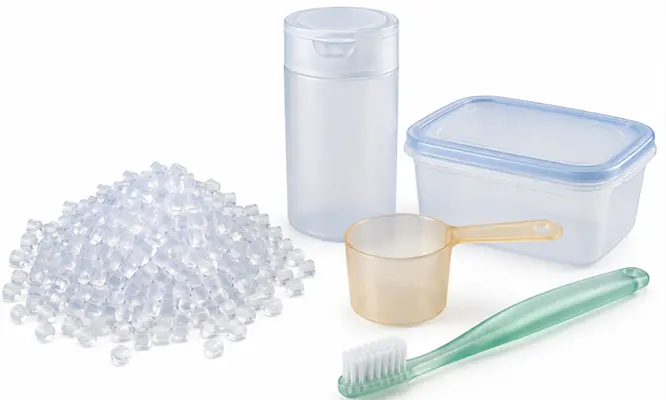
Translucent plastic allows light to pass through, but the light is significantly scattered within the material or at its surface. As a result, objects behind the material cannot be seen clearly; only blurred shapes or outlines are visible.
Translucent does not simply mean “less transparent.” Even if a material transmits a relatively large amount of light, it can still appear translucent if the transmitted light is strongly scattered.
Common translucent plastics include:
PP (Polypropylene): Natural-colored grades often have a certain degree of translucency.
PE (Polyethylene): Some thin-wall or natural-colored grades can appear translucent.
PC: Can be made translucent through material formulation or surface treatment.
PA (Nylon): Some natural grades have a translucent or milky appearance.
Translucent plastics are commonly used in products that need to transmit light without allowing a clear view through the material.

4. What Is Opaque Plastic?
Opaque plastic does not allow enough visible light to pass through for objects behind the material to be seen. Incoming light is generally absorbed, reflected, or scattered by the material.
Common opaque plastics include:
ABS: Commonly used for electronic housings and consumer product enclosures.
POM (Polyoxymethylene): Often used for gears, sliding components, and mechanical parts.
Filled or reinforced plastics: Adding glass fibers, mineral fillers, and similar materials usually reduces light transmission.
Colored plastics: Many transparent resins can become opaque when high concentrations of pigments are added.
In engineering applications, “opaque” generally means that objects behind the material cannot be seen clearly. It does not necessarily mean that absolutely no light can pass through.

5. What Determines Whether a Plastic Is Transparent, Translucent, or Opaque?
The optical appearance of a plastic mainly depends on whether light is absorbed, reflected, or scattered as it travels through the material. Several factors influence this behavior.
1) Polymer Structure
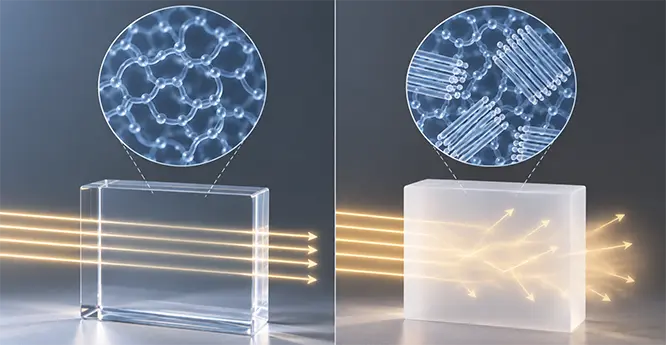
Amorphous plastics have a relatively uniform internal structure, which generally causes less light scattering and makes high transparency easier to achieve. PMMA and PC are typical examples.
Semi-crystalline plastics contain both crystalline and amorphous regions. Because these regions have different optical properties, light is more likely to scatter as it passes through their interfaces. This is why many semi-crystalline plastics naturally appear translucent or opaque.

2) Additives and Pigments
Plastics are rarely used as pure polymers, and various additives can affect their optical appearance.
For example:
- Pigments and color masterbatches absorb or reflect specific wavelengths of light;
- Fillers and glass fibers increase light scattering within the material;
- Light-diffusing additives deliberately increase scattering, giving transparent plastics a softer translucent appearance;
- Certain clarifying agents and nucleating agents can improve the transparency of some plastics.
As a result, the same base resin can appear transparent, translucent, or even opaque depending on its formulation.
3) Phase Structure and Refractive Index Matching
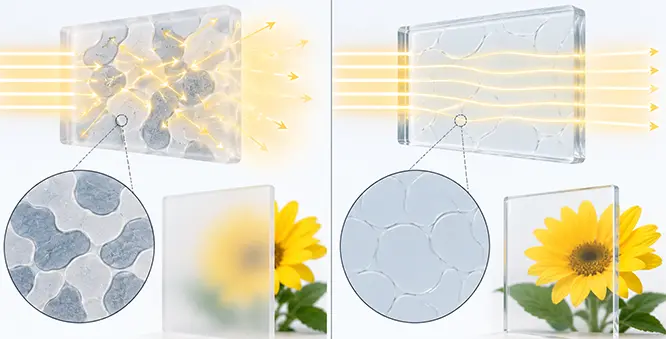
In polymer blends, modified plastics, or multiphase materials, differences in refractive index between different phases directly affect how light travels through the material.
If the refractive indices of the different phases differ significantly, light will be strongly refracted and scattered at their interfaces, making the material appear whitish, hazy, or less transparent.
Conversely, when the refractive indices of the different phases are closely matched, light scattering can be significantly reduced. Even a material containing multiple components may still retain good transparency.

6. How Is Plastic Transparency Measured?
Visual inspection can quickly indicate whether a material is transparent, translucent, or opaque, but engineering applications usually require optical properties to be measured quantitatively.
1) Light Transmittance
Light transmittance indicates the proportion of incident light that passes through a material.
Higher transmittance means more light passes through the plastic. However, high light transmittance does not necessarily mean that the material appears transparent, because the transmitted light may still be strongly scattered.
2) Haze
Haze describes the degree to which transmitted light is scattered as it passes through a material.
With low haze, light changes direction very little and the material generally appears clearer. With high haze, transmitted light is scattered more strongly, giving the material a hazy or translucent appearance.
3) Clarity
Clarity describes how clearly images and outlines can be seen through a material.
Two plastics can have similar light transmittance but very different clarity because their levels of light scattering differ.
7. How Does Injection Molding Affect the Transparency of Plastic Parts?
Even when a transparent-grade resin is selected, the optical appearance of the final molded part can still be affected by part design, mold condition, and processing parameters.
1) Part Design
Part thickness directly affects the distance light must travel through the material.
The same plastic may appear relatively transparent in a thin-wall section, while greater thickness can increase light absorption and scattering. Large variations in wall thickness may also create noticeable differences in transparency and color across the part.
2) Mold Surface
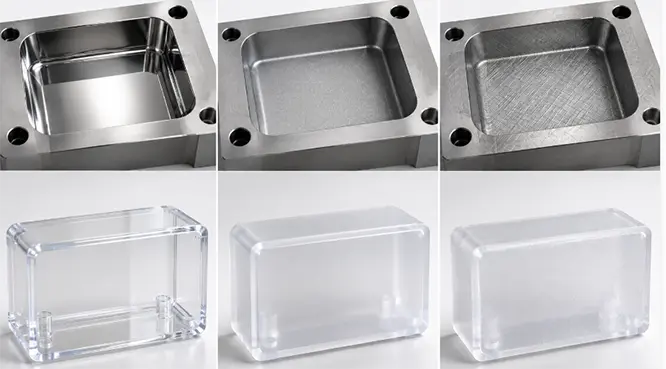
The surface roughness of the mold is transferred directly to the plastic part, which in turn affects how light travels through or reflects from the surface.
A highly polished mold surface helps produce a smooth, clear, transparent appearance. Frosted, textured, or rougher mold surfaces increase light scattering and can make a transparent plastic appear translucent.
This is why some plastic parts made from transparent PC still look translucent after molding.

3) Molding Process
Transparent parts tend to reveal molding issues more readily than ordinary opaque parts.
For example, insufficient material drying can lead to silver streaks or gas marks. Improper melt temperature, mold temperature, injection speed, or pressure may cause material degradation, uneven flow, or poor surface replication.
4) Molding Defects
Many defects that may be barely noticeable on ordinary plastic parts become much more visible on transparent and translucent components.
Common issues include: silver streaks, bubbles, flow marks, weld lines, black specks, yellowing, and localized haze.
FAQ
Q1: Is frosted plastic considered translucent?
Usually, yes. A frosted surface increases light scattering, allowing light to pass through while preventing a clear view through the material, which gives it a translucent appearance.
Q2: Can the same plastic be transparent, translucent, and opaque?
Yes. Different grades, pigments, additives, and surface treatments can give the same base resin different optical appearances.
Q3: Why does transparent plastic become hazy?
Common causes include increased light scattering, surface roughness, moisture in the material, molding defects, changes in crystallinity, or material degradation.
Q4: Can transparent plastic remain clear over the long term?
Not necessarily. UV exposure, thermal aging, chemical exposure, and long-term use can cause yellowing, haze, or a gradual loss of transparency.
Q5: Does translucent plastic transmit light?
Yes. Translucent plastic allows a certain amount of light to pass through, but the transmitted light is significantly scattered.