


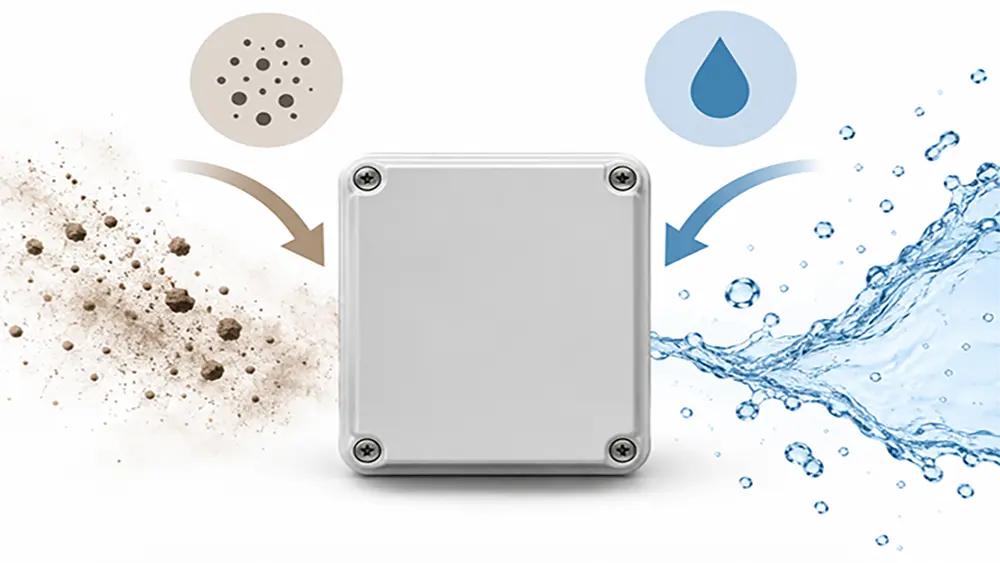
For outdoor electronics, sensors, controllers, and industrial equipment, plastic enclosures must do more than protect internal components. They also need to keep out dust and water. IP ratings are used to measure this level of protection, and achieving IP65, IP67, or higher depends largely on the sealing structure, part accuracy, and dimensional stability of the molded enclosure.
1. What Is an Ingress Protection (IP) Rating?
An Ingress Protection Rating, commonly referred to as an IP Rating, indicates how effectively an enclosure protects against solid objects, dust, and water ingress.
IP ratings are classified according to the IEC 60529 standard. This standard defines different levels of protection for electrical equipment enclosures and expresses them in the format “IP + digits.”
For example, in IP67, the first digit, “6,” indicates the level of protection against solid objects and dust, while the second digit, “7,” indicates the level of protection against water ingress.

2. How to Read an IP Rating
An IP rating is typically followed by two digits. The first indicates protection against solid objects and dust, while the second indicates protection against water.
First Digit: Protection Against Solids and Dust
| First Digit | Protection Level | Description |
| 0 | No protection | No specific protection against solid objects |
| 1 | ≥50 mm solid objects | Protects against access by the back of a hand or similarly large objects |
| 2 | ≥12.5 mm solid objects | Protects against fingers and similar objects |
| 3 | ≥2.5 mm solid objects | Protects against thicker tools, wires, and similar objects |
| 4 | ≥1.0 mm solid objects | Protects against small tools, wires, and larger particles |
| 5 | Dust-protected | Limited dust ingress is permitted, provided it does not interfere with normal equipment operation |
| 6 | Dust-tight | Completely prevents dust ingress |
Second Digit: Protection Against Water
| Second Digit | Protection Level | Description |
| 0 | No protection | No specific protection against water |
| 1 | Vertically dripping water | Protects against harmful effects caused by vertically falling water drops |
| 2 | Dripping water when tilted | Provides protection against dripping water when the enclosure is tilted to a specified angle |
| 3 | Spraying water | Protects against water sprayed within a specified angular range |
| 4 | Splashing water | Protects against water splashing from all directions |
| 5 | Water jets | Resists water jets from any direction |
| 6 | Powerful water jets | Resists more powerful water jets |
| 7 | Temporary immersion | Protects against temporary immersion under specified depth and time conditions |
| 8 | Immersion under specified conditions | Provides protection under immersion conditions more demanding than IPX7, as defined by the product requirements |
| 9 | High-pressure, high-temperature water jets | Resists high-pressure and high-temperature water jets |
3. Common IP Ratings for Plastic Enclosures
For plastic electronic enclosures and industrial equipment, IP54, IP65, IP66, IP67, and IP68 are among the most commonly used ratings.
| IP Rating | Solid Protection | Water Protection | Typical Applications |
| IP54 | Dust-protected | Protected against splashing water from all directions | General indoor equipment and partially sheltered outdoor equipment |
| IP65 | Dust-tight | Protected against water jets | Outdoor controllers, electrical enclosures, and industrial electronics |
| IP66 | Dust-tight | Protected against powerful water jets | Exposed outdoor equipment and industrial equipment requiring washdown |
| IP67 | Dust-tight | Protected against temporary immersion under specified conditions | Outdoor sensors, portable devices, and products that may be temporarily submerged |
| IP68 | Dust-tight | Protected against more demanding immersion conditions | Underwater equipment or products requiring a higher level of immersion protection |
It is important to note that IP67 should not simply be considered an upgraded version of IP65. IPX5 and IPX6 primarily address water-jet exposure, while IPX7 and IPX8 address immersion. The test methods are different.
4. How Do Plastic Enclosures Keep Out Dust and Water?
The key to keeping dust and water out of a plastic enclosure is to block every possible ingress path and create a continuous, stable sealing boundary after assembly.
Enclosure joints, screw holes, buttons, connectors, cable entries, metal inserts, and vent openings can all become ingress paths. If even one of these areas is insufficiently sealed, the IP performance of the entire enclosure may be compromised.
For this reason, IP protection depends on the sealing integrity of the enclosure as a complete system, not simply on the plastic material itself.
5. Main Sealing Structures for Plastic Enclosures
1) Gaskets and O-Rings
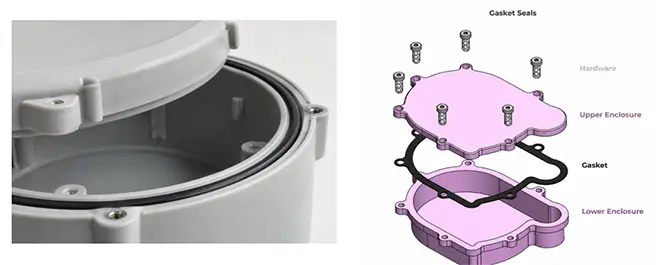
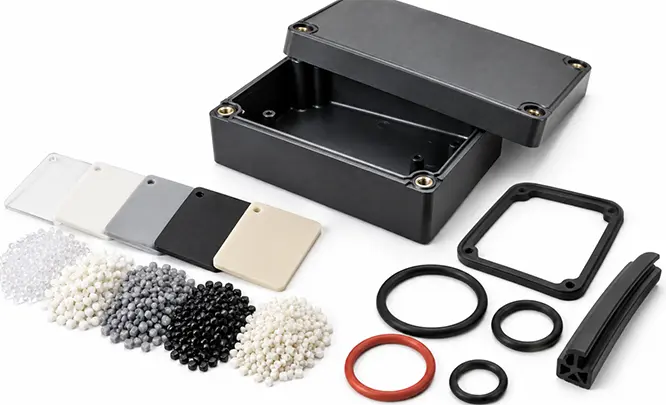
Gaskets and O-rings are among the most common sealing methods used in plastic enclosures. They are compressed between mating surfaces and elastically deform to fill small gaps, helping prevent water and dust from entering.

2) Tongue-and-Groove and Labyrinth Structures
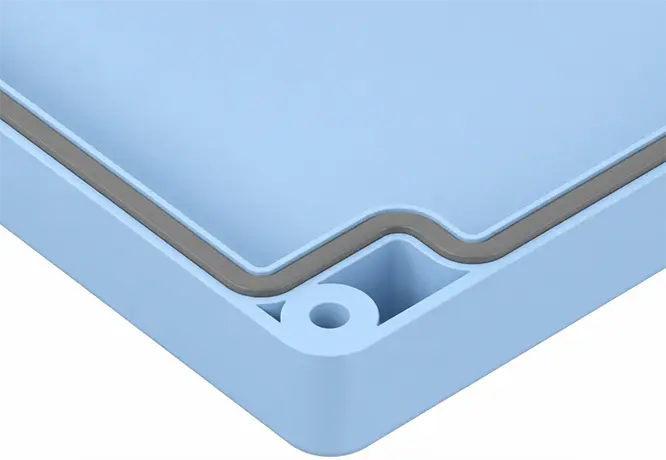
A tongue-and-groove structure uses interlocking raised and recessed features between enclosure halves to create a more tortuous ingress path. It can also provide a stable location for a gasket.
A labyrinth structure works in a similar way by forcing water and dust through multiple turns or overlapping paths before they can reach the enclosure interior. These structures are often used as secondary protection in combination with gaskets or O-rings.

3) Screw and Snap-Fit Compression
Screws and snap-fits are not sealing materials themselves, but they hold enclosure halves together and keep the sealing element under compression.
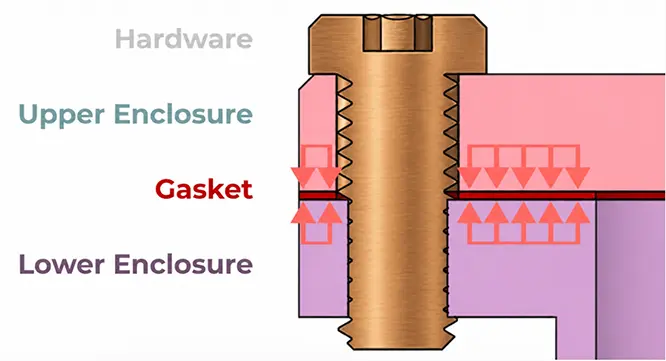

Screw fastening is commonly used where greater clamping force is required. Snap-fits can reduce the number of fasteners and simplify assembly. Both methods can be combined with gaskets, O-rings, or other sealing structures.
4) Overmolded Seals
Overmolding or two-shot molding can mold elastomeric materials such as TPE or TPU directly onto a rigid plastic enclosure, integrating the soft sealing feature with the housing.
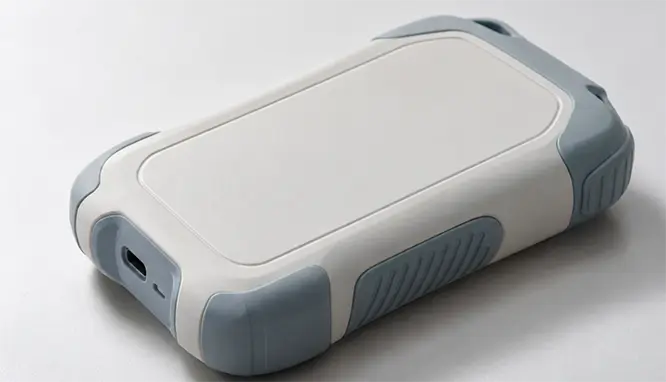

This approach can create integrated gaskets, sealing lips, waterproof buttons, and other flexible sealing areas while reducing the number of separate sealing components and assembly steps.
5) Sealing Openings and Through-Wall Components
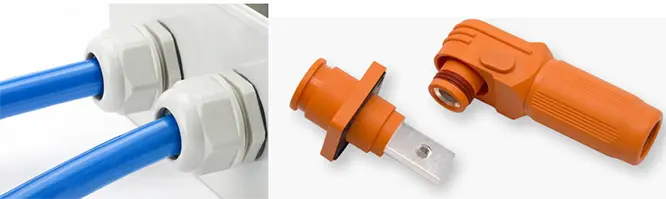
Connectors, cables, metal terminals, inserts, buttons, and other components that pass through the enclosure wall can create potential water-entry paths and therefore usually require independent sealing.
Common solutions include cable glands, connector seals, rubber membranes, flexible sealing boots, and localized encapsulation. Metal terminals, threaded inserts, and other through-wall components may also be incorporated through insert molding, reducing the need for additional assembly interfaces.

6) Waterproof Venting
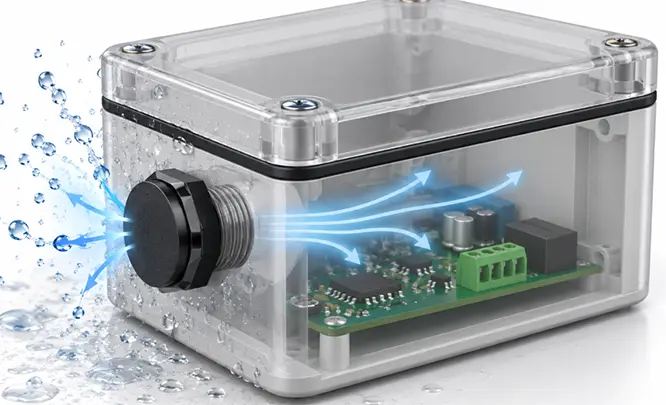
Some sealed plastic enclosures need to allow air exchange while still blocking water and dust. In these cases, a waterproof breathable membrane or vent can be used.
These structures use microporous membranes to allow gases to pass through while blocking liquid water and larger contaminants. They are commonly used in outdoor electronics, sensors, and sealed enclosures that experience internal temperature changes.

6. Injection Molding Design Considerations for IP-Rated Enclosures
A sealing structure that appears gap-free in CAD does not guarantee that the molded enclosure will remain watertight in production. Warpage, shrinkage, and dimensional variation can all change the actual compression applied to the sealing element.
1) Sealing Surface Flatness
Large flat areas, long enclosure edges, and thin-wall designs require particular attention to sealing-surface flatness and overall rigidity. The flatter the sealing surface, the easier it is to maintain uniform compression across the seal.
2) Wall Thickness and Warpage
Uneven cooling and shrinkage across an injection-molded part are major causes of warpage. Maintaining relatively uniform wall thickness helps reduce differential shrinkage and deformation. Where necessary, properly designed ribs can improve the rigidity of larger enclosure surfaces.
For waterproof enclosures, this is more than an appearance issue. Even slight warpage can change how the sealing surfaces contact one another.
3) Dimensional Tolerances and Tolerance Stack-Up
Tolerance stack-up should be evaluated during the design stage to make sure the seal remains within an acceptable compression range under both maximum and minimum dimensional conditions. Actual compression is typically influenced by a combination of:
Upper enclosure dimensions + lower enclosure dimensions + seal-groove dimensions + seal dimensions + fastening structure
4) Parting Line Design
Critical sealing surfaces should avoid unnecessary parting lines, flash, or mold mismatch wherever possible.
Injection molding flash commonly occurs along parting surfaces. Even a small amount of flash can interrupt a continuous seal if it appears on an O-ring or gasket contact surface.
5) Gate and Ejector Pin Locations
The locations of gates and ejector pins influence not only molding behavior but also local surface quality and dimensional accuracy.
Critical areas such as O-ring grooves, gasket seating surfaces, and connector sealing surfaces should be kept free from ejector marks, gate vestiges, or localized deformation wherever possible.
6) Seal Compression After Assembly
What ultimately determines waterproof performance is the assembled condition, not the dimensions of an individual plastic part. Key factors include:
- Whether screw torque remains consistent
- The actual compression of the seal
- Whether the enclosure halves deform during assembly
- Whether clamping pressure is evenly distributed
- Whether the seal can recover after repeated disassembly and reassembly
7. Material Selection for Sealed Plastic Enclosures
The enclosure material affects more than mechanical strength. It also influences dimensional stability, warpage, moisture absorption, and outdoor durability, all of which can affect long-term sealing performance.
Common Enclosure Materials
| Material | Key Characteristics | Considerations for Sealed Enclosures |
| ABS | Easy to process, relatively good dimensional stability, moderate cost | Suitable for general electronic enclosures; weather resistance should be considered for long-term outdoor use |
| PC | High impact strength and good heat resistance | Suitable for sealed enclosures requiring greater strength and durability |
| PC/ABS | Combines the toughness of PC with the processability of ABS | Commonly used in electronic, electrical, and industrial equipment housings |
| PA (Nylon) | High strength and good wear resistance | Moisture absorption can cause dimensional changes, so sealing tolerances require careful control |
| PP | Good chemical resistance, low density, and good moisture resistance | Relatively high shrinkage means warpage and dimensional stability require closer attention |
Sealing Materials
Common sealing materials include silicone, TPE, TPU, and EPDM. Key selection factors include:
- Hardness and compressibility
- Compression set
- Operating temperature
- Water and chemical resistance
- Aging resistance
- Compatibility with the enclosure material
For overmolding or two-shot molding, the bonding performance between the rigid and soft materials, as well as the actual molding process, must also be considered.
8. What IP Rating Does a Plastic Enclosure Need?
A higher IP rating is not always better. Moving to a higher rating usually requires a more complex sealing structure, tighter dimensional control, and higher manufacturing and validation costs. The appropriate target should therefore be based on the actual operating environment.
| Operating Condition | IP Rating to Consider |
| General indoor use, limited dust, or occasional splashing | IP4X–IP54 |
| Outdoor equipment requiring dust and rain protection | IP54–IP65 |
| Industrial environments or equipment exposed to water jets | IP65–IP66 |
| Outdoor sensors or products that may be temporarily submerged | IP67 |
| Products requiring prolonged or deeper immersion under specified conditions | IP68 |
Conclusion
Achieving reliable IP protection in a plastic enclosure is not simply a matter of adding a gasket. It requires controlling every potential ingress path while coordinating the sealing structure, material selection, molding accuracy, and assembly compression.
The earlier the target IP rating is defined and incorporated into the product and mold design, the easier it becomes to achieve consistent and repeatable protection against dust and water.