

When the quote for the mold of a smart speaker’s enclosure arrived from China, it was 30% lower than that of the local molds. But Lisa, a German product manager, delayed her decision. Whether it could save tens of thousands of euros in mold costs depends on many hidden variables. Because she knew that the designs of complex snap-fit and precise acoustic meshes on the drawings would bring many unexpected communication costs and delays during tool fabrication and mass production.
Her quandary is exactly what global hardware manufacturers are all facing: weighing the cost savings of China molds against the control and responsiveness of local suppliers.(For the purpose of this article, ‘Local Mold’ specifically refers to tooling produced in North America or Europe)
Many manufacturers or purchasers only compare the prices on the quotation sheet when choosing a mold supplier. This approach may be feasible if no unexpected costs arise, but once it comes to complex projects or long-term cooperation, it will not make sense.
In fact, factors such as the maturity of one’s own product, team collaboration ability and risk tolerance should also be considered. Here is a four-dimensional decision framework that can help you transform the complex supply chain selection into quantifiable strategic decisions.


I. 4-Dimensional Comparison (Key Decision)
Choosing local or China molds is no longer a simple “either-or” decision but a multi-dimensional comprehensive consideration. The following is a detailed comparative analysis of the four key dimensions:
1. Cost Structure (Direct Costs and Implicit Costs)
Advantages and Challenges of China Molds:
Products manufactured in China generally have a significant advantage in direct costs. Therefore, the overall cost of molds is usually 30%-50% lower than that of locally sourced molds. This advantage is more prominent for molds with complex structures. (This is because China’s internal supply chain for raw materials and components, supported by policies and developed logistics, is highly flexible, which reduces supply costs.); in addition, economies of scale (as production scale expands, the cost per unit decreases) and extensive experience in manufacturing molds for large-scale production, especially molds with a daily output of tens of thousands, contribute to this cost advantage. However, additional costs such as international logistics, tariffs, and insurance (which typically account for approximately 15%-25% of the total price) should also be clearly allocated in the budget.
The “sticker price” of molds is only one part of the total cost. Besides the aforementioned costs, time loss, modification cycle, and communication barriers may lead to costs much higher than the price difference, which is also called implicit costs. When calculating, these three implicit costs should be included: communication risk, time risk, and quality risk. After factoring them, many schemes that originally seemed cheaper may suddenly narrow the gap.
Advantages and Challenges of Local Molds:
The local quotations are almost always transparent and controllable, usually in the form of “turnkey” quotations, and unexpected costs are rarely encountered. Moreover, the cost for small batches is relatively low, especially for trial production or small-scale production of less than 5,000 pieces. In terms of modification and adjustment, the cost is even lower. However, the proportion of labor costs is high, and complex molds may incur higher overall costs due to labor costs.
2. Technical Capabilities (Specialized Fields)
Technical Strengths of China Molds:
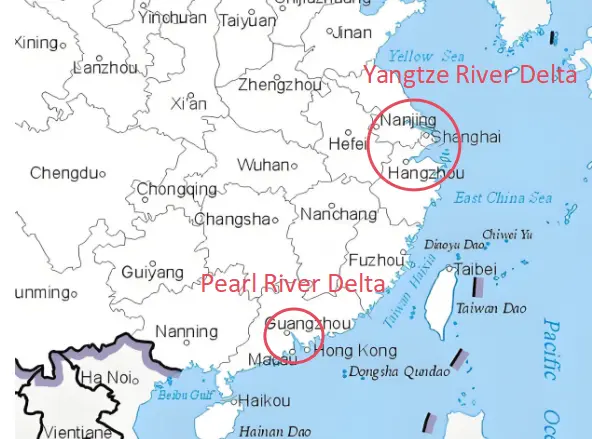
Currently, the regional characteristics of China’s mold industry are very distinct, and they are highly specialized. The vast majority are concentrated in the Pearl River Delta and the Yangtze River Delta regions. The plastic molds in Guangdong rank among the top in the country. In addition, China has rich experience in large-scale manufacturing, especially for products with a lifecycle production volume of over one million pieces, it has very mature process optimization plans. At the same time, Chinese manufacturers are quick to learn and adopt efficient production, and many factories have already achieved automated injection molding and assembly; Facing mature technology fields, they can quickly absorb and apply advanced international plastic injection molding processes, and innovate on this basis (such as micro-hole foaming injection molding, air-assisted injection molding, two-color injection molding, insert injection molding, etc.).

The technical Advantages of Local Molds:
Local mold manufacturers are more familiar with the FDA, CE, UL and other certification requirements and processes in the local market. Moreover, when designing molds, they will take regulatory requirements into account, significantly reducing the occurrence of project delays due to non-compliance with molds. Secondly, they are skilled at producing small-batch, high-precision components, such as medical minimally invasive devices and precision optical components, in the high-end fields. (all with nanometer-level precision and surface finish (Ra).). Europe and the United States are also at the forefront in material application. They usually cooperate with top material suppliers such as BASF, DuPont, and Covestro, which enables them to have earlier access to innovative engineering plastics and special materials.
When making technical choices, please adhere to a hard rule: 90% of molds with unfinished design cannot be offshore outsourced. It’s not a cost issue, but a survival issue!
The reason is simple: When the drawings need frequent revisions, each communication with Chinese mold manufacturers will take at least 2 weeks; if the modifications are made locally, they can be connected and see the new processing plans within 24 hours. New products typically undergo 3-5 major revisions before going to market, and any cross-border delays during this period could turn into “daily market losses”.
3. Communication and Delivery (Efficiency and Controllability)
Key Points for Communication with China Mold Manufacturers:
Time zone difference is a challenge in communication, but it can be easily overcome by establishing a fixed overlapping working time window (such as European morning/Chinese afternoon). The next is language. In China’s vast talent market, there are many people proficient in various languages, and most companies will have translators who are proficient in English or other minor languages. During cross-border communication, structured communication can be adopted (review milestones in stages, with clear deliverables and acceptance criteria for each stage).
The Communication Advantages of Local Makers:
One of the biggest advantages of choosing a local manufacturer is the convenience of communication. When encountering various problems, prompt responses can be made. In emergency situations, problems can be resolved through on-site meetings within a few hours. Moreover, it can avoid language barriers and subtle misunderstandings caused by cultural differences between different countries.
Hard-won experience reminds us: The ability of a team to conduct remote collaboration is crucial!
The best way to determine whether a team can undertake cross-border mold projects is to consider the following three questions:
- Do there exist project engineers who can adapt to the Chinese working hours?
- Can DFM, prototyping, and modifications be forcibly terminated?
- Can finance accept “payment by milestones”? (Money is the best tool for progress management. For example, “Pay 20% after the full 3D mold structure diagram is submitted and approved”, “Pay 30% after the T2 prototype passes all size inspections”.)
If these fundamentals are all lacking, cross-border molds will become a continuous source of pressure rather than a cost advantage.
4. Supply Chain Resilience (Globalization and Regionalization)
Nowadays, a stable supply chain can also significantly enhance the competitiveness of products in the market. The selection of mold manufacturers is also an indispensable part of the supply chain.
The characteristics of the supply chain for Chinese molds:
The concentration of mold industries in the Yangtze River Delta and Pearl River Delta regions of China not only offers advantages in terms of cost and technology, but also leads to a complete upstream supply chain and highly flexible production capacity. From mold steel to precision standard parts, hot runner systems, and more, there are multiple suppliers. Moreover, for urgent orders that exceed one’s own production capacity, they can be subcontracted to equivalent idle factories at the same level.
The characteristics of the local mold supply chain:
- Low political risk: Completely avoid the risks of supply chain disruptions such as increased tariffs, port blockades, cargo detention, delays or revocation of import/export licenses due to tense political relations. The production plan and delivery schedule are more reliable.
- Green supply chain: The main advantage lies in the “compliance and performance” aspect, which ensures that enterprises can meet the entry requirements and reporting requirements of the international market and avoid ESG risks. However, in terms of absolute energy efficiency, resource recycling and other technical performance, China’s leading green factories may also be able to achieve this, and can also reduce the costs associated with the spillage due to the local implementation of sustainability standards.
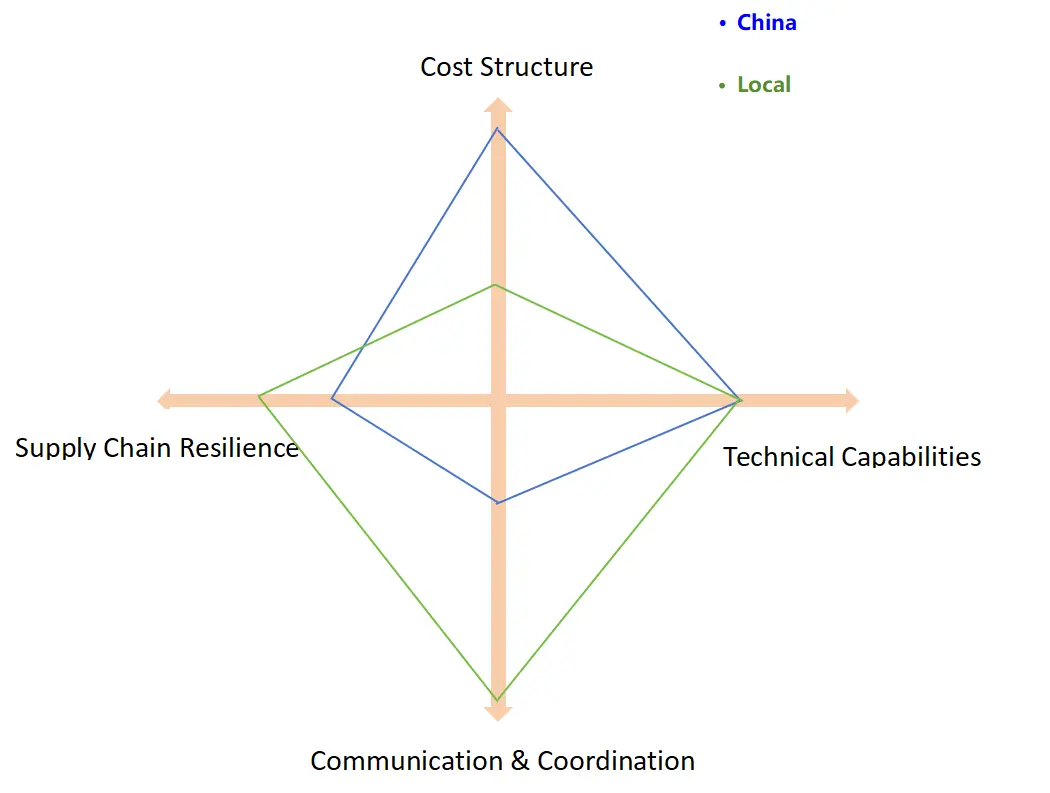
China–Local Competitiveness Radar

II. 3 Key Questions for Positioning
The process that each product undergoes from design to launch varies, but by answering the following three core questions, you can quickly determine the most suitable model for manufacturing the molds for your product:
1. How sensitive is the budget?
If the cost budget for your project is very limited and your team has sufficient energy and ability to manage a complex supply chain, then China molds are worth considering as a priority. However, you also need to clearly define the value of your product:
- If the profit margin of the product is limited or it requires extreme cost-effectiveness (such as consumer goods and daily necessities, consumer electronic cases and accessories, etc.) → Chinese suppliers
- If the product has high value and the failure cost is huge (such as implantable medical devices, automotive power and safety systems, aerospace engines, etc.) → Local manufacturers / Choose Chinese suppliers with caution
2. Product design maturity?
Technical maturity directly affects the frequency of mold modifications, which is also the key to the selection decision:
- Highly mature products (size fine-tuning, appearance optimization ≤ 2 times): Chinese molds have obvious advantages and can be directly selected.
- Frequent iterations (estimated modifications ≥ 5 times): Local molds or mixed mode are more suitable.
- Intermediate state (estimated modifications 3-4 times): Need to consider the advantages and disadvantages of each option in depth
3. Product launch time pressure?
The degree of time flexibility determines the requirements for logistics and communication efficiency:
- Flexible time (more than 8 weeks): Chinese molds are feasible, and phased delivery can be considered
- Urgent time (needs to be completed within 6 weeks): Local molds must be chosen or an urgent solution for Chinese molds (the supplier needs to break the production schedule plan, which may incur urgent costs, and the urgent costs and air freight costs need to be calculated and then compared with the local production costs to make a decision)
III. Implementing the Hybrid Approach
For many complex projects, a hybrid model may offer the optimal solution. Here are three verified hybrid collaboration schemes:
1. Technology Disassembly
- Core mold components and frame separation: The parts that determine the key quality of the product (appearance, precise fit) – such as the front and rear mold cores, sliders, inclined dies, etc. – are processed locally. The parts that do not directly contact the product and mainly serve as support, such as the frame, base plate, and pin plate, are processed in China. Finally, the final assembly and debugging are carried out locally or in the vicinity of the mass production factory. This way, the core precision is controlled, and the heavy cutting processing capabilities of low-cost regions are utilized.
- Process Disassembly: Rough processing, heat treatment are done in China; fine processing (high-speed milling, electrical discharge machining), polishing, assembly are done locally. Steel and standard parts are purchased globally, but the “value integration” is done locally.
2. Process Disassembly (“Stage Relay” Mode)
- First stage (design verification): Multiple rapid iterations are conducted locally using soft molds (such as aluminum molds) or 3D printing. All design details are frozen during this stage. This stage aims for speed, not mold lifespan.
- Second stage (process development): The frozen design data is sent to Chinese suppliers for mold design and process optimization at the production scale level (such as optimizing cooling waterways, exhaust design). They have rich experience in this area.
- Third stage (mold marking and trial run): Manufacturing is carried out according to the disassembly strategy, and the final trial and acceptance are conducted in the location close to the production site.
3. Supply Chain Disassembly
If mass production is set to take place in China, then having the molds produced locally is undoubtedly the most strategic, economical, and controllable option.
If the final mass production is carried out locally and there are multiple factories, the molds can be manufactured in China and then transported to Eastern Europe (such as the Czech Republic or Poland) for mold trial and initial production. Once the process is stable, the molds can be replicated to other regional factories. This takes advantage of the logistics and collaboration convenience within Europe.