

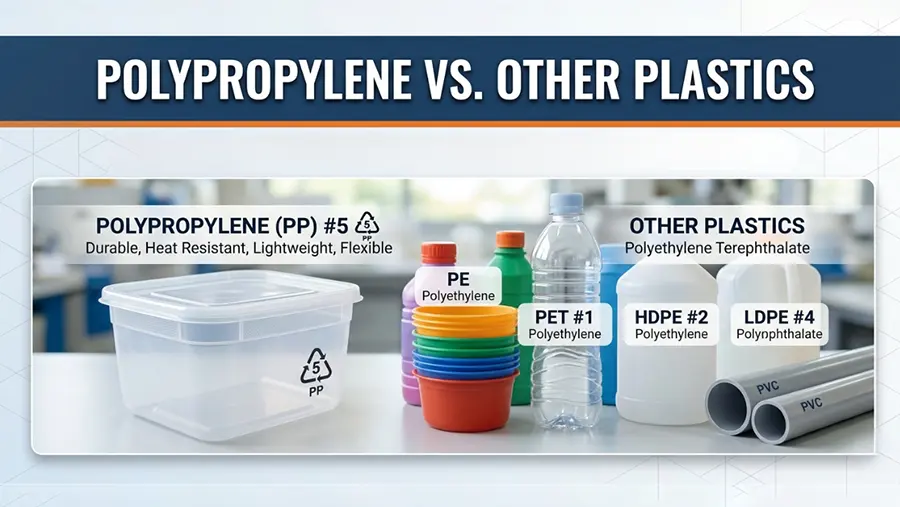

Choosing between polypropylene, ABS, PVC, nylon, and polyethylene can be an expensive decision in injection molding. For example, high material costs and heavy parts hurt your profit. You need a plastic that is light but strong enough for the job. Polypropylene is the best plastic for injection molding. This guide compares it to other plastics so you can choose the right one for your factory.
What Makes Polypropylene Different From Other Plastics?
Polypropylene is a plastic you likely see every day. People often call it PP for short. It is different from other plastics because it is one of the lightest plastics you can buy today.
PP is also a very safe choice for food. You will often see it used for yogurt cups and water bottles.
Heat Safe: It does not melt easily. You can use it in the microwave.
No Chemicals: It does not leak harmful chemicals into your food.
Strong: It works well with oily or acidic foods like lemon juice.
BPA-Free: Most PP containers do not contain BPA.
The Core Properties Of Polypropylene
Density
The first thing in polypropylene properties is the density. The density is about 0.90 grams per cubic centimeter. This means it is very light. So, it actually floats on water. Most other plastics will sink to the bottom. Because it is so light, you can make more parts from one kilogram of material. This helps you save money on raw materials.
Fatigue Resistance
Another big polypropylene property is fatigue resistance. This plastic can bend many times without breaking. Engineers use it to make living hinges. These are the small plastic parts on bottle caps that let you flip the lid open and shut. You can do this thousands of times and the plastic stays strong.
Chemical Resistance
The chemical resistance is also excellent. It does not react with most acids or bases. Therefore, it is a great choice for cleaning bottles or medical tools. The heat resistance is decent as well. It melts between 130 and 170 degrees Celsius. This is high enough for many industrial uses.
Low Melt Viscosity
Polypropylene melting point is 160 to 171 °C. The processing is easy. It has a low melt viscosity. This means it flows like water when it is hot. Therefore, it fills the mold very quickly. This leads to shorter cycle times in your machines. You make more parts in less time. This is how you win on production costs.
Two Grades of PP You Need to Know
There are two types of polypropylene plastics you should know about.
- Homopolymer
- Copolymer
Homopolymer
First, there is the Homopolymer. This is the most common grade. It is very stiff and strong. It is the best choice if your part needs to stay rigid and firm.
Copolymer
The second type is the Copolymer. This grade has a little bit of ethylene added to it. This makes the plastic softer but much tougher. It will not shatter if you drop it. This is very useful for parts used in cold weather. So, the reason you pick one over the other depends on your needs. Choosing the wrong grade will waste your money.
Polypropylene Properties vs Polyethylene
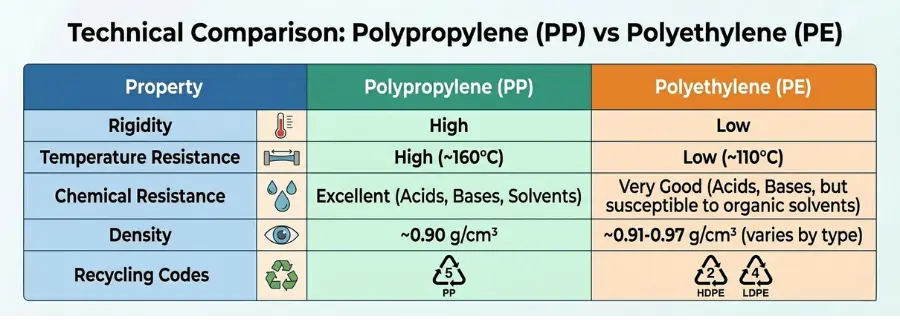

Polypropylene and Polyethylene are very similar. They are both from the polyolefin family. People get them confused all the time. But there are clear reasons to pick one over the other for your project.
Where PP Wins Over PE
Polypropylene is much stiffer than Polyethylene. If you make a plastic chair, Polypropylene will hold the weight better. It has higher tensile strength. This means it does not stretch or bend as easily under pressure.
Polypropylene plastic properties also handles heat much better than Polyethylene. Polyethylene gets soft at lower temperatures. If your part needs to go in a dishwasher or a microwave, you should choose Polypropylene.
Another win is the fatigue resistance. Polyethylene is not good for living hinges. If you bend it too much, it will turn white and then snap. But the problem is not there with Polypropylene. It stays strong even after much flexing.
Where PE Has the Advantage
But Polyethylene has its own strengths. First, it is often cheaper per pound. If you are making simple plastic bags or film, Polyethylene is the lower cost choice.
Second, it is much better in the cold. Polypropylene can get brittle when it is freezing. But Polyethylene stays flexible. This is why freezer bags and ice containers are made of Polyethylene.
Third, it is a better moisture barrier. If you need to keep water inside or outside a package, Polyethylene does a great job. Here, you must weigh the stiffness of PP against the flexibility of PE.
Polypropylene vs ABS
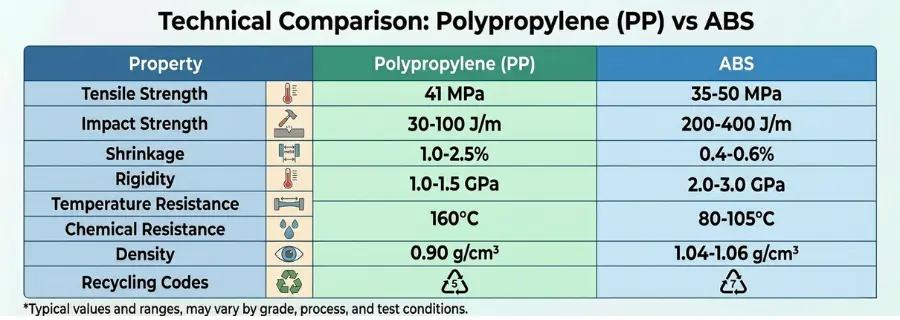
- ABS tensile strength is from 35 to 50 MPa.
- PP reaches a maximum of only 41 MPa
- ABS impact strength is 200 to 400 J/m
- ABS shrinkage is 0.4 to 0.6%
- PP shrinkage is 1.0 to 2.5%
Many people ask if they can switch from ABS to Polypropylene to save money.
Strength and Impact Resistance
ABS is much stronger than Polypropylene. It is very hard and has high impact resistance. If you hit an ABS part with a tool, it will likely not break. It is also very stable. This means it does not shrink much when it cools down. ABS parts come out of the mold with very exact sizes.
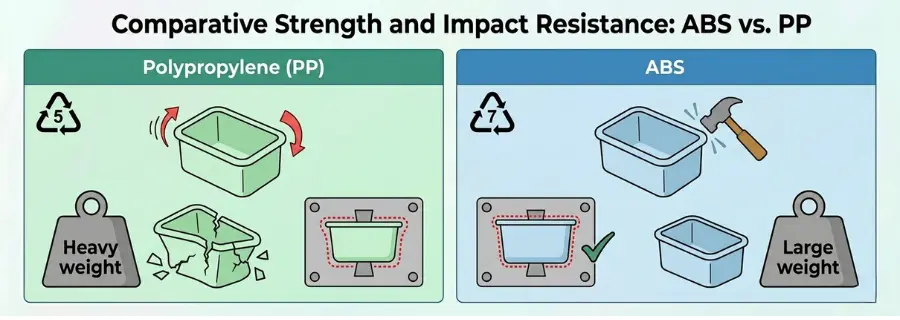
If you need a part with very tight tolerances, ABS is the winner. Polypropylene shrinks more as it cools. This can make it hard to get the size exactly right every time.
Cost and Processing
But Polypropylene wins on cost every time. It is much cheaper per kilogram than ABS. Because it is lighter, you also get more parts from each bag of plastic.
The processing is also faster. Polypropylene cools down quickly in the mold. You can often run your machines 10 to 20 percent faster. This saves you a lot of money on labor and energy.
Also, it needs less pressure in mold making. This means your expensive metal molds will last longer. There is less wear and tear on your equipment. Therefore, your total cost of ownership goes down.
This makes polypropylene ideal for injection molding, especially when producing high volumes of lightweight, durable parts.
When to Swap ABS for PP
You should swap ABS for Polypropylene when you want to reduce weight. This is very common in the car industry. If the part does not need to be super stiff, Polypropylene is fine.
You should also switch if the part will touch chemicals. ABS can crack when it touches some oils or cleaners. Polypropylene handles these much better.
Finally, swap if your production volume is very high. Even a small saving per part adds up to millions of dollars over time. But you must plan for the higher shrinkage rate of Polypropylene.
If you need help selecting the right material for your next project, contact our engineering team for a free consultation.
Polypropylene vs PVC
PVC is a very heavy and dense plastic. It is often used for pipes and window frames. Many people are now looking at Polypropylene as a replacement for PVC.
Weight and Cost Comparison
PVC has a density of about 1.38. Polypropylene has a density of 0.90. This is a huge difference. For the same size pipe, the PVC version will be much heavier.
The cost per kilogram is often similar. But because Polypropylene is lighter, you get more material for the same weight. So, the cost per part is almost always lower with Polypropylene.
Heavy parts also cost more to ship. You can fit more Polypropylene parts on a truck before you hit the weight limit. This lowers your carbon footprint and your shipping bills.
Where Each Material Belongs
PVC is still the best for fire resistance. It does not burn as easily as other plastics. It is great for electrical wires and underground pipes.
But Polypropylene is better for almost everything else. It is much safer to process. PVC can release dangerous gases if it gets too hot in the factory. Polypropylene does not have this problem.
It is also better for food and medicine. Polypropylene is FDA approved. PVC often contains chemicals called plasticizers that people worry about. Therefore, Polypropylene is the cleaner and safer choice for consumer goods.
Polypropylene vs Polystyrene
Polystyrene is the plastic used for foam cups and clear food trays. It is very cheap but it has some big problems.
Single-Use Cost vs Long-Term Value
Polystyrene is very brittle. If you squeeze a clear PS cup, it will shatter into sharp pieces. It has a very low cycle life. This means you can only use it once or twice.
Polypropylene is much more durable. You can drop it or step on it and it will not break. It has a much higher value because people can keep and reuse the containers.
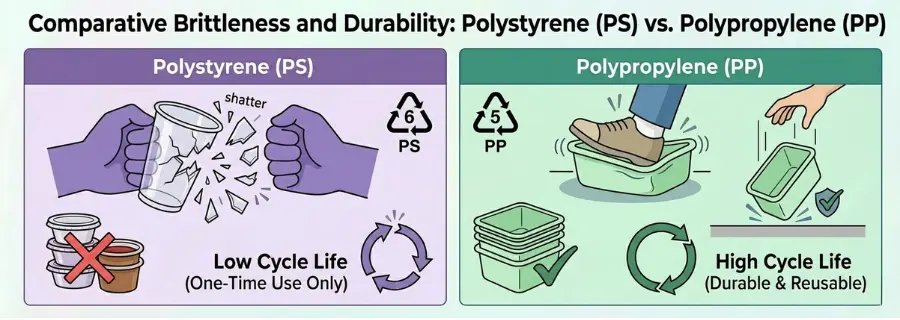
Also, Polypropylene can handle the heat. You can put it in the microwave. Polystyrene will melt or release a bad smell if it gets too hot. So, the reason people are switching to PP is for safety and quality.
Recyclability and Environmental Edge
The world is changing. By 2026, most companies must use plastics that are easy to recycle. Polypropylene is Resin Code number 5. It is widely recycled in most cities.
Polystyrene is Resin Code number 6. It is very hard to recycle. Most recycling centers do not want it. This makes Polypropylene a much better choice for the environment. It helps you follow new laws and keeps your brand looking good.
Polypropylene vs Nylon
Nylon is a high end plastic. It is used for gears and engine parts. It is very strong but it is also very expensive.
The Performance of Nylon
Nylon can handle very high temperatures. It also resists rubbing and wear better than almost any other plastic. If you need a gear that turns thousands of times, Nylon is the best choice.
But Nylon is heavy. It has a density of 1.14. It is also very expensive. It can cost three times more than Polypropylene.
Another problem is that Nylon absorbs water. When it gets wet, it grows. This can make your parts fit poorly.
Why PP Offers Better Cost Value
Polypropylene does not absorb water. Its size stays the same in any weather. It is also much lighter.
For parts that do not carry heavy loads, Polypropylene is much cheaper. It has excellent fatigue resistance for many industrial jobs. You can save a lot of money by using it for covers, housings, and simple connectors. Therefore, you should only pay for Nylon when the mechanical stress is very high.
PP vs All Major Plastics
This table helps you compare the numbers quickly. You can see how Polypropylene stacks up against the others.
| Plastic Type | Density (g/cm³) | Cost ($/kg) | Strength | Chemical Resistance | Recyclability |
| Polypropylene | 0.90 | Low | Moderate | Excellent | Good |
| Polyethylene | 0.95 | Lowest | Low | Good | Excellent |
| ABS Plastic | 1.05 | High | High | Moderate | Limited |
| PVC Plastic | 1.38 | Medium | Moderate | Good | Poor |
| Polystyrene | 1.05 | Low | Moderate | Poor | Poor |
| Nylon | 1.14 | Very High | Very High | Moderate | Limited |
Which Plastic Do You Actually Need?
Follow this simple plan to select the right plastic.
Choose PP When…
First, choose it when weight is your main concern. If you need to make a light car, Polypropylene is a good choice.
Second, choose PP for any part that needs to bend. If you have a cap with a hinge, you must use Polypropylene.
Third, PP is good for high volume production. If you are making millions of parts, the fast cycle times will save you a fortune.
Fourth, you can incorporate Polyethylene for food and medical use. It is safe and does not react with chemicals.
Choose an Alternative When…
But you should choose a different plastic sometimes. Choose ABS if your part needs to be very stiff and have an exact size. Choose Nylon if you are making gears that get very hot and carry heavy loads.
Choose Polyethylene if the part will live in a freezer. Choose PVC only if you need very high fire resistance or for underground pipes.
Finally, choose Polystyrene only if you need the absolute lowest price for a part that will be thrown away immediately. But remember that this choice might hurt your brand because it is hard to recycle.
The 3-Question Test Before You Spec a Plastic
Ask yourself these three things.
First, does the part need to resist chemicals or water? If yes, Polypropylene is a top choice.
Second, does the part carry a heavy structural load? If yes, you should look at ABS or Nylon instead.
Third, is your biggest problem the weight or the cost? If yes, Polypropylene is the best solution for both.
Summary
Polypropylene is the best choice for many jobs. It solves the problem of high cost and heavy weight. It is strong, safe, and easy to recycle. While PP is not perfect for every job, it wins on value most of the time. Use this guide to make a smart choice for your next project.
If you have any question, we select the best material for injection molding, RJC provides professional level injection molding services in China.
Frequently Asked Questions
Is Polypropylene cheaper than ABS or PVC?
Yes, it usually is. PP is much cheaper than ABS. It is similar to PVC in price per kilogram, but you get more parts because it is lighter.
What plastic weighs the least for packaging?
Polypropylene is the lightest solid plastic. Only foam materials are lighter, but they are not as strong.
Why is Polypropylene used in automotive parts?
It is used because it is very light. This helps car companies meet fuel rules. It is also cheap and resists oil and salt.
Can Polypropylene replace ABS in injection molding?
In many cases, yes. It is cheaper and faster to mold. But you must adjust your mold for the higher shrinkage rate.
Is Polypropylene better for the environment than PVC?
Yes. It is easier to recycle. It also does not release toxic gases when it is made or burned.
Does Polypropylene cost less than Nylon?
Yes, it costs much less. Nylon can be three or four times more expensive. Polypropylene is the better choice for non-load bearing parts.