


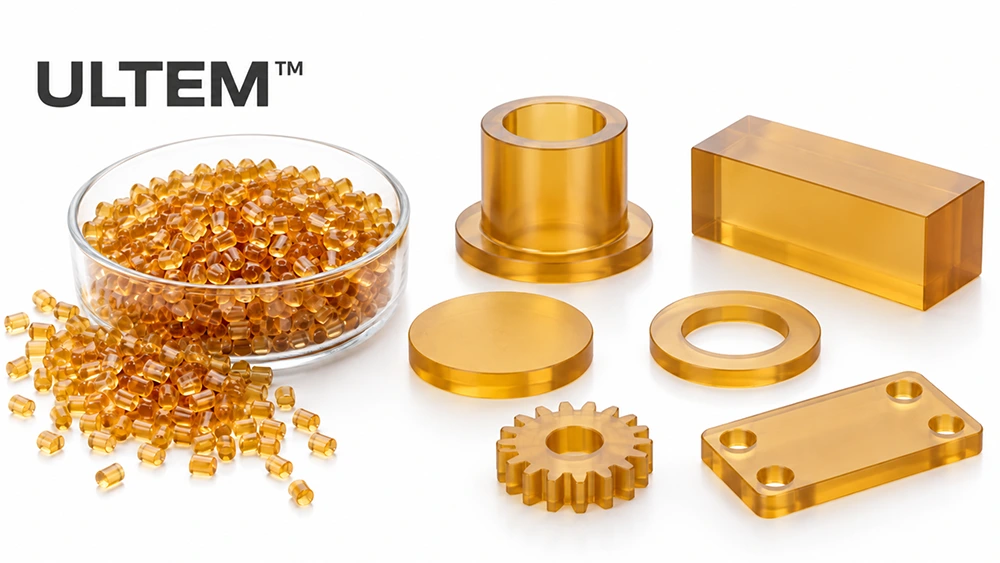
Ultem is a high-performance polyetherimide (PEI) engineering thermoplastic known for its excellent heat resistance, mechanical strength, flame retardancy, and dimensional stability. It is widely used in aerospace, medical, and electrical and electronic applications. This article covers Ultem’s key properties, common grades, applications, and processing methods, along with a comparison with PEEK and PPS.
1. What Is Ultem?
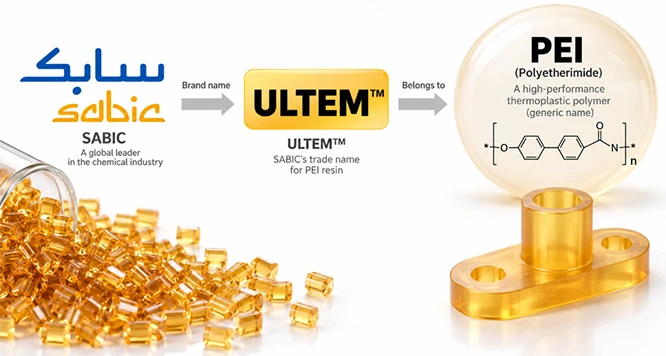
Ultem is a high-performance thermoplastic brand owned by SABIC and belongs to the polyetherimide (PEI) family.
PEI is an amorphous engineering thermoplastic known for its heat resistance, high strength, and excellent electrical insulation properties. ULTEM™ is SABIC’s commercial brand name, while PEI is the generic name for this class of polymers.

2. Key Properties of Ultem
Ultem’s key advantages come from its heat-resistant, amorphous polymer structure, which allows it to retain good mechanical and electrical properties even at elevated temperatures.
Heat Resistance
Ultem 1000 has a glass transition temperature of approximately 217°C and a UL Relative Thermal Index (RTI) of up to 170°C, making it suitable for parts requiring long-term heat resistance.
Mechanical Strength and Rigidity
Ultem 1000 has a tensile yield strength of approximately 110 MPa and a flexural modulus of around 3.3 GPa, allowing it to withstand structural loads.
Flame Retardancy
Ultem is inherently flame-retardant. Ultem 1000 achieves a UL 94 V-0 rating at a thickness of 0.75 mm.
Dimensional Stability
Its relatively low coefficient of thermal expansion and controlled molding shrinkage help maintain part accuracy, although moisture absorption and temperature changes still need to be considered.
Electrical Insulation
Ultem offers high volume resistivity and good dielectric properties, maintaining reliable electrical insulation even at elevated temperatures.
Chemical Resistance
Ultem resists certain oils and common chemicals but is sensitive to some organic solvents, particularly when chemical exposure is combined with mechanical stress.


Typical Properties of Ultem 1000
| Property | Typical Value | Test Standard or Conditions |
| Density | 1.27 g/cm³ | ISO 1183 |
| Tensile Yield Strength | 110 MPa | ISO 527, 50 mm/min |
| Tensile Modulus | 3,200 MPa | ISO 527, 1 mm/min |
| Flexural Modulus | 3,300 MPa | ISO 178, 2 mm/min |
| Glass Transition Temperature | Approx. 217°C | SABIC product specifications |
| Heat Deflection Temperature | 192°C | ISO 75, 1.8 MPa |
| Coefficient of Linear Thermal Expansion | 52 × 10⁻⁶/K | ISO 11359-2, −40 to 150°C |
| Flammability Rating | UL 94 V-0 | 0.75 mm thickness |
| Electrical RTI | 170°C | UL 746B |
Source: SABIC official Ultem 1000 technical data. These are typical material values. Actual part performance may vary depending on molding conditions, part geometry, and operating environment.
3. Common Ultem Grades
Ultem is available in various unfilled and reinforced grades, with differences in flowability, strength, and heat resistance.
| Grade | Type | Tensile Modulus (MPa) | MVR (cm³/10 min) | Key Characteristics |
| Ultem 1000 | Unfilled | 3,200 | 13 | General-purpose grade with balanced properties |
| Ultem 1010 | Unfilled | 3,200 | 25 | Higher melt flowability |
| Ultem 2300 | 30% Glass-Fiber Reinforced | 10,500 | 6 | High rigidity and low shrinkage |
| Ultem 9085 | Modified PEI Blend | 2,850 | — | Good toughness, suitable for specific aerospace and additive manufacturing requirements |
Note: Tensile modulus values are measured according to ISO 527 (1 mm/min), while melt volume-flow rate (MVR) values are measured according to ISO 1133 (360°C / 5 kg). Ultem 9085 is excluded from the MVR comparison because its test conditions differ.
4. Main Limitations of Ultem
Higher Material Cost: Ultem is generally significantly more expensive than commodity plastics such as ABS and PP. Actual costs vary depending on the material grade, order quantity, and supply channel.
Limited Chemical Resistance: Acetone, toluene, and certain halogenated hydrocarbons can cause swelling, dissolution, or stress cracking.
High Processing Temperatures: Ultem 1000 requires a recommended injection molding melt temperature of 350–410°C and a mold temperature of 135–180°C, demanding high-temperature processing equipment and precise temperature control.
Risk of Stress Cracking: Cracks may develop when residual stress, mechanical loads, and incompatible chemicals act together.
5. Ultem vs. PEEK vs. PPS
Ultem, PEEK, and PPS are all high-performance engineering thermoplastics, but each offers different advantages in heat resistance, chemical resistance, mechanical properties, and cost.
| Property | Ultem (PEI) | PEEK | PPS |
| Polymer Structure | Amorphous | Semi-crystalline | Semi-crystalline |
| Glass Transition Temperature | 217°C | 143°C | Approx. 90°C |
| Heat Resistance | ★★★★ | ★★★★★ | ★★★★ |
| Mechanical Strength | ★★★★ | ★★★★★ | ★★★★ |
| Chemical Resistance | ★★★ | ★★★★★ | ★★★★★ |
| Dimensional Stability | ★★★★★ | ★★★★★ | ★★★★★ |
| Electrical Insulation | ★★★★★ | ★★★★★ | ★★★★ |
| Relative Material Cost | $$$$ | $$$$$ | $$$ |
Note: This comparison reflects the general characteristics of common material grades. Ultem is represented by grade 1000, PEEK by Victrex 450G, and PPS by the general material category.
6. Typical Applications of Ultem
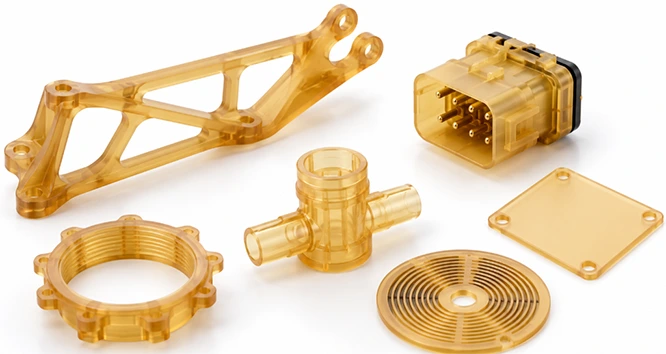
Aerospace: Aircraft interior components, electrical connectors, and lightweight structural parts.
For example, aircraft seat brackets made from specific Ultem grades can benefit from the material’s flame retardancy and high strength, helping reduce weight while meeting relevant safety requirements.
Medical Equipment: Reusable sterilizable medical instrument components, equipment housings, and structural parts.
Electrical and Electronics: High-temperature connectors, insulating components, and coil bobbins.
For example, high-temperature electrical connectors benefit from Ultem’s electrical insulation and dimensional stability, helping maintain reliable electrical connections at elevated operating temperatures.
Automotive: Electrical system components and structural parts exposed to high-temperature environments.
Industrial Equipment: Insulating brackets, precision mechanical parts, and heat-resistant functional components.

7. How Is Ultem Processed?
Injection Molding
Injection molding is suitable for producing complex parts and high-volume quantities. However, Ultem’s high processing temperatures place greater demands on equipment and process control. For Ultem 1000, the recommended melt temperature is 350–410°C, with mold temperatures ranging from 135°C to 180°C. The material must also be thoroughly dried before processing to minimize moisture-related degradation and molding defects.
CNC Machining
CNC machining typically uses Ultem sheets and rods and is suitable for functional prototypes, low-volume production, and high-precision parts. Cutting heat, clamping forces, and residual stresses must be carefully controlled to prevent deformation or cracking.
3D Printing
Ultem 9085 and certain Ultem 1010 materials can be processed using high-temperature FDM/FFF 3D printing, making them suitable for functional prototypes and complex components.
Due to the material’s high processing temperature, high-temperature nozzles, heated build chambers, and stable temperature control are generally required to minimize warping and poor interlayer bonding.
FAQs
Q1: Is Ultem Always the Best Choice for High-Temperature Parts?
Not necessarily. Ultem is well suited for applications requiring heat resistance, electrical insulation, and flame retardancy. However, PEEK or PPS may be better options in highly corrosive environments, high-wear applications, or conditions involving higher continuous operating temperatures.
Q2: Why Does Ultem Typically Have an Amber Color?
Natural, uncolored Ultem 1000 has a transparent amber appearance due to its polymer molecular structure. This is an inherent optical characteristic and does not mean it performs better than other colors. Ultem is also available in black and other colored grades.
Q3: What Are the Common Problems When Manufacturing Ultem Parts?
Common issues include insufficient material drying, melt degradation, molding deformation, and residual stress cracking.
Q4: What Should Engineers Consider Before Choosing Ultem?
Key factors include continuous operating temperature, mechanical loads, chemical exposure, flame-retardancy requirements, dimensional tolerances, and production volume. The appropriate material grade should be selected based on these requirements.
Q5: Can Ultem Replace Metal Parts?
Yes. Ultem can replace metals such as aluminum in certain lightweight structural components, electrical insulation parts, and corrosion-resistant applications. However, its stiffness, thermal conductivity, and long-term creep behavior differ from those of metals, so structural design and performance testing are necessary to confirm suitability.