


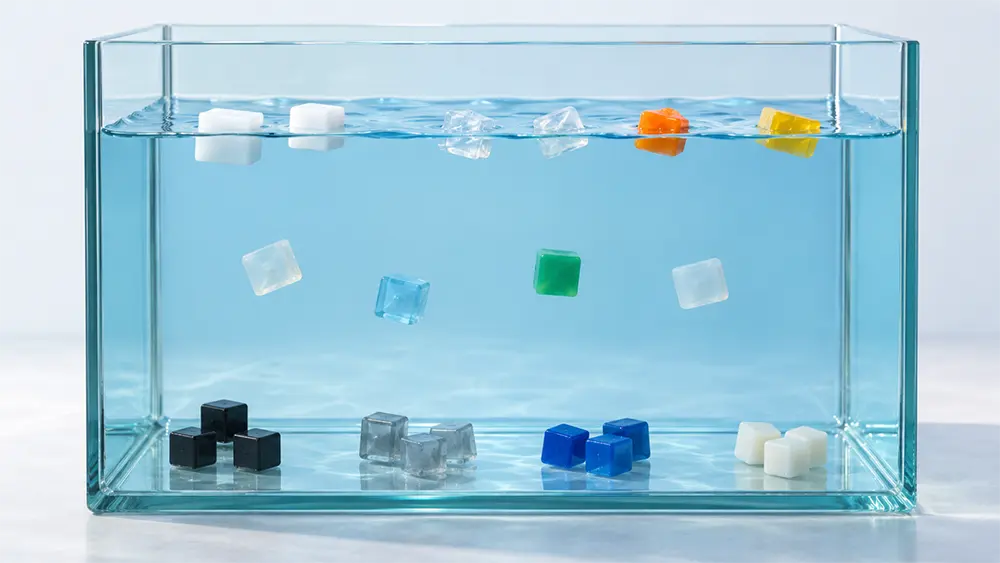
Plastic density is one of the most fundamental physical properties used to compare different plastic materials. It also directly affects part weight, material consumption, and manufacturing cost. Different resins, fillers, and modification methods can all cause variations in density.
This article introduces the basic concept of plastic density, typical density ranges of common materials, the main factors that affect density, and common testing methods. It also explains how density is applied in actual manufacturing.
1. What Is Plastic Density?
Plastic density refers to the mass of a plastic per unit volume. It is typically represented by the Greek letter ρ and calculated using the following formula:
ρ = m / V
Where: ρ = density, m = mass, V = volume
The most common units used for plastic density are g/cm³ and kg/m³, where: 1 g/cm³ = 1000 kg/m³
Different plastics have different molecular compositions and internal structures. Molecular arrangement, crystallinity, fillers, and additives can also change the final density of a material.
2. Density Chart of Common Plastics
The table below lists typical density ranges for plastic materials commonly used in manufacturing.
| Material | Abbreviation | Density Range (g/cm³) | Density Range (kg/m³) | Notes |
| Polypropylene | PP | 0.90–0.91 | 900–910 | Common lightweight plastic |
| Low-Density Polyethylene | LDPE | 0.917–0.940 | 917–940 | Flexible and relatively low in density |
| High-Density Polyethylene | HDPE | 0.94–0.97 | 940–970 | Higher density than LDPE |
| Acrylonitrile Butadiene Styrene | ABS | 1.03–1.08 | 1030–1080 | Density can vary noticeably by grade |
| Polystyrene | PS | 1.04–1.05 | 1040–1050 | Refers to standard unfilled PS |
| Polymethyl Methacrylate | PMMA | 1.17–1.20 | 1170–1200 | Commonly known as acrylic |
| Polycarbonate | PC | 1.19–1.22 | 1190–1220 | Common transparent engineering plastic |
| Nylon 6 | PA6 | 1.12–1.14 | 1120–1140 | Density can be affected by moisture content |
| Nylon 66 | PA66 | 1.13–1.15 | 1130–1150 | Unreinforced grade |
| Polyoxymethylene | POM | 1.41–1.42 | 1410–1420 | Relatively high density |
| Polyethylene Terephthalate | PET | 1.30–1.40 | 1300–1400 | Strongly affected by crystallinity |
| Polybutylene Terephthalate | PBT | 1.30–1.40 | 1300–1400 | Common engineering plastic |
| Polyvinyl Chloride | PVC | 1.35–1.50 | 1350–1500 | Mainly refers to rigid PVC |
| Thermoplastic Polyurethane | TPU | 1.10–1.25 | 1100–1250 | Strongly influenced by formulation and hardness |
| Thermoplastic Elastomer | TPE | 0.89–1.20 | 890–1200 | Varies widely among different TPE families |
| Polyether Ether Ketone | PEEK | 1.26–1.32 | 1260–1320 | High-performance engineering plastic |
| Polyphenylene Sulfide | PPS | Approx. 1.35 | Approx. 1350 | Density increases significantly with fillers |
| Polytetrafluoroethylene | PTFE | 2.10–2.20 | 2100–2200 | One of the denser common plastics |
| PC/ABS Alloy | PC/ABS | 1.10–1.15 | 1100–1150 | Depends on blend ratio and grade |
| 30% Glass-Fiber-Reinforced Nylon 66 | PA66-GF30 | Approx. 1.37 | Approx. 1370 | Significantly denser than standard PA66 |
These values are suitable for material comparison and preliminary calculations. For actual design and production, the technical data sheet of the specific material grade should be used. Formulation, filler content, and modification methods can all affect density.
3. Why Do Different Plastics Have Different Densities?
1) Polymer Molecular Structure
Plastics are made from different polymer molecules. Their chemical composition, chain structure, and how closely the molecules are packed all affect the amount of mass contained within a given volume.
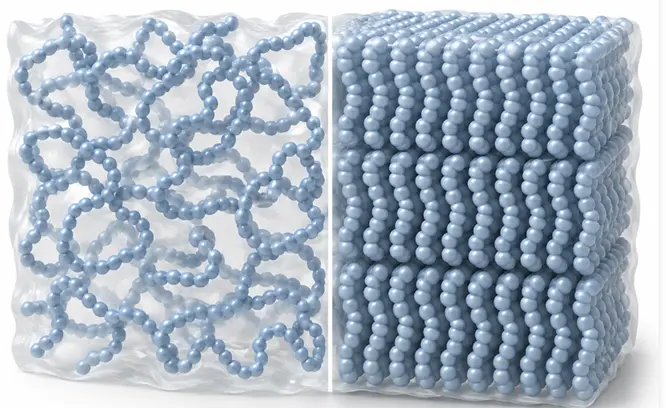
2) Crystallinity
When polymer molecules are arranged more regularly, they can generally form more tightly packed crystalline regions. For the same semi-crystalline plastic, changes in crystallinity may result in changes in density.

3) Fillers and Reinforcements
Glass fibers, mineral fillers, and other reinforcing materials can change the overall density of a plastic.
For example, standard PA66 typically has a density of about 1.13–1.15 g/cm³. With approximately 30% glass fiber added, PA66-GF30 can reach around 1.37 g/cm³.
4) Additives
Flame retardants, plasticizers, pigments, impact modifiers, and other additives alter the material formulation. Different additive types and loading levels can cause density to vary even among grades based on the same resin.
PVC is a typical example. Rigid PVC, plasticized PVC, and filled PVC can have noticeably different density ranges.
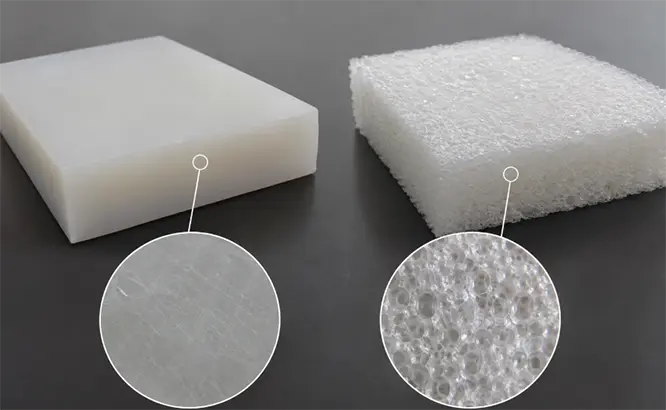
5) Foamed Structure
Foamed plastics contain large numbers of gas cells or microvoids. Since less polymer is present within a given volume, the apparent density is reduced.
In general, a higher foaming ratio leads to a lower apparent density. For these materials, density should be evaluated together with the specific foaming process and the structure of the finished part.

4. What Is the Difference Between Plastic Density and Specific Gravity?
Density is the ratio of mass to volume and has a defined unit.
Specific gravity, also known as relative density, is the ratio of a material’s density to the density of a reference substance and has no unit. For solid plastics, water is commonly used as the reference.
At room temperature, the density of water is close to 1 g/cm³, so the numerical value of a plastic’s density in g/cm³ is often very close to its specific gravity. For example, a plastic with a density of about 1.20 g/cm³ will typically have a specific gravity close to 1.20.
5. How Is Plastic Density Measured?
1) Immersion Method
The immersion method is commonly used to measure the density of solid plastics and is based on Archimedes’ principle.
The sample is first weighed in air and then fully immersed in a liquid of known density and weighed again. The two measurements are used to calculate the sample volume and density.
This method is suitable for solid plastic sheets, rods, injection-molded parts, extruded parts, and similar samples without significant internal voids.
2) Common Testing Standards
Common standards include:
ASTM D792-20: Determines the density and specific gravity of solid plastics using a displacement method. Water or another suitable liquid may be used.
ISO 1183-1:2025: Applies to non-cellular plastics and includes the immersion method, liquid pycnometer method, and titration method.
The appropriate method should be selected based on sample form, whether the material absorbs moisture, and whether the test liquid may react with the plastic.
6. How Does Plastic Density Affect Manufacturing?
In manufacturing, density is mainly used for weight, material consumption, and cost calculations. Whether a part is produced by injection molding, CNC machining, extrusion, or thermoforming, density can be used to convert material volume into mass once the volume is known.


1) Estimating Part Weight and Material Consumption
When the volume of a CAD model is known, the weight of a plastic part can be estimated quickly:
Part Weight = Part Volume × Material Density
For example, for the same 100 cm³ part, PP at 0.90 g/cm³ gives a theoretical weight of about 90 g.
Using ABS at 1.05 g/cm³ increases the theoretical weight to about 105 g. As production volume increases, this difference directly affects total material consumption.
2) Estimating Manufacturing Cost
Plastic raw materials are generally purchased by weight, while CAD models provide part volume. Density connects the two:
Material Cost ≈ Part Volume × Material Density × Material Price
Actual production also requires allowance for reasonable process losses. Injection molding may involve runners and sprues, while CNC machining requires consideration of stock size and the amount of material removed during machining.
3) Converting Material Weight and Volume in Different Manufacturing Processes
This conversion is useful across a range of manufacturing processes.
In injection molding, cavity volume and material density can be used to estimate part weight, total plastic weight per mold cycle, and the required shot size.
In extrusion, density helps calculate the theoretical weight per meter of pipes, profiles, or rods.
In CNC machining, the volume of plastic sheet or rod stock can be used to estimate blank weight, while the finished-part volume can help estimate how much material will be removed.
For thermoformed sheets, sheet area, thickness, and material density can be used to estimate sheet weight and material requirements.
4) Lightweight Design and Material Comparison
In weight-sensitive products such as automotive components, consumer electronics, and robotics, material density is an important consideration in lightweight design. For the same part volume, a lower-density plastic can directly reduce part weight.
Density alone, however, is not enough to determine the lightest practical design. Strength, stiffness, and allowable wall thickness also need to be considered. Some reinforced plastics have a higher density, yet they may still reduce the final part weight by allowing thinner walls or fewer reinforcing features.
5) Density Changes in Filled and Reinforced Plastics
In manufacturing, it is important to distinguish between base resins and reinforced grades.
Take PA66 as an example. Standard PA66 has a density of about 1.13–1.15 g/cm³, while PA66-GF30 can reach approximately 1.37 g/cm³. If the same CAD volume is still calculated using the density of unreinforced PA66, both the estimated part weight and actual material requirement will be understated.
For quoting, material purchasing, and production planning, using the density of the specific material grade provides a more reliable result.
Plastic Density Application Example
In one structural component project, the customer wanted to further reduce product weight. After evaluating the part’s mechanical strength, stiffness, service temperature, and dimensional stability, we recommended changing the original material from PBT-GF30 to PP-GF30.
The original PBT-GF30 had a density of approximately 1.52 g/cm³. With a net CAD volume of 120 cm³, the theoretical part weight was: 120 × 1.52 = 182.4 g
After switching to PP-GF30 with a density of approximately 1.13 g/cm³, the theoretical weight at the same volume dropped to: 120 × 1.13 = 135.6 g
This reduced the weight of each part by about 46.8 g, or approximately 25.7%. The project ultimately produced 10,000 parts, reducing the total net product weight by about 468 kg. Material consumption was also reduced, along with packaging, storage, and transportation weight and costs.


FAQ
Q1: Does plastic density change with temperature?
Yes. Plastics generally expand as temperature rises, increasing in volume and causing density to decrease.
Q2: Does the color of a plastic affect its density?
It can. Pigments, color masterbatches, and other additives alter the material composition, although the density change caused by ordinary coloring is usually small.
Q3: Does a higher glass fiber content increase plastic density?
Generally, yes. Glass fiber is denser than most base resins, so increasing the glass fiber content usually raises the overall density of the composite.
Q4: Do plastic pellets and molded parts have the same density?
The true material density is generally similar, but the bulk density of plastic pellets is lower because air gaps exist between the pellets.
Q5: Why does the same type of plastic have different density values from different suppliers?
The main reasons are differences in material grade, filler content, flame-retardant systems, plasticizers, and other modifiers. For actual applications, the data sheet for the specific grade should be used.