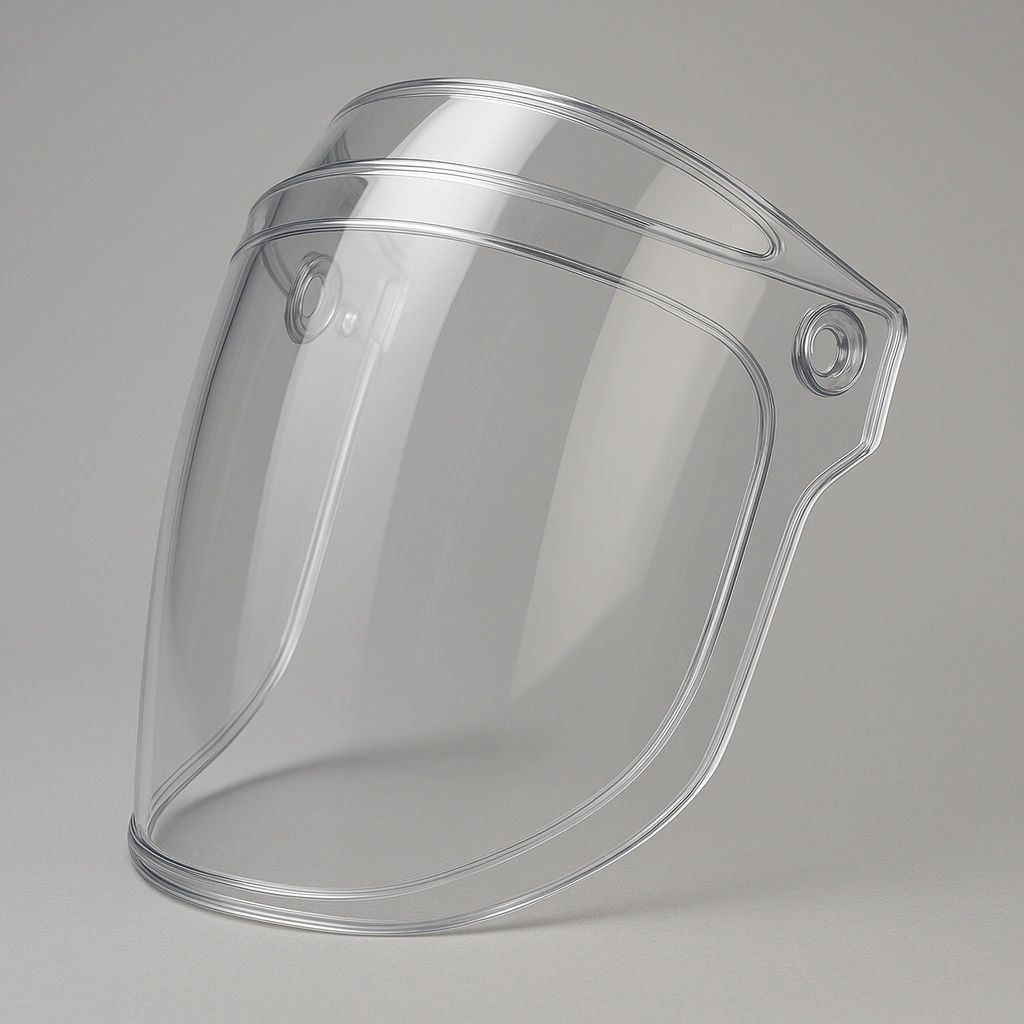
Our Polycarbonate Injection Molding Capabilities
From impact-resistant safety shields to precision optical components, we deliver PC molding solutions tailored to your industry’s performance requirements.
Product Design Support
- DFM analysis for high-strength transparent parts
- Guidance on wall thickness for impact absorption and clarity balance
- Selection of PC grades with UV, flame-retardant, or glass-fiber reinforcement
Mold Design & Manufacturing
- High-polish mold finishes for optical surfaces
- Flow and cooling optimization to prevent stress marks and warping
- Venting design to avoid bubbles and surface defects
Plastic Injection Molding
- Tight tolerance molding (±0.03 mm) for critical assemblies
- Controlled drying and melt temperature for clarity and toughness
- Overmolding with TPE, ABS, or other compatible materials
Post-processing & Assembly
- Optical polishing for clarity enhancement
- Anti-scratch, anti-fog, or UV-protective coatings
- Assembly and packaging for safety or medical standards
What is PC – Polycarbonate
Polycarbonate (PC) is a high-strength, transparent thermoplastic known for its excellent impact resistance and dimensional stability. It can withstand higher mechanical loads than many common plastics while maintaining clarity, making it ideal for electronic housings, protective covers, optical components, and automotive parts. PC can be processed through injection molding or CNC machining. Careful temperature control, drying, and mold design are important to maintain optical clarity, surface quality, and dimensional accuracy.
| Property | Typical Value / Description | Notes |
|---|---|---|
| Tensile Strength | 60–70 MPa | High strength, suitable for load-bearing components; tested at 23°C with standard specimens |
| Flexural Strength | 90–110 MPa | Strong enough for structural parts |
| Impact Strength (Notched/Unnotched) | 600–800 J/m | Excellent impact resistance; resists drops and shocks |
| Elastic Modulus | 2.2–2.4 GPa | Provides good rigidity |
| Heat Deflection Temperature | 130–140°C | Can tolerate moderately high temperatures; UV exposure may affect long-term stability |
| Density | 1.20 g/cm³ | Lightweight yet strong |
| Chemical Resistance | Moderate; resistant to water and alcohol, but susceptible to ketones and strong acids | Avoid harsh solvents |
| Water Absorption | 0.15–0.25% | Dry before processing to prevent bubbles and surface defects |
| Shrinkage | 0.4–0.7% | Mold design must consider shrinkage to maintain optical and dimensional quality |
| Flammability | UL94 V-2 | Moderate flame resistance; can be improved with additives |
Common Applications of Polycarbonate Molded Parts
| Industry | Example Parts | Why PC Works Well |
|---|---|---|
| Automotive | Headlight covers, sunroof panels | High impact resistance, thermal stability |
| Electronics | Protective covers, connector housings | Dimensional accuracy, flame retardancy options |
| Safety Equipment | Helmet visors, face shields | Impact absorption, optical-grade transparency |
| Industrial | Machine guards, transparent enclosures | Shatter resistance, long-term durability |
Production & Delivery Solutions
| Solution Type | Best For | Typical Lead Time | Notes |
|---|---|---|---|
| Rapid Prototyping | Functional testing & design validation | 7–12 days | Low-volume mold setup for quick trials |
| Small Batch | Pre-production and market testing | 2–3 weeks | Cost-efficient for short runs |
| Mass Production | Consistent large-scale supply | 3–5 weeks | Optimized for performance and finish quality |
| Export Molds | Overseas production of PC parts | 4–6 weeks | Meets international optical & strength specs |
Polycarbonate Injection Molding FAQs
PMMA offers better clarity and scratch resistance than PC, but lower impact strength. For higher impact requirements, impact-modified PMMA can be used.
Certain grades are FDA-compliant and safe for food-contact applications—material certification is available upon request.