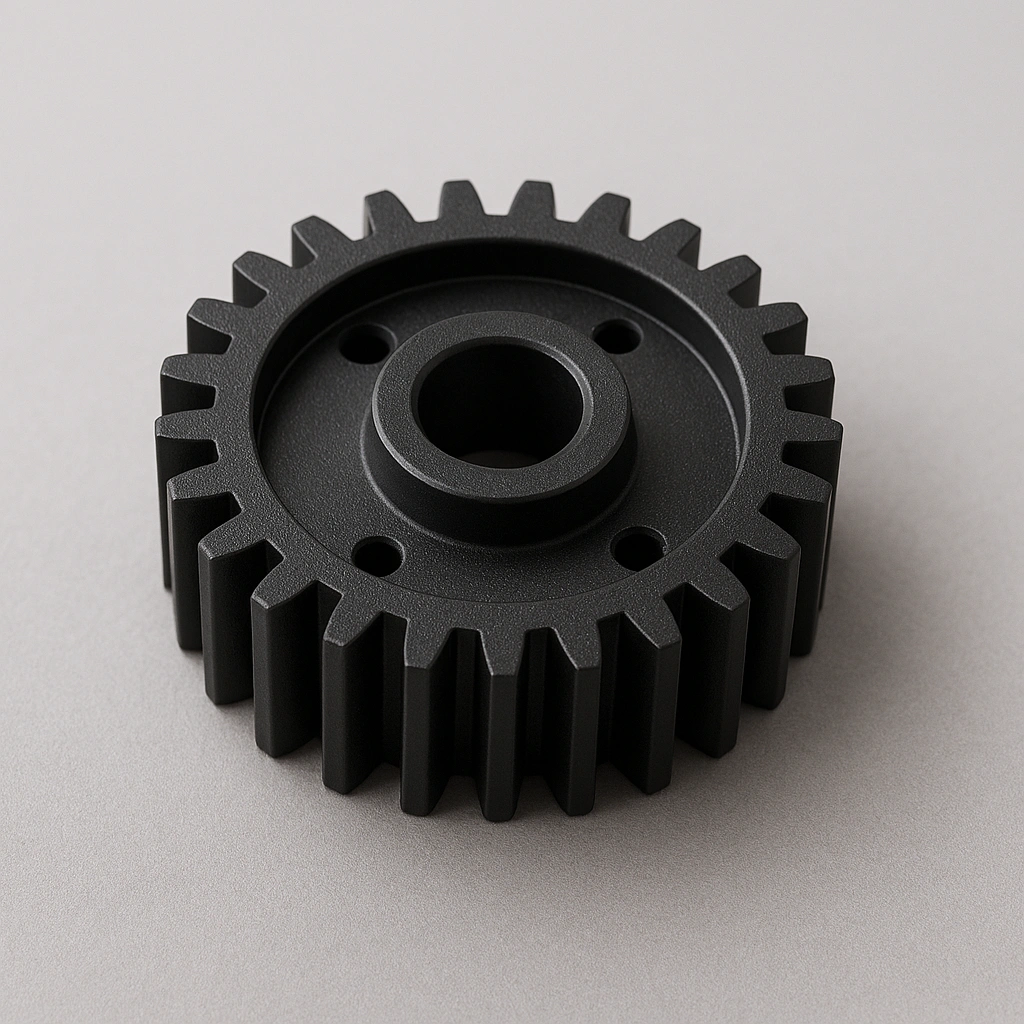
Our POM Injection Molding Capabilities
From design validation to mass production, we help you create precision POM components that meet strict quality standards.
Product Design Support
- DFM review with focus on shrinkage control and dimensional accuracy
- Grade selection including homopolymer and copolymer POM
- Structural optimization to minimize warping and creep
Mold Design & Manufacturing
- Hardened steel molds for high-cycle production
- Specialized gating for uniform filling and reduced sink marks
- Domestic and export mold solutions available
Plastic Injection Molding
- Precision tolerances down to ±0.02 mm
- Machine capacity 50T – 1000T for small-to-medium components
- Single-shot and multi-component molding
Post-processing & Assembly
- CNC machining for ultra-precise finishes
- Polishing, tumbling, and laser marking
- Component assembly and custom packaging
What is POM – Polyoxymethylene (Acetal)
Polyoxymethylene (POM), also known as Acetal, is a high-strength, stiff, and wear-resistant engineering thermoplastic. It offers excellent dimensional stability, low friction, and good chemical resistance, making it ideal for precision mechanical components such as gears, bearings, fasteners, and automotive parts. POM can be processed through injection molding or CNC machining. Proper drying, mold design, and processing control are essential to prevent warping and maintain dimensional accuracy.
| Property | Typical Value / Description | Notes |
|---|---|---|
| Tensile Strength | 60–70 MPa | High strength suitable for mechanical components; tested at 23°C |
| Flexural Strength | 90–110 MPa | Provides rigidity for structural and moving parts |
| Impact Strength (Notched/Unnotched) | 40–60 J/m | Good toughness; copolymer grades improve impact resistance |
| Elastic Modulus | 2.8–3.0 GPa | Stiff material with good dimensional stability |
| Heat Deflection Temperature | 110–120°C | Suitable for moderate temperature applications |
| Density | 1.41 g/cm³ | Moderate density, stable under load |
| Chemical Resistance | Excellent; resistant to most solvents, fuels, and weak acids/bases | Avoid strong oxidizers or strong acids |
| Water Absorption | 0.2–0.5% | Low, ensures dimensional stability |
| Shrinkage | 1.0–2.0% | Mold design must account for shrinkage and uniform wall thickness |
| Flammability | UL94 HB | General flame resistance |
Common Applications of POM Molded Parts
| Industry | Example Parts | Why POM Works Well |
|---|---|---|
| Automotive | Gears, fuel system components | Low friction, wear resistance |
| Consumer Electronics | Keyboard mechanisms, precision connectors | Dimensional stability, smooth movement |
| Industrial Machinery | Bearings, cams, conveyor parts | High stiffness, fatigue resistance |
| Household Appliances | Door latches, water pump parts | Moisture resistance, consistent performance |
Production & Delivery Solutions
| Solution Type | Best For | Typical Lead Time | Notes |
|---|---|---|---|
| Rapid Prototyping | Functional test parts | 5–10 days | Low-volume, quick turnaround |
| Small Batch | Pre-production validation | 2–3 weeks | Flexible volumes, cost-effective |
| Mass Production | Long-term supply | 3–5 weeks | Optimized for consistency |
| Export Molds | Overseas manufacturing | 4–6 weeks | Compatible with global molding standards |
POM Injection Molding FAQs
Homopolymer offers slightly higher strength and stiffness, while copolymer has better chemical and thermal stability. Selection depends on application requirements.
Prototype orders typically take 5–10 days; mass production 3–5 weeks depending on complexity.
Yes, POM’s naturally low coefficient of friction makes it suitable for dry-running applications.
Standard POM can degrade under UV exposure, but UV-stabilized grades are available.
Absolutely, we regularly mold POM gears, cams, and moving parts with tight tolerances and fine surface finishes.