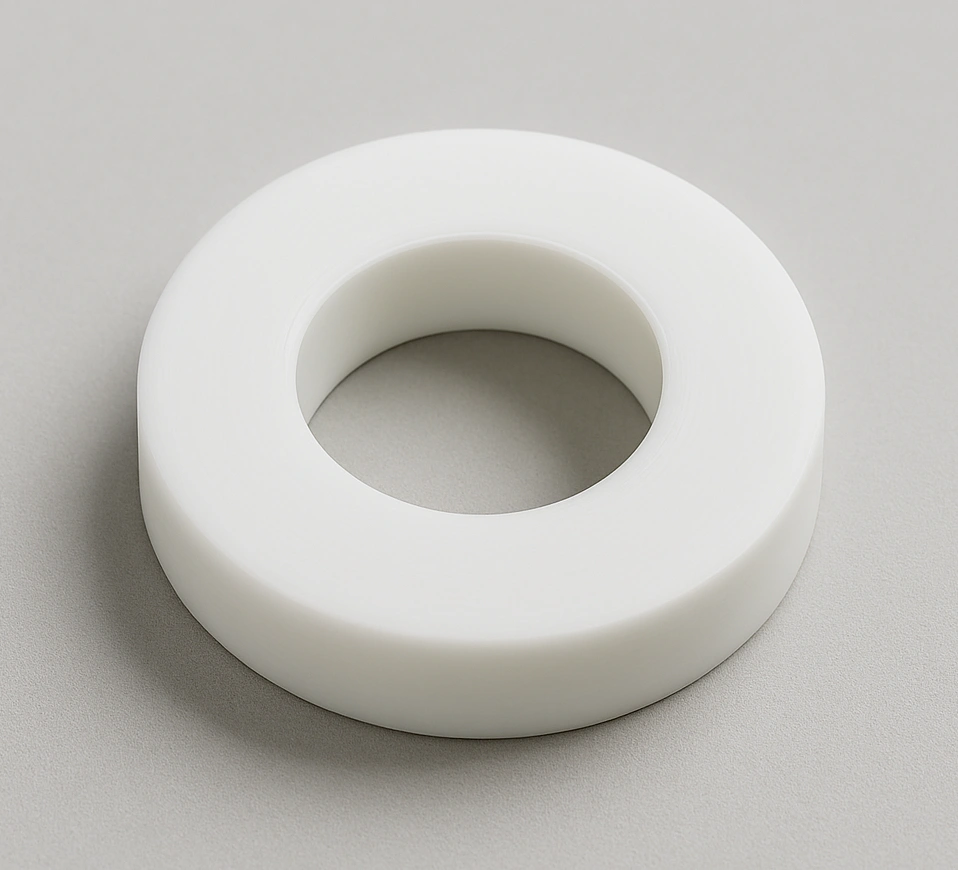
Our PTFE Injection Molding Capabilities
From chemical processing seals to non-stick food-grade components, our PTFE injection molding service provides precision manufacturing for extreme environments.
Product Design Support
- DFM guidance for complex geometries in PTFE
- Expertise in shrinkage compensation (high shrink rate materials)
- Selection between virgin PTFE and filled grades (glass, carbon, bronze)
Mold Design & Manufacturing
- Corrosion-resistant mold materials for aggressive PTFE processing
- Polished cavity surfaces for easy demolding and high finish quality
- Designs to handle PTFE’s low melt flow characteristics
Plastic Injection Molding
- Processing up to 380°C for virgin PTFE
- Specialized screw and barrel materials to prevent degradation
- Dimensional control despite PTFE’s high shrinkage
Post-processing & Assembly
- Machining for tight sealing tolerances
- Surface texturing or etching for bonding applications
- Assembly of PTFE with metals or elastomers for hybrid components
What is PTFE – Polytetrafluoroethylene (Teflon)
Polytetrafluoroethylene (PTFE), commonly known as Teflon, is a high-performance fluoropolymer notable for its excellent chemical resistance, extremely low friction, and wide operating temperature range. PTFE is non-reactive to most chemicals, highly weather-resistant, and has excellent electrical insulation properties. It is widely used for seals, gaskets, bearings, bushings, and lining materials. PTFE can be processed through compression molding, ram extrusion, or CNC machining. Due to its softness and tendency to deform under stress, careful handling and tooling are required during machining.
| Property | Typical Value / Description | Notes |
|---|---|---|
| Tensile Strength | 20–35 MPa | Moderate mechanical strength; not suitable for heavy load-bearing components |
| Flexural Strength | 25–35 MPa | Low rigidity; highly flexible |
| Impact Strength | 10–20 J/m | Low; PTFE is soft and deformable |
| Elastic Modulus | 0.5–0.7 GPa | Very low stiffness |
| Continuous Use Temperature | -200°C to 260°C | Can withstand extreme cold and moderate high temperatures |
| Density | 2.10–2.20 g/cm³ | Relatively heavy compared to most engineering plastics |
| Chemical Resistance | Excellent; resistant to almost all chemicals | Ideal for aggressive chemical environments |
| Water Absorption | <0.01% | Dimensionally stable in moisture |
| Shrinkage | 1–2% | Must be considered during molding or machining |
| Flammability | Non-flammable; self-extinguishing | Excellent fire resistance |
Common Applications of PTFE Molded Parts
| Industry | Example Parts | Why PTFE Works Well |
|---|---|---|
| Chemical Processing | Valve seats, pump liners, gaskets | Inert to almost all chemicals, resists corrosion |
| Food Processing | Non-stick coatings, conveyor rollers | FDA compliant, non-stick, easy to clean |
| Medical | Catheter liners, seals | Biocompatibility, chemical sterilization resistant |
| Electronics | Insulation sleeves, connectors | Excellent dielectric properties, heat resistance |
Production & Delivery Solutions
| Solution Type | Best For | Typical Lead Time | Notes |
|---|---|---|---|
| Rapid Prototyping | Testing PTFE’s non-stick & chemical resistance | 10–14 days | Ideal for validation in food/chemical settings |
| Small Batch | Low-volume specialty parts | 2–3 weeks | Flexible for custom-grade PTFE |
| Mass Production | Large-scale production | 4–6 weeks | Consistent quality for critical applications |
| Export Molds | Overseas PTFE molding | 5–7 weeks | Built to handle PTFE-specific processing |
PTFE Injection Molding FAQs
PTFE has unique processing requirements. It’s often compression molded or paste extruded, but modified PTFE grades can be injection molded with specialized equipment.
Continuous service up to 260°C, with short-term peaks higher, without loss of properties.
Yes, virgin PTFE is FDA compliant and widely used in food processing equipment.
PTFE offers superior chemical resistance and non-stick performance, but lower mechanical strength compared to PEEK/PPS.
Yes, with surface etching or special primers, PTFE can be bonded to metals or elastomers.