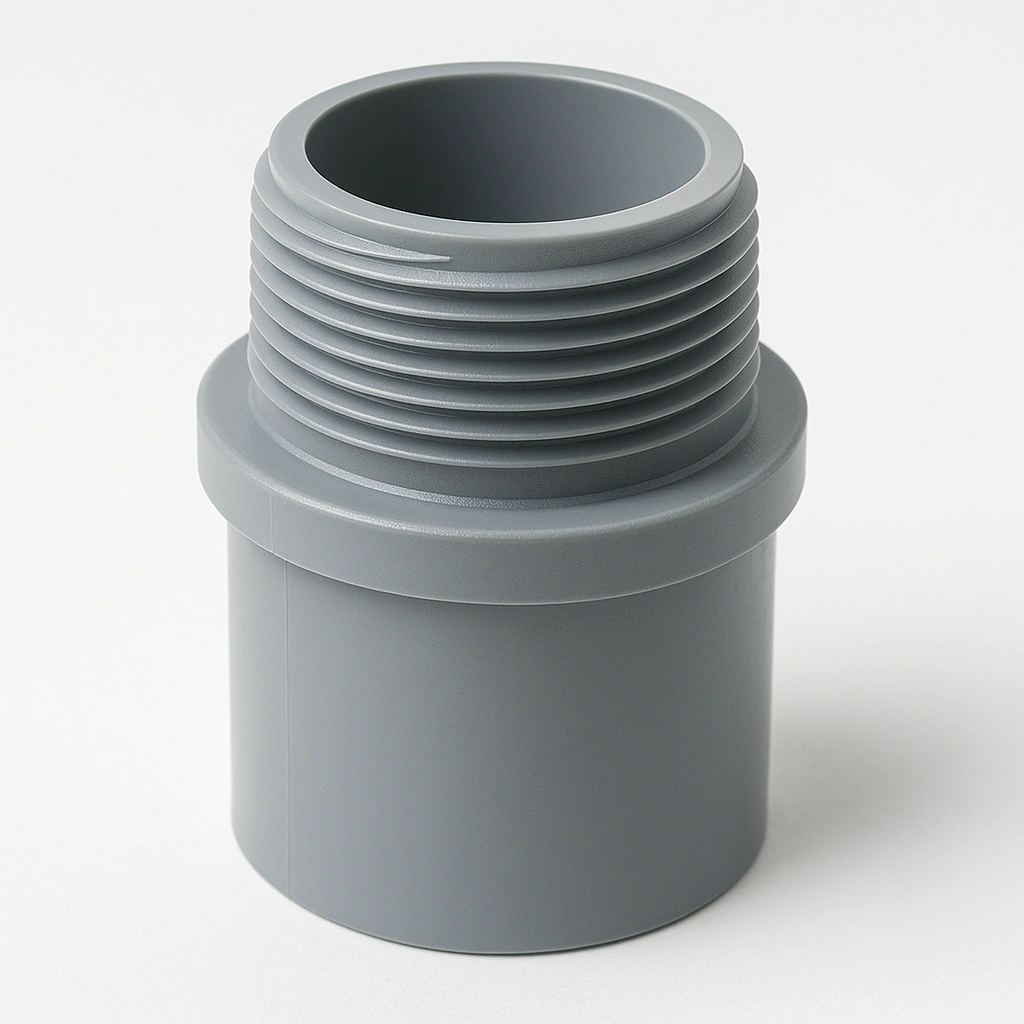
Our PVC Injection Molding Capabilities
Whether you need durable pipe fittings, safe medical tubing, or cost-effective electrical housings, our PVC injection molding service can deliver precision, quality, and speed.
Product Design Support
- Optimization for wall thickness and mold flow in rigid/flexible PVC
- Design considerations for flame safety and compliance standards
- Engineering for impact resistance and dimensional stability
Mold Design & Manufacturing
- Corrosion-resistant mold materials to handle PVC’s processing properties
- Cooling channel design for efficient cycle times
- Polishing and texturing options for surface finish
Plastic Injection Molding
- Processing for both rigid and flexible PVC grades
- Controlled heating to prevent degradation and maintain part quality
- Capable of producing small precision parts to large structural components
Post-processing & Assembly
- CNC trimming, drilling, and secondary machining
- Printing, labeling, and surface treatments
- Assembly of multi-material products and inserts
What is PVC – Polyvinyl Chloride
Polyvinyl Chloride (PVC) is a widely used thermoplastic known for its excellent chemical resistance, durability, and cost-effectiveness. PVC can be formulated as rigid (uPVC) or flexible (fPVC), enabling applications in piping, window profiles, electrical conduits, cable insulation, and consumer goods. It offers good dimensional stability and flame resistance. PVC can be processed through injection molding, extrusion, or CNC machining. Careful temperature control and drying (for some grades) are important to avoid warping or degradation during processing.
| Property | Typical Value / Description | Notes |
|---|---|---|
| Tensile Strength | 40–60 MPa | Moderate strength; suitable for structural and general-purpose components |
| Flexural Strength | 60–80 MPa | Provides rigidity for rigid grades; flexible grades have lower modulus |
| Impact Strength (Unnotched) | 15–50 J/m | Rigid PVC is brittle; flexible PVC offers higher toughness |
| Elastic Modulus | 2.0–3.0 GPa (rigid), 10–50 MPa (flexible) | Varies depending on grade; rigid for structural, flexible for hoses or films |
| Heat Deflection Temperature | 70–80°C (rigid) | Sensitive to high temperatures; prolonged heat can cause deformation |
| Density | 1.30–1.45 g/cm³ | Relatively heavy among common plastics |
| Chemical Resistance | Excellent; resistant to acids, bases, salts, and many solvents | Not recommended for ketones or strong oxidizers |
| Water Absorption | <0.2% | Maintains dimensional stability in humid environments |
| Shrinkage | 0.4–0.8% | Must consider in mold design, especially for rigid grades |
| Flammability | UL94 V-0 (rigid) | Good flame resistance, can be enhanced with additives |
Common Applications of PVC Molded Parts
| Industry | Example Parts | Why PVC Works Well |
|---|---|---|
| Construction | Pipe fittings, valve components, siding | Corrosion resistance, weather durability |
| Electrical | Cable insulation, junction boxes | Flame retardant, electrical insulation |
| Healthcare | IV connectors, tubing, housings | Biocompatible grades, easy sterilization |
| Consumer Goods | Toys, protective gear, household items | Cost-effective, adaptable flexibility |
Production & Delivery Solutions
| Solution Type | Best For | Typical Lead Time | Notes |
|---|---|---|---|
| Rapid Prototyping | Functional PVC samples | 7–10 days | Supports material testing and validation |
| Small Batch | Specialty or custom-colored parts | 2–3 weeks | Flexible production for low-volume runs |
| Mass Production | High-volume industrial components | 4–6 weeks | Stable quality, cost-efficient per unit |
| Export Molds | Overseas PVC molding | 5–7 weeks | Precision tooling for long-term production |
PVC Injection Molding FAQs
Yes, food-grade PVC is available and complies with safety standards, but selection of the right formulation is critical.
Rigid PVC is strong and dimensionally stable, ideal for housings and pipes. Flexible PVC, made with plasticizers, is soft and bendable for tubing and seals.
PVC is inherently flame retardant and self-extinguishing, making it a preferred choice in electrical applications.
Yes, PVC can be overmolded with compatible materials for enhanced grip, aesthetics, or performance.
Yes, PVC can be recycled, but processing requires proper handling due to its chemical composition.