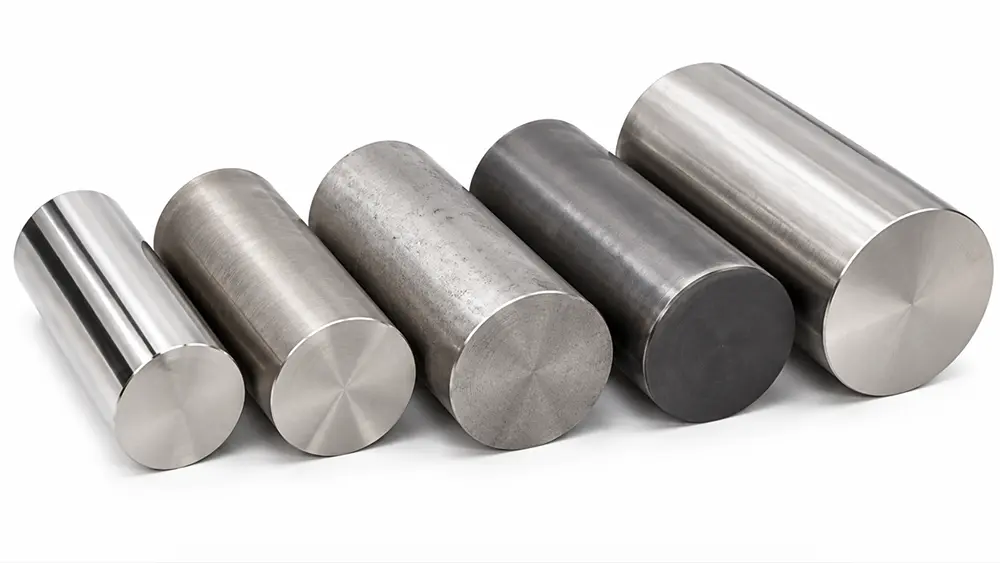

Aluminum, titanium, steel, copper, and magnesium are the five most commonly used metal materials in CNC machining.
The goal of this article is to go over the key properties of these five metals and make a side-by-side comparison for easy reference.
Basic Physical Properties
| Metal | Density (g/cm³) | Melting Point (℃) | Color |
|---|---|---|---|
| Aluminum (Al) | 2.7 | 660 | Silver-white |
| Titanium (Ti) | 4.5 | 1668 | Silver-gray |
| Steel (Fe) | 7.8–8.0 | 1370–1530 | Silver-gray |
| Copper (Cu) | 8.96 | 1085 | Purplish-red |
| Magnesium (Mg) | 1.74 | 650 | Silver-white |
Magnesium is the lightest, steel and copper are the heaviest, and titanium has the highest melting point. Most metals are silver in color, except for copper, which has a reddish tone.
Mechanical Properties
| Metal | Tensile Strength (MPa) | Strength-to-Weight Ratio | Elastic Modulus (GPa) | Fatigue Strength |
|---|---|---|---|---|
| Aluminum (Al) | 310 (6061 alloy) | Good | 69 | Low |
| Titanium (Ti) | 950 (Ti-6Al-4V) | Excellent | 110 | High |
| Steel (Fe) | 250–1500 | Moderate | 200–210 | Moderate |
| Copper (Cu) | 200–600 | Low | 110–130 | Low |
| Magnesium (Mg) | 345 (AZ31B alloy) | Excellent | 45 | Moderate |
Titanium is super strong and light, making it great for tough jobs that need to last. Aluminum is light and pretty strong but wears out faster with repeated use. Steel is strong and stiff but heavier. Magnesium is really light and strong for its weight, but not very stiff. Copper is softer and not ideal for heavy or repeated stress.
Chemical Properties
| Metal | Corrosion Resistance | Oxidation Resistance | Biocompatibility |
|---|---|---|---|
| Aluminum (Al) | Moderate (requires coating) | Moderate (oxidizes at high temps) | Low (potential toxicity) |
| Titanium (Ti) | Excellent (naturally corrosion-resistant) | Excellent (high-temperature oxidation resistance) | Excellent (medical-grade) |
| Steel (Fe) | Stainless steel is excellent; carbon steel rusts easily | Stainless steel is excellent; carbon steel corrodes | Low |
| Copper (Cu) | Excellent (forms protective oxide layer) | Excellent (stable at high temps) | Low |
| Magnesium (Mg) | Poor (oxidizes easily) | Poor (flammable at high temps) | Low |
Titanium stands out with great corrosion and oxidation resistance, plus it’s safe for medical use. Aluminum and copper resist corrosion okay but usually need coatings or special care. Steel is good if it’s stainless, but regular steel rusts easily. Magnesium doesn’t hold up well—it corrodes and reacts easily
Machinability, Cost, and Sustainability
| Metal | Material Cost | Machining Cost | Recyclability | Environmental Impact |
|---|---|---|---|---|
| Aluminum (Al) | Low | Low | High (easily recycled) | Excellent |
| Titanium (Ti) | High (10x aluminum) | High | Low | Moderate |
| Steel (Fe) | Moderate | Low | High | Excellent |
| Copper (Cu) | High | Moderate | High | Excellent |
| Magnesium (Mg) | Moderate | High (flammable machining) | Moderate | Moderate |
Aluminum is cheap, easy to machine, and recycles really well, making it great for the environment. Titanium is expensive to buy and machine, and not as easy to recycle. Steel is affordable to machine and also recycles well. Copper costs more but is easy to recycle too. Magnesium is moderately priced but tricky to machine safely, and its environmental impact is just okay.
Key Applications
Here are the most common applications for each metal:
| Metal | Primary Applications |
|---|---|
| Aluminum (Al) | Consumer electronics, automotive lightweighting, construction |
| Titanium (Ti) | Aerospace, medical implants, marine engineering |
| Steel (Fe) | Buildings, machinery, automotive frames |
| Copper (Cu) | Electrical wiring, electronics, heat exchangers |
| Magnesium (Mg) | Aerospace (weight reduction), 3C product casings |
How to Choose the Right Metal?
- Need lightweighting? → Aluminum or magnesium (but consider strength and corrosion resistance).
- High-strength requirements? → Steel or titanium (e.g., bridges, aircraft landing gear).
- Corrosion resistance? → Titanium or stainless steel (e.g., marine environments, chemical plants).
- Electrical/thermal conductivity? → Copper (power transmission), aluminum (heat sinks).
- High-temperature applications? → Titanium or nickel alloys (e.g., jet engines, furnaces).
Ready to machine metal parts? RJC Mold has the experience and supports aluminum, titanium, steel, copper, magnesium, and more. Send us your drawings for a quick quote, and we’ll help you find the right machining solution. Want to learn more? Check out our cnc machining services page.