PA6 and PA66 are both nylon (polyamide) engineering plastics, but they don’t work the same way when they are used in real parts. When comparing PA6 vs PA66, you should choose PA66 if you want something that can handle more heat and is stiffer. PA6 is better if you want to make things easier to work with and stronger or better at taking hits. This guide will show you the structure, properties, processing, and best uses for each kind of injection-molded part.
The global PA6 market will be 2.99 million tons in 2025, which shows the use of these materials. So, choosing between PA6 vs PA66 can affect production on a large scale, not just one part. For the sake of practicality, we’ll say that performance depends on the grade (unfilled vs. glass-filled), the moisture (dry vs. conditioned), and the design (wall thickness, ribs, and tolerances).
What PA6 and PA66 Are (And Why the “6 vs 66” Is Important)
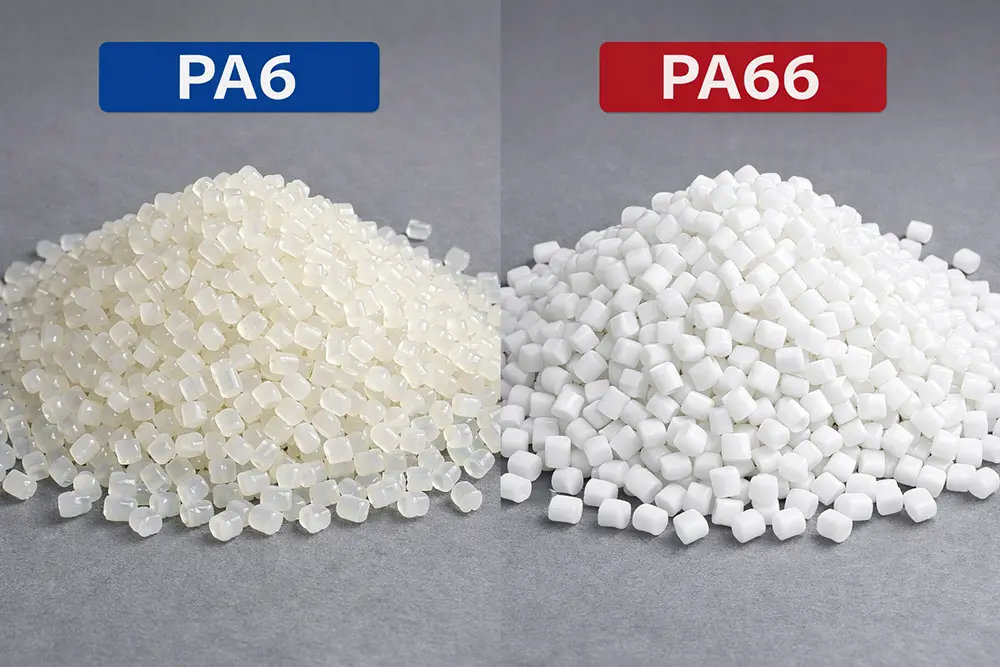
Most of the injection-molded engineering components have either PA6 or PA66 polyamides (nylons). They are used by people when they require items that are tough and cannot be easily broken. Not only that, but they are also prevalent in designs that require to be light and rust-free.
The 6 vs 66 label concerns the blocks constituting the polymer chain. PA6 (Nylon 6) is prepared by opening up a ring using caprolactam. PA66 (Nylon 66) consists of 2 monomers, hexamethylenediamine and adipic acid. This renders the repetition pattern more regular.
The tendency alters the lining capabilities of the chains. Most grades of PA66 are more organized, are more crystalline, and even crystallize more rapidly as they cool. It is among the primary reasons why PA6 vs PA66 can be different when applied in demanding situations.
PA6 vs PA66: Property Differences in Molded Parts
Heat Resistance and Melting Point
This becomes important when parts are near engines, heaters, or hot water. According to NIRLAB, PA6 melts between 220 and 225°C. On the other hand, PA66 melts between 250 and 260°C. This implies that PA66 has a broader safety margin as temperatures increase.
Strength, Stiffness, Toughness (Impact)
If your part needs to stay stiff when it’s under load, PA66 is the better choice, but it should be dry. In contrast, in different common molding grades, PA6 might feel tougher and better able to deal with shock if your part gets hit, dropped, or vibrates a lot.
Moisture Absorption and Dimensional Stability
When nylon absorbs water out of the air, it may change size and the manner in which it behaves mechanically. Per TORAY PLASTICS, at 23°C with 60% relative humidity, the equilibrium figures of nylon 6 and 66 are 3.5% and 2.5%, respectively. That is why those parts that must be fitted snugly can demand conditioning schemes and careful check-fitting and warping.
Crystallinity, Creep, and Long-Term Performance
Now think about parts that hold weight for months or years, such as clips, brackets, or housings. In the context of PA6 vs PA66, the structure of the latter might make it more likely to crystallize, which helps it resist creep and keep its dimensions better over time in many circumstances.
PA6 vs PA66: Injection Molding and Processing Differences
Drying and Moisture Control (Must-Do)
Drying them is the initial stage in the context of nylon injection molding. It avoids splay, bubbles, weak areas, and size variations that occur between runs, which cannot be explained. According to Nylene, a beginning point could be to dry the resin in a desiccant dryer at 82°C for 2-4 hours. The next step is to modify it after checking the resin datasheet and past storage.
Melt and Mold Temperature Ranges
In PA6 vs PA6, SpecialChem has indicated that the melt temperature of PA6 is in the range 240-270°C. For PA66, it is 270-300°C. The temperature of the mold is 55 to 80°C for surface and flow. Actual setpoints always vary with fillers and part geometry; utilize these only as an initial.
RJCMold Shop-Floor View
“We found that PA66 parts need a tighter grip on the melt/mold temperature to fill thin ribs cleanly. PA6 is more forgiving, particularly on complex shapes.” That might be because PA66 needs a hotter, more stable melt window to keep the flow steady in thin areas. When the temperature drops, you can quickly see incomplete fill and other problems with flow.
Which One Should You Choose? Application Match-Ups
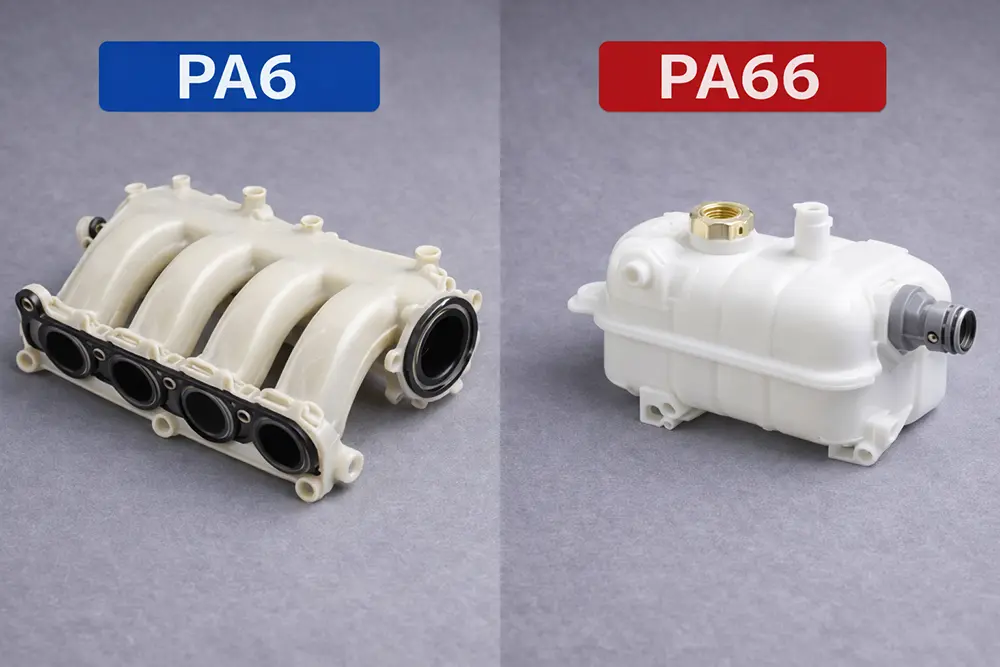
When choosing between PA6 vs PA66 for injection molding, think about what your part will do. As an instance, Nylon 66 can be the safer choice if it has to deal with hot lubricants, hot water, or long-term structural load, like under-hood housings, valve parts, and connectors.
Nylon 6 is the better choice if the part is more “general-duty,” gets more knocks than heat, or you want a wider processing comfort zone for complex shapes. And if you’re thinking about grades with glass in them, be ready for the decision to change. Glass reinforcement changes the whole balance, and it can also change how the mold shrinks and warps, which you’ll have to deal with.