Introduction
In a previous article, we mentioned that if a product has an internal undercut, a lifter can be added to the mold as a solution. However, if the outside of the product includes holes, snaps, grooves, or similar features, the mold often needs a side-action mechanism—a slider.
What Is a Slider?
A slider is a moving mechanism in an injection mold used to form and release side features of a product.
When a product feature cannot be released directly along the normal mold opening direction, the mold must first move the corresponding section out from the side so that the part can be ejected smoothly. The slider performs this function. It is installed inside the mold and is not part of the product itself.
When Is a Slider Used?
The product has side holes
Side holes are one of the most common situations.
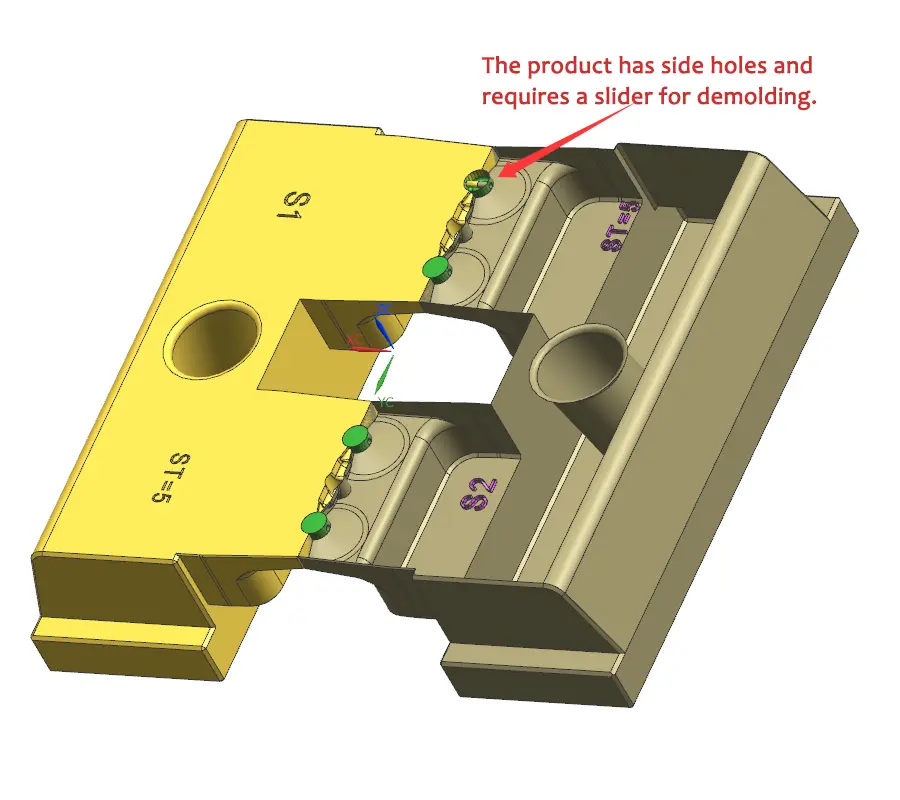
For example, side openings on electronic housings such as connector holes, screw mounting holes, inspection holes, or certain ventilation openings may not be aligned with the normal mold opening direction. In such cases, these features often cannot be formed directly by a standard two-plate mold.
Under these conditions, the mold usually requires a slider to form the feature from the side and retract it during mold opening so the part does not get stuck.
The product has undercut features
Undercuts are another typical situation where sliders are used.
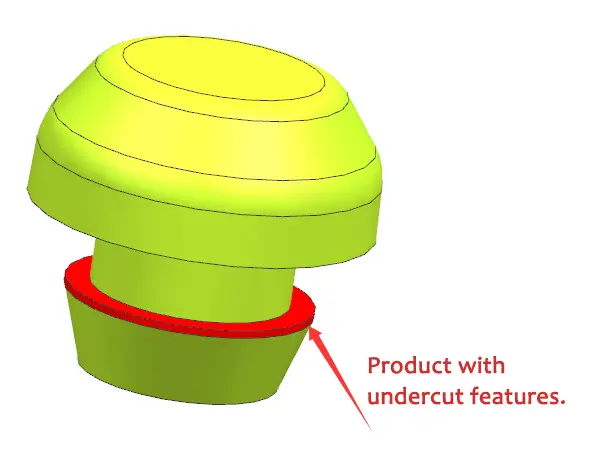
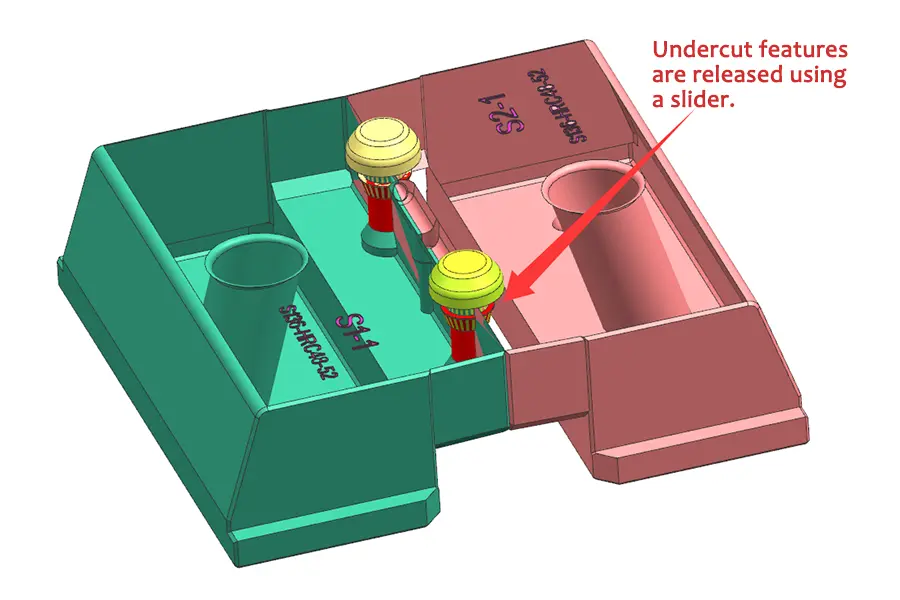
Features such as snaps, hooks, retaining features, and locking tabs are very common in plastic parts, especially in assembly-type components. If these features catch on the mold during opening, the part cannot be released directly. In this case, a slider is usually needed to move the related section out from the side first.
The product has side grooves or protrusions
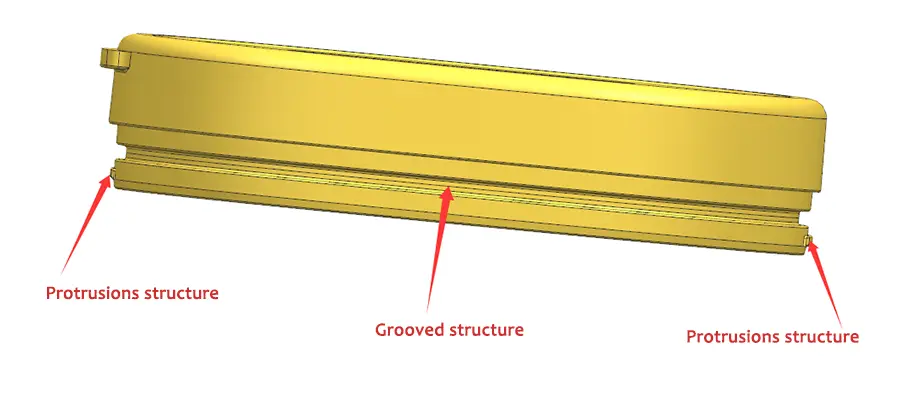
Some products may not look structurally complex, but if there are locating grooves, functional features, or local bosses on the side, these may also affect the part release path.
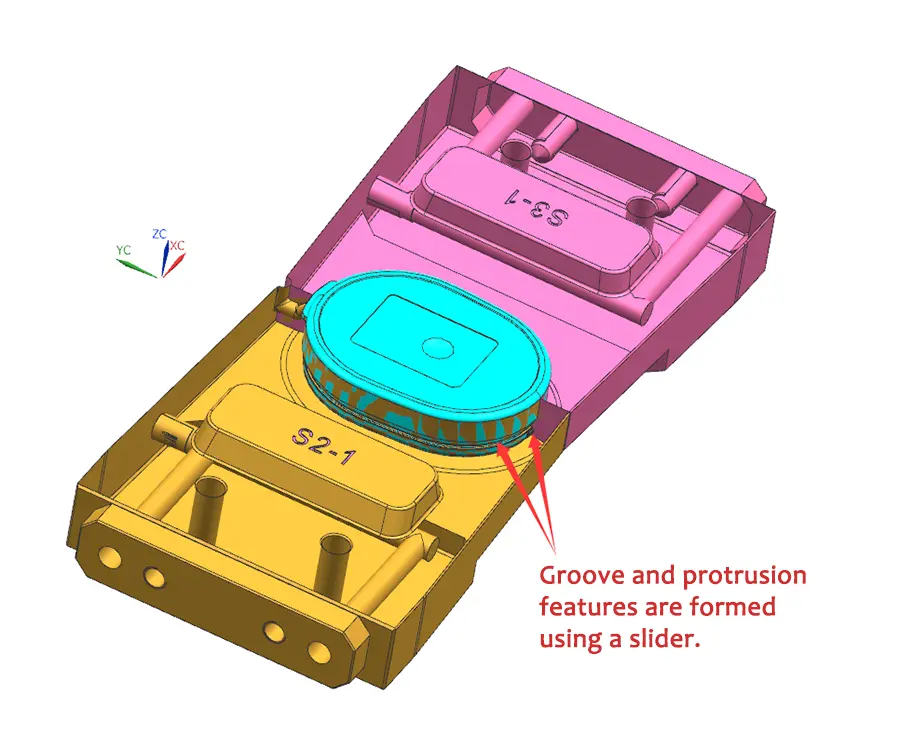
As long as these features interfere with normal part ejection, the use of a slider should be evaluated.
One-piece molding is preferred to reduce post-assembly
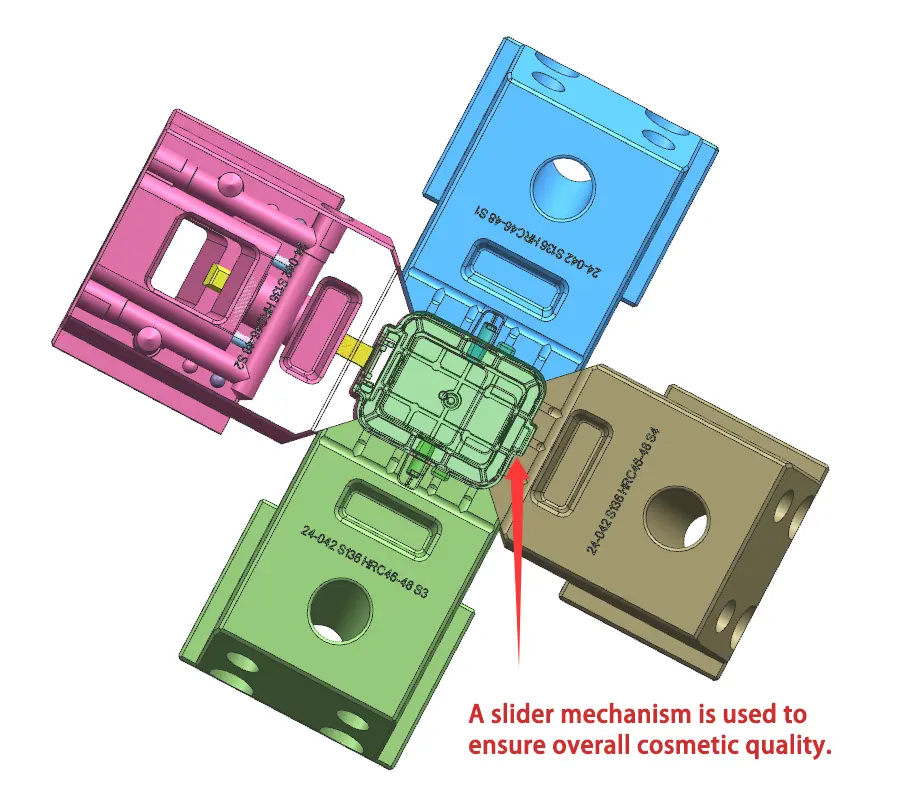
Some features do not absolutely require a slider, but if the customer wants the part to be molded as a single piece in order to reduce secondary assembly, improve appearance integrity, or reduce assembly error, a slider may still be chosen.
How Does a Slider Work?
In principle, the working process of a slider is not difficult to understand.
During injection molding, molten plastic fills the mold cavity and the part is formed. After cooling, the mold begins to open. At the same time, the slider moves sideways with the mold-opening action and retracts from the positions that originally formed the side holes, undercuts, or other side features.
Once these areas are released from the part, the plastic component is no longer trapped and can then be ejected smoothly.
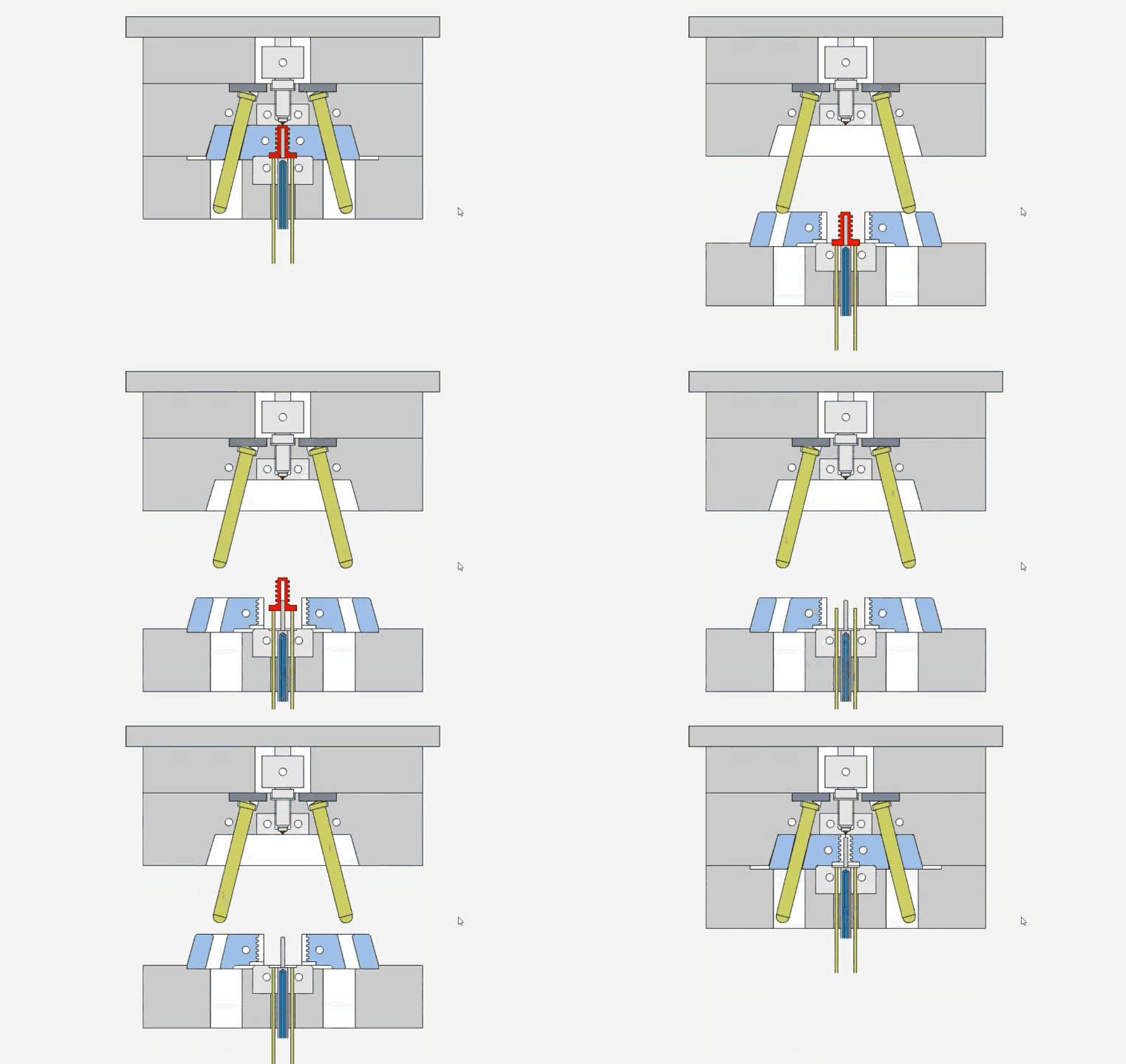
Operation process of an injection mold slider
To put it more simply, the sequence usually works like this:
- The part is formed inside the mold
- The mold begins to open
- The slider retracts sideways
- The side feature is released
- The part is demolded and ejected
Impact
- Mold cost will increase
A slider means that side-action mechanisms are added to the mold, which increases machining and assembly work. If a product requires multiple sliders, the mold quotation usually increases as well. - Development time may become longer
Molds with sliders generally require more coordination and adjustment during manufacturing and trial molding than standard molds. This becomes more noticeable when the product structure is compact or when multiple sliders are involved. - The solution needs to be evaluated earlier
A slider is usually not an isolated issue. It often comes together with side holes, undercuts, appearance requirements, and assembly methods.
If it is evaluated during the product design stage, it is usually easier to control the mold budget and development schedule.
Is a Slider the Only Solution?
Not necessarily. Some side features can be redesigned to avoid the need for a slider. Some products can also be split into multiple parts, molded separately, and then assembled. Whether a slider should be used usually depends on the structure requirements, appearance requirements, budget, production volume, and lead time. For a project, the more important question is not whether a slider can be used, but whether the feature is worth achieving with a slider. In some cases, more complex structures require not only a slider, but even a lifter integrated into the slider.
If you would like to read more articles about injection mold components:
Plastic Mold Gates Types, Selection, and Practical Case Studies
What is a Lifter in Injection Molds?