
Selecting a plastic material is a systematic decision-making process that requires balancing multiple factors. Below is a clear and practical framework to help you choose the most suitable plastic material for your application.
Core Selection Framework: “P.I.E.S.” + Cost
You can evaluate material options using the P.I.E.S. + Cost model:
- P – Performance Requirements
- I – Manufacturing / Processing Method
- E – End-Use Environment
- S – Standards, Regulations, and Safety
- Cost
Step 1: Define Your Application Requirements
(P.I.E.S. + Cost Checklist)
Before selecting a material, answer the following questions as thoroughly as possible.
1. P – Performance Requirements
- Mechanical Properties
- Strength & Stiffness
How much load must the part withstand? Will it bend or deform?
(Reference metrics: tensile strength, flexural modulus) - Toughness vs. Brittleness
Will the part experience impact? Does it need drop resistance or fracture resistance?
(Reference metric: impact strength) - Wear Resistance
Will the part experience friction or abrasion? - Creep Resistance
Does the part need to carry long-term loads without deformation?
- Thermal Properties
- Maximum Operating Temperature
What temperature will the product operate at? Will it contact hot water or heat-generating components? - Minimum Operating Temperature
Will it be used in low-temperature environments? Will it become brittle? - Flame Resistance
Is flame retardancy required? What rating is needed (e.g., UL94 V-0, V-2, HB)? - Electrical Properties
- Is electrical insulation required, or conductivity / antistatic performance?
- Optical Properties
- Transparent, translucent, or opaque?
- Is a high-gloss surface finish required?
2. I – Manufacturing / Processing Method
What manufacturing process will be used?
- Injection Molding
Ideal for complex geometries and high-volume production; requires good melt flow. - Extrusion
Used for continuous profiles such as pipes, rods, sheets, and films. - Blow Molding
Used for hollow products such as bottles and containers. - Thermoforming (Vacuum Forming)
Used for thin-wall packaging products.
Different processes impose different requirements on melt flow index, thermal stability, and processing window.
3. E – End-Use Environment
- Chemical Exposure
- What chemicals will the part contact?
(Acids, alkalis, oils, solvents, cleaners, etc.) - Will it be exposed to water long-term?
Is hydrolysis a concern?
- Outdoor Exposure
- Will it be used outdoors for long periods?
Is UV resistance and weatherability required?
- Special Environments
- Food contact?
- Medical use?
- Long-term contact with the human body?
4. S – Standards, Regulations, and Safety
- Food Contact Compliance
FDA (U.S.), EU 10/2011, GB standards (China), etc. - Medical Grade
USP Class VI, ISO 10993 biocompatibility standards. - Flame Retardancy & Electrical Safety
UL (U.S.), IEC (international) standards. - RoHS / REACH
Restrictions on hazardous substances.
5. Cost Considerations
- Material Cost
Price per kilogram. - Processing Efficiency
Ease of processing, cycle time, scrap rate, yield. - Design Optimization
Can material usage be reduced through smart design
(e.g., uniform wall thickness, reinforcing ribs)?
Step 2: Typical Application Scenarios and Material Selection
Below are common applications and their frequently used plastic materials, provided as a quick reference.
| Application Scenario | Key Requirements | Common Materials | Selection Rationale |
| Housings / Structural Parts(Appliances, Tools, Electronics) | Strength, toughness, cost efficiency, good surface appearance | ABS, PC, PC/ABS, PP | ABS: Good overall mechanical properties, excellent surface finish, moderate cost.PC: High strength and toughness, optional transparency.PC/ABS: Combines PC’s heat resistance and toughness with ABS’s processability.PP: Low cost, excellent fatigue resistance (ideal for living hinges). |
| Transparent Products(Lenses, Cups, Medical Containers) | High transparency, surface hardness, impact resistance | PMMA, PC, PS, PETG | PMMA (Acrylic): Outstanding optical clarity and hardness, but brittle.PC: Extremely impact-resistant, but prone to surface scratching.PS: Low cost, very brittle.PETG: Good transparency, high toughness, easy to process. |
| High-Temperature Components(Electrical Connectors, Automotive Engine Bay, Kettles) | Long-term heat resistance, dimensional stability | PA (Nylon), PPS, PBT, PEI, PEEK | PA: High strength and wear resistance; moisture absorption can affect dimensions.PPS / PBT: Excellent heat resistance and electrical properties.PEI / PEEK: Ultra-high temperature capability (>200 °C) for high-end applications. |
| Flexible Products(Seals, Hoses, Phone Cases) | Flexibility, elasticity, fatigue resistance | TPE/TPU, Silicone, PVC | TPE/TPU: Rubber-like elasticity with thermoplastic processability; widely used for overmolding.Silicone: Excellent high- and low-temperature resistance and biocompatibility.PVC: Low cost; hardness adjustable using plasticizers. |
| Food Packaging & Containers(Water Bottles, Lunch Boxes, Cling Film) | Food safety compliance, transparency, tear resistance | PP, PE, PET, PS | PP: Microwave-safe; widely used for food containers.PE: Flexible; used for plastic bags and cling film.PET: High strength, transparent, good barrier properties (water bottles).PS: Disposable food containers and yogurt cups. |
| Outdoor Products(Lawn Furniture, Logistics Bins) | Weatherability, UV resistance, impact resistance | ASA, Modified PP, PC | ASA: Excellent UV and weather resistance; outdoor alternative to ABS.UV-stabilized PP: Cost-effective solution for outdoor use.PC: High impact resistance, but surface scratches easily. |
| Wear-Resistant Parts(Gears, Bearings, Pulleys) | Low friction, high wear resistance, high strength | PA (Nylon), POM (Acetal), UHMW-PE | POM: High rigidity and very low friction; ideal for gears.PA: High strength and wear resistance, but lower dimensional stability.UHMW-PE: Exceptional wear resistance and impact strength. |
Case Study 1
High-Strength, High-Temperature Automotive Engine Bay Component
Example: Intake Manifold
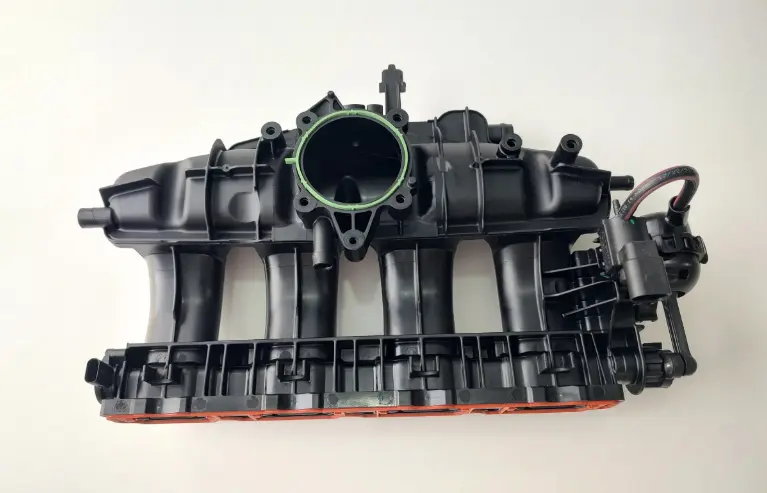
Requirements
- Continuous operation above 120 °C; short-term peaks above 200 °C
- High strength and stiffness to withstand vibration and internal pressure
- Excellent resistance to oil, coolant, and fuel vapors
- Lightweight (metal replacement)
- High dimensional stability under temperature fluctuations
Material Selection Process
Initial Screening
- Commodity plastics (ABS, PC) eliminated due to insufficient heat resistance
- Engineering plastics considered: PA, PPS, PBT
Detailed Comparison
- PA66:
Pros: Balanced performance, high strength, oil resistance, lower cost; glass-fiber reinforcement significantly improves heat resistance
Cons: Absorbs moisture, affecting dimensions and properties - PPS:
Pros: Outstanding heat resistance (>220 °C), near-zero moisture absorption, exceptional chemical resistance
Cons: Brittle, very expensive - PBT:
Pros: Good heat resistance, excellent electrical properties, low moisture absorption
Cons: Lower impact resistance; limited hot-water resistance
Final Selection
- PA66 reinforced with 30% glass fiber (PA66-GF30) is the most common choice, offering the best balance of performance and cost
- PPS is used for components near turbochargers where extreme temperatures justify the higher cost
Conclusion: PA66-GF30 is the preferred solution.
Case Study 2
High-Appearance, Electroplated Consumer Electronics Housing
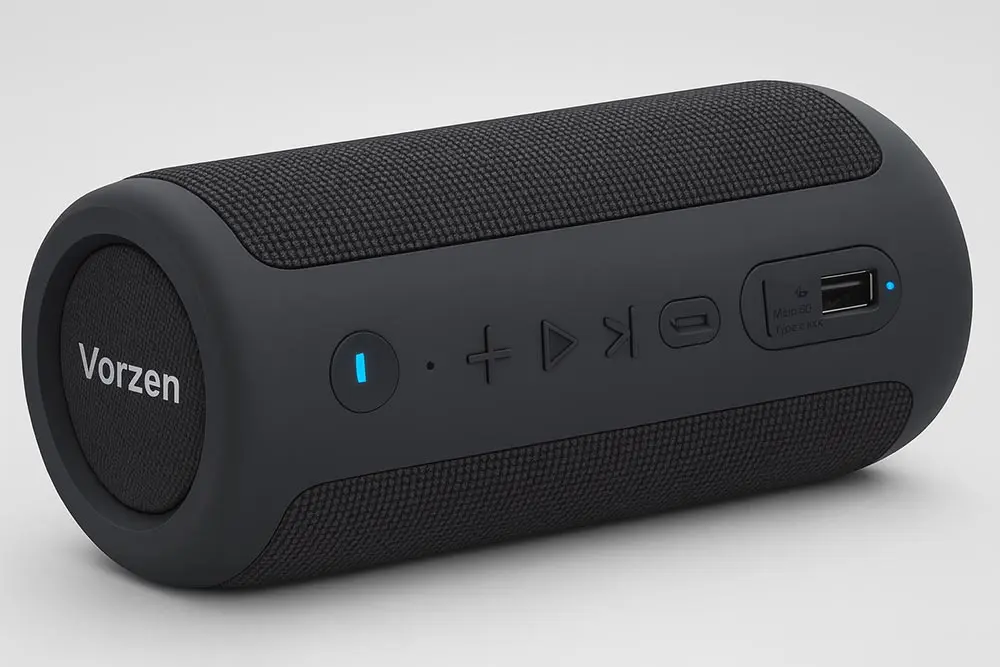
Example: Bluetooth Speaker Enclosure
Requirements
- Premium surface appearance suitable for painting and electroplating
- Good strength and impact resistance for daily use
- Adequate stiffness for structural integrity
- Good flowability for complex geometries
- Controlled cost
Material Selection Process
Initial Screening
- Electroplating requires amorphous or lightly crystalline materials with good adhesion
- ABS is a classic electroplating material
- PC/ABS considered to improve strength and heat resistance
Detailed Comparison
- ABS:
Pros: Excellent plating adhesion, low cost, easy processing
Cons: Lower strength and heat resistance - PC/ABS:
Pros: Combines PC’s strength and heat resistance (110–120 °C) with ABS’s processability and plating performance
Cons: Higher cost than ABS - PC:
Pros: Outstanding strength and toughness
Cons: Poor plating adhesion, higher cost, internal stress risk
Final Selection
- PC/ABS is the optimal choice for mid- to high-end Bluetooth speaker housings
- ABS may be used for cost-sensitive, low-strength applications
- PC is generally not recommended for electroplating
Conclusion: PC/ABS is the preferred solution.
Step 3: Practical Material Selection Workflow
- Define Requirements
Create a detailed checklist and distinguish between “must-have” and “nice-to-have.” - Initial Screening
Narrow down to 2–4 candidate materials. - In-Depth Comparison
- Review datasheets from suppliers (SABIC, DuPont, BASF, Dow, etc.)
- Evaluate compatibility with existing manufacturing equipment
- Prototyping & Testing
- Build prototypes using candidate materials
- Perform drop tests, thermal aging tests, chemical resistance tests
(This is the most critical step.)
- Final Decision
Select based on test results, cost analysis, and supply chain stability.
Summary
There is no “best” plastic—only the most suitable one.
Successful material selection comes from a deep understanding of the application and a systematic evaluation process. When in doubt between materials, building prototypes and conducting real-world testing is the most effective way to reach a confident decision.