Working Principles, Technical Approaches, and Core Advantages of Liquid Cooling Systems
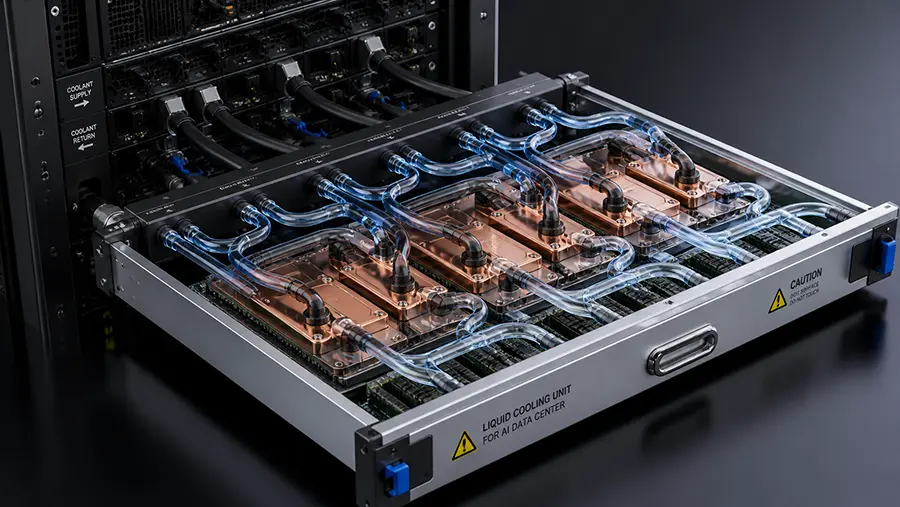
Liquid cooling systems circulate specialized heat-conducting fluids inside devices to quickly absorb and transfer heat generated by CPUs, GPUs, AI accelerators, and other core components. This heat is then expelled through external heat exchange equipment, ensuring stable and efficient temperature control.
In the AI computing field, mainstream liquid cooling technologies are mainly divided into two types: cold plate liquid cooling and immersion liquid cooling. Cold plate cooling transfers heat through metal plates closely attached to heat-generating components. It offers flexible deployment and easy retrofitting, making it the most widely used solution. Immersion cooling submerges servers directly in insulating cooling fluids, providing more uniform heat dissipation without hotspots, ideal for ultra-high-density, high-performance AI computing clusters.
Compared with traditional air cooling, liquid cooling has clear advantages in heat dissipation efficiency, equipment stability, space utilization, and energy consumption. It keeps device temperatures more stable, reduces performance degradation caused by overheating, lowers operating noise, and extends hardware lifespan, allowing high-density AI servers to run reliably over the long term.
Liquid cooling technology has long been applied in fields such as injection molding (see “What is Injection Cooling System – RJC Molds”), molds, new energy, and industrial temperature control. In the era of AI computing, its cooling advantages have become even more pronounced, evolving from an optional feature into essential infrastructure and forming a key technology foundation for large-scale, high-density AI development.
Strong Demand for Liquid Cooling in AI Computing Hardware
With the global rapid adoption of AI applications such as large-scale model training, multimodal processing, autonomous driving simulations, and real-time big data analytics, computing demand continues to grow at a high pace. AI servers operate under long-term high-load, high-density, and continuous conditions, causing rising chip power consumption and cabinet heat generation. Traditional air cooling is no longer sufficient for next-generation computing hardware.
Overheating can trigger automatic throttling, unstable performance, increased latency, and even accelerated hardware aging or failure, directly impacting AI model training speed, inference accuracy, and overall service reliability. In this context, liquid cooling is the most effective and scalable solution for high-density heat dissipation.
Through high-efficiency heat exchange, liquid cooling maintains device temperatures within stable and safe ranges, prevents hotspot accumulation, and ensures continuous computing output. It also helps improve data center energy efficiency, reducing overall power consumption and aligning high-performance computing with green, low-carbon development goals.
Global Applications of Liquid Cooling in AI Computing
Leading tech companies and data center operators worldwide increasingly regard liquid cooling as a core direction for AI infrastructure upgrades.
As a front-runner in AI computing, NVIDIA signaled at GTC 2026 that AI competition has shifted from simply measuring computing performance to overall infrastructure capability. Its next-generation Vera Rubin platform fully adopts a 100% liquid-cooled architecture, further demonstrating the central role of liquid cooling in AI computing.
Today, supercomputing centers, intelligent computing centers, large-scale cloud platforms, and high-density AI training clusters worldwide widely use liquid cooling technology. Whether using cold plate or immersion solutions, liquid cooling has become standard in high-performance computing, serving as a key factor in improving computing scale, stability, and competitiveness.
RJC’s Custom Services and Core Value in Liquid Cooling
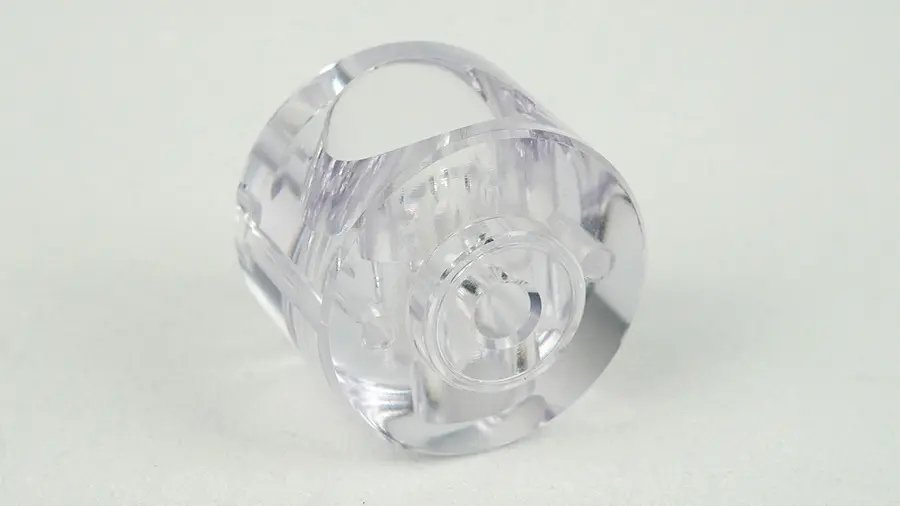
RJC has years of experience in manufacturing liquid cooling components, specializing in custom development and high-precision production. Leveraging expertise in mold making, injection molding, and CNC machining, RJC can customize cooling channels, liquid cooling connectors, heat-dissipation housings, cold plate structural components, and more. With precise quality and strong sealing, RJC products are widely compatible with AI servers, computing cabinets, and data center thermal management equipment, providing reliable component support for AI liquid cooling facilities worldwide.
Conclusion
Liquid cooling systems have become a key factor in AI computing power competition. With higher heat dissipation efficiency, lower energy consumption, and more stable performance, liquid cooling enables AI computing hardware to achieve higher performance, higher density, and more reliable continuous operation. As AI computing continues to advance, liquid cooling will remain a core infrastructure component, driving the industry toward greater efficiency, greener operations, and scalable development.