Pure metals often offer good electrical conductivity, ductility, or corrosion resistance, but their strength, hardness, and heat resistance may not be sufficient for industrial applications. By adding appropriate amounts of other elements, the structure and properties of a metal can be modified, creating alloys suited to different products and operating environments. This article introduces the main classifications of alloys, common grades, their properties, and specific applications.
1. What Is an Alloy?
An alloy is a material made up of two or more elements that retains metallic characteristics, with at least one of those elements being a metal. The metal present in the largest proportion is called the base metal, while the elements added to modify its properties are known as alloying elements.
Alloys do not necessarily consist entirely of metallic elements. Steel, for example, is primarily made of iron and carbon, even though carbon is a nonmetal. Aluminum alloys, on the other hand, use aluminum as the base metal and commonly contain elements such as magnesium, silicon, copper, or zinc.
Compared with pure metals, the composition and microstructure of alloys can be adjusted to meet specific requirements. As a result, alloys can generally achieve higher strength and hardness, better corrosion and heat resistance, or processing characteristics better suited to particular manufacturing methods.
2. How Are Alloys Classified?
Alloys can be classified according to whether iron is the base metal, the primary base metal they contain, or the way atoms are arranged within the crystal lattice. These classification methods look at alloys from different perspectives and do not conflict with one another.
Ferrous and Non-Ferrous Alloys
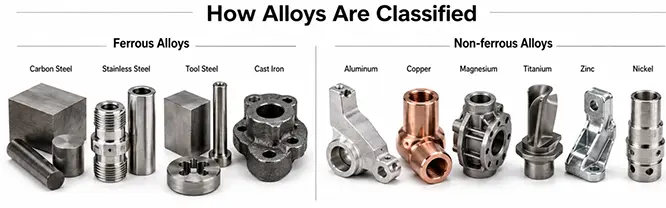
Ferrous alloys contain iron as their primary component and include carbon steel, alloy steel, stainless steel, tool steel, and cast iron.
Non-ferrous alloys do not use iron as the primary base metal. Common examples include aluminum, copper, magnesium, titanium, zinc, and nickel alloys.
Compared with ferrous alloys, non-ferrous alloys may offer lower weight, better electrical conductivity, stronger corrosion resistance, or better performance at elevated temperatures.
Note: Non-ferrous does not mean completely free of iron. Some non-ferrous alloys may contain small amounts of iron. As long as iron is not the primary base metal, the material is still classified as a non-ferrous alloy.
Classification by Base Metal
In industry, alloys are commonly named after the metal that makes up the largest proportion of the material, such as aluminum alloys, copper alloys, magnesium alloys, titanium alloys, zinc alloys, and nickel alloys. The base metal determines the alloy’s fundamental physical and chemical characteristics, while alloying elements are used to further adjust its properties.
This classification method directly reflects the basic characteristics of the material. Aluminum alloys, for example, generally have relatively low density; copper alloys often provide good electrical and thermal conductivity; and nickel alloys are typically better suited to high-temperature or corrosive environments.
Classification by Atomic Structure
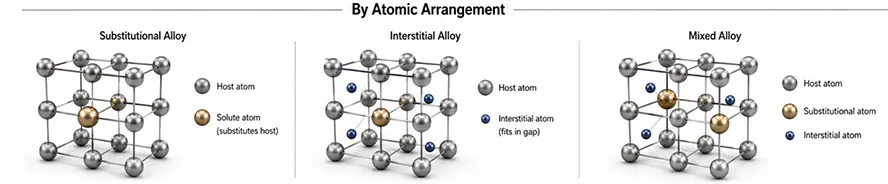
According to the position of alloying elements within the crystal lattice of the base metal, alloys can be divided into the following three types.
Substitutional alloys: Atoms of the alloying element replace some of the base-metal atoms. The two types of atoms are usually similar in size. Brass is a typical example, where zinc atoms replace some of the copper atoms.
Interstitial alloys: Smaller atoms occupy the spaces between atoms of the base metal. In steel, for example, carbon atoms enter the spaces within the iron lattice and can significantly increase the material’s strength and hardness.
Substitutional–interstitial alloys: Both substitutional and interstitial atoms are present in the material. Many alloy steels containing carbon, chromium, nickel, and other elements have this type of structure.
This classification helps explain why alloys can be stronger than pure metals. In actual purchasing and manufacturing, however, materials are more commonly identified by their base metal and specific grade.
3. Common Alloy Types and Properties
The data in the table below are intended to show typical property levels of different alloys. They should not be used as a substitute for design standards or supplier material certifications.
| Alloy Category | Representative Grade and Condition | Main Alloying Elements | Density (g/cm³) | Tensile Strength (MPa) | Yield Strength (MPa) | Hardness |
| Carbon Steel | AISI 1018, cold drawn | Fe-C-Mn | 7.87 | 440 | 370 | 126 HB |
| Stainless Steel | 304, annealed | Fe-Cr-Ni | 7.90 | ≥515 | ≥205 | ≤201 HB |
| Aluminum Alloy | 6061-T6 | Al-Mg-Si | 2.70 | 310 | 276 | 95 HB |
| Aluminum Alloy | 7075-T6/T651 | Al-Zn-Mg-Cu | 2.81 | 572 | 503 | 150 HB |
| Copper Alloy | C36000 brass, H02 half-hard | Cu-Zn-Pb | 8.50 | ≥310 | ≥117 | Approx. 60 HRB |
| Magnesium Alloy | AZ91D-F, as-cast | Mg-Al-Zn | 1.81 | Approx. 230 | Approx. 150 | Approx. 63 HB |
| Titanium Alloy | Ti-6Al-4V, annealed plate | Ti-Al-V | 4.42 | ≥895 | ≥828 | Approx. 334 HB |
| Zinc Alloy | Zamak 3, as-cast | Zn-Al-Mg | 6.7 | 268 | 208 | 97 HB |
| Nickel Alloy | Inconel 718, annealed and not cold worked | Ni-Cr-Fe-Nb-Mo | 8.19 | 876 | 655 | Varies with condition |
4. Applications of Alloys
The applications of an alloy are determined not only by its category, but also by its specific grade, heat-treatment condition, product form, and service environment.
| Alloy Category | Common Grade | Typical Applications |
| Carbon Steel | AISI 1018 | Shafts, pins, bolts, tie rods, gear blanks, and mechanical brackets |
| Stainless Steel | 304 | Food containers, pipe fittings, kitchen equipment, screws, instrument housings, and equipment panels |
| Tool Steel | H13 | Die-casting molds, hot extrusion dies, hot-shear blades, and forging dies |
| Aluminum Alloy | 6061-T6 | Equipment frames, mounting brackets, robotic-arm components, heat sinks, and electronic housings |
| Aluminum Alloy | 7075-T6 | Aircraft structural fittings, high-load brackets, bicycle components, and high-strength fixtures |
| Brass | C36000 | Threaded fittings, valve stems, nozzles, bushings, terminals, and precision-turned parts |
| Bronze | C93200, etc. | Bushings, plain bearings, worm gears, pump components, and wear-resistant washers |
| Magnesium Alloy | AZ91D | Camera bodies, laptop housings, steering-wheel frames, and lightweight enclosures |
| Titanium Alloy | Ti-6Al-4V | Orthopedic screws, aircraft fasteners, blades, pressure-vessel components, and high-performance connectors |
| Zinc Alloy | Zamak 3 | Door-lock components, zipper sliders, handles, decorative parts, connectors, and thin-wall precision housings |
| Nickel Alloy | Inconel 718 | Turbine disks, engine fasteners, combustion-chamber components, valves, and high-temperature elastic components |
5.Why Are Alloys More Commonly Used Than Pure Metals?

They Can Meet Higher Strength Requirements
Alloying elements can alter the structure of a metal, increasing its strength, hardness, and wear resistance. This makes alloys suitable for load-bearing components and parts exposed to long-term friction.
They Perform Better in Demanding Environments
Alloys can provide improved corrosion and heat resistance. Stainless steel, for example, is well suited to humid environments, while nickel alloys can retain their properties at elevated temperatures.
They Can Be Better Matched to Manufacturing Processes
By adjusting the composition, manufacturers can improve properties such as casting fluidity, machinability, weldability, or formability, allowing the material to meet the manufacturing requirements of different components.
Specific Functional Properties Can Be Adjusted
Alloying can also change electrical conductivity, thermal conductivity, magnetic properties, and other characteristics, making the material better suited to electrical, thermal-management, or other functional components.
They Make It Easier to Balance Performance and Cost
Alloys can provide higher strength, better processability, or a longer service life at a reasonable cost, helping reduce material, manufacturing, and maintenance costs over the life of a component.
Final Thought
Adding alloying elements creates a series of changes in material performance: increasing strength may reduce ductility, while improving heat resistance can also make a material more difficult to process. For this reason, no single property can fully represent how a material will perform in an actual component.
The value of an alloy lies in the ability to predict and control these changes so that the material’s properties remain matched to the real requirements of the part.