Polyester and Nylon are both common synthetic materials that are widely used in injection molded parts within the engineering plastics field.
They have significant differences in strength, water absorption, wear resistance, dimensional stability, and other properties. This article will analyze the differences between Polyester and Nylon from the perspectives of material characteristics, performance comparison, applications, and injection molding.
*In this article, Polyester and Nylon refer to engineering plastic materials rather than textile fibers used in the textile industry.
1. What Is Polyester?
Polyester is a type of polymer material containing ester groups. In the field of engineering plastics, common types include PET (Polyethylene Terephthalate) and PBT (Polybutylene Terephthalate).
Key Properties of Polyester
Low water absorption: Less affected by humidity, providing better dimensional stability.
Good rigidity: Suitable for structural components and precision parts.
Excellent electrical properties: Commonly used in electronic and electrical applications.
Good chemical resistance: Able to withstand various chemical media.
2. What Is Nylon?
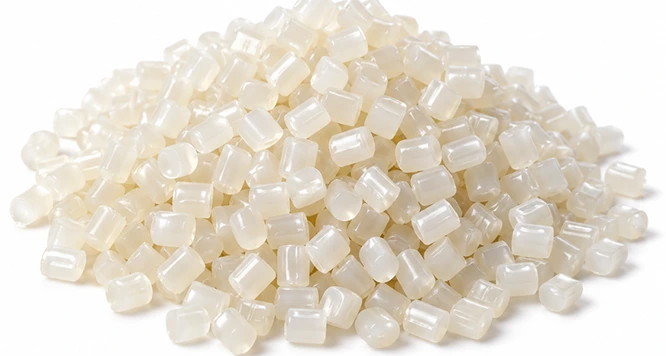
Nylon is a type of polyamide (PA) engineering plastic. Common grades include PA6 and PA66.
Key Properties of Nylon
High strength and toughness: Capable of withstanding significant mechanical loads.
Excellent wear resistance: Suitable for long-term friction applications.
Good fatigue resistance: Suitable for components subjected to repeated loading.
Good heat resistance: Especially PA66, which provides more stable performance in high-temperature environments.
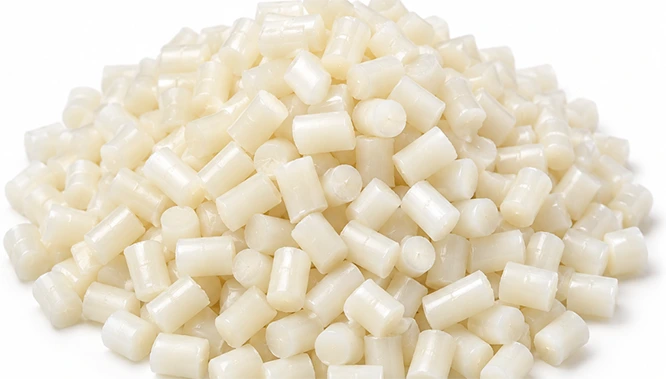
3. Polyester vs. Nylon: Key Performance Comparison
| Property | Polyester | Nylon |
| Common Types | PET, PBT | PA6, PA66 |
| Strength | High | Higher |
| Toughness | Good | Excellent |
| Wear Resistance | Good | Excellent |
| Impact Resistance | Moderate | Excellent |
| Water Absorption | Very Low | Higher |
| Dimensional Stability | Excellent | Affected by moisture absorption |
| Fatigue Resistance | Average | Excellent |
| Heat Resistance | Good | Better |
| Electrical Properties | Excellent | Good |
| Cost | Lower | Higher |
1) Differences in Mechanical Properties
Nylon generally provides higher toughness and impact resistance, making it suitable for components that need to withstand mechanical loads.
For common materials, the tensile strength of unreinforced PA66 is typically around 70-90 MPa, while PET generally has a tensile strength of approximately 55-75 MPa.
2) Differences in Water Absorption
Nylon is a moisture-absorbing engineering plastic. The saturated water absorption of PA6 can reach approximately 2%-3% or higher, while PA66 is typically around 1%-2%. After absorbing moisture, its dimensions, strength, and stiffness may change.
Polyester has significantly lower water absorption. PET typically has a water absorption rate of around 0.1%-0.2%, while PBT is usually below 0.1%.
Therefore, Polyester has advantages in applications requiring high dimensional accuracy and strict size control.
3) Differences in Temperature Performance
Nylon generally provides better heat resistance, especially PA66.
Typical data:
| Material | Melting Point | Long-Term Service Temperature |
| PA6 | Approx. 220℃ | Approx. 100-120℃ |
| PA66 | Approx. 260℃ | Approx. 120-150℃ |
| PBT | Approx. 220-230℃ | Approx. 100-120℃ |
| PET | Approx. 250-260℃ | Approx. 100-120℃ |
For applications requiring higher temperature performance, glass fiber reinforced materials, such as PA66 GF30 and PBT GF30, can further improve heat deflection temperature and mechanical properties.
4) Differences in Dimensional Stability
Polyester generally provides better dimensional stability.
The main reason is that Polyester has low water absorption, is less affected by humidity changes, and maintains its dimensions better after molding.
For example, the water absorption of PBT is typically below 0.1%, while Nylon materials may absorb several percent of moisture. As a result, the dimensional changes of the two materials can be significantly different in humid environments.
5) Differences in Wear Resistance and Fatigue Performance
One of the biggest advantages of Nylon is its excellent wear resistance. It provides:
- Low friction coefficient
- Good self-lubricating properties
- Excellent fatigue resistance
Polyester also offers certain wear resistance, but it is generally more focused on dimensional stability and precision applications. For example, Nylon is more commonly used for gears and bushings that require continuous friction resistance, while Polyester is better suited for connectors and precision structural components where dimensional accuracy is more important.
6) Differences in Chemical Resistance
Both Polyester and Nylon have good chemical resistance, but their strengths are different.
Polyester generally provides better stability against solvents and oils, making it suitable for electronic and electrical applications that require long-term stability. Nylon has better resistance to oils and fuels, so it is more commonly used in automotive and mechanical components.
4. Common Applications of Nylon and Polyester
Common Applications of Polyester
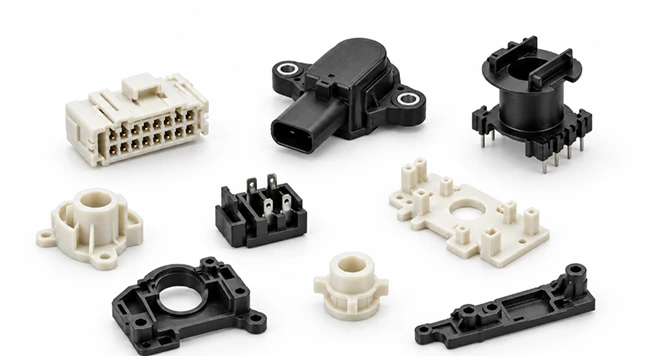
Polyester offers low water absorption, good dimensional stability, and excellent electrical insulation properties. Therefore, it is commonly used for precision and electronic plastic parts, such as:
- Electronic connectors
- Sensor housings
- Coil bobbins
- Insulation components
- Precision structural parts
These applications typically require high dimensional accuracy, assembly stability, and long-term performance retention.
Common Applications of Nylon
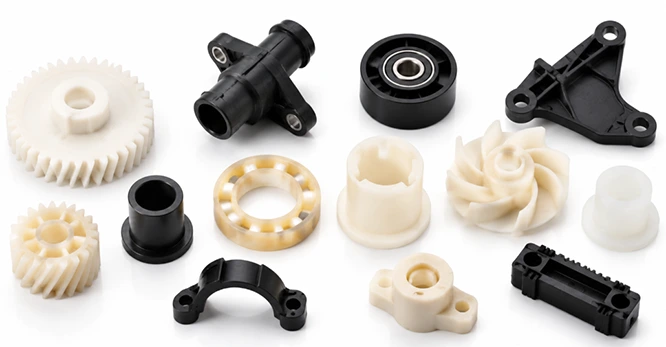
Nylon offers high strength, excellent wear resistance, and good fatigue performance. It is suitable for components that need to withstand friction, impact, or continuous loading, such as:
- Plastic gears
- Bushings
- Bearing retainers
- Automotive components
- Industrial mechanical components
These components usually require long-term operation and materials with good durability and mechanical performance.
5. Polyester vs. Nylon: How to Choose the Right Material?
If the component requires high strength, wear resistance, and fatigue resistance, such as gears, bushings, and other continuously moving components, Nylon is usually a better choice.
If the component requires better dimensional stability, low water absorption, and electrical performance, such as connectors and precision structural components, Polyester is generally more suitable.
In practical applications, factors such as operating temperature, service environment, and processing requirements should also be considered for comprehensive evaluation.
6. Differences Between Polyester and Nylon in Injection Molding
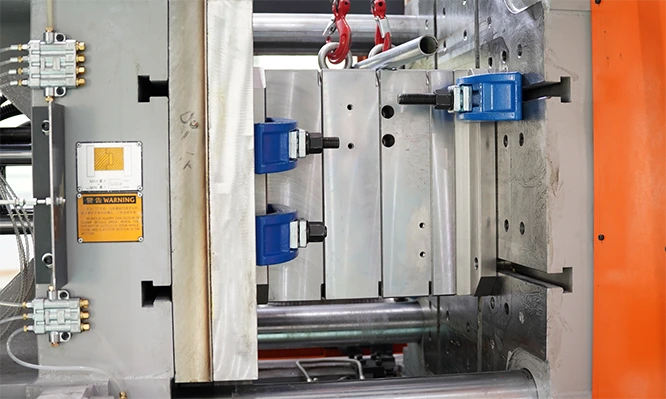
During injection molding, Polyester and Nylon have different processing requirements. Material drying, molding parameters, and part design can all affect the final part quality.
Nylon generally requires sufficient drying before injection molding. Its typical melting temperature is around 220-280℃. Since Nylon has relatively higher shrinkage, factors such as wall thickness, ribs, and dimensional compensation need to be considered during part design and mold development to reduce warpage and dimensional deviations.
Polyester also requires strict moisture control during processing, with typical processing temperatures around 230-280℃. Compared with Nylon, Polyester provides better dimensional stability after molding, making it easier to control tolerances and assembly requirements when designing precision structures.
Case Study:
We once compared PA66 and PET material solutions during the prototyping stage of a connector housing project.
When using PA66 for injection molding, we found during trial molding that the part dimensions showed noticeable variation. Additional optimization was required through mold compensation adjustments and molding parameter tuning. Since later mold modifications would involve relatively high costs, we evaluated an alternative solution and switched to PET for trial molding. The results showed that the molded dimensions were more stable, and the terminal positioning and assembly tolerances were easier to control.
FAQ
Q1: What are the prices of Nylon and Polyester?
Nylon is generally more expensive than Polyester, but the actual price depends on the material grade, reinforcement method, supplier, and order quantity.
Q2: What is Nylon made of?
Nylon is a type of polyamide material mainly composed of polymer chains containing amide groups. Common types include PA6 and PA66.
Q3: What plastic parts are commonly made from Nylon?
Nylon is commonly used for manufacturing gears, bushings, bearing retainers, automotive components, and other engineering plastic parts that require wear resistance and high strength.
Q4: Which is more environmentally friendly, Polyester or Nylon?
Both materials have recyclable options. Their environmental impact depends on factors such as production methods, recycling systems, and specific application scenarios.
Q5: Can Polyester and Nylon be mixed together?
Yes. In some applications, the two materials can be modified through blending or composite technologies to improve performance. However, the formulation needs to be designed according to specific performance requirements.