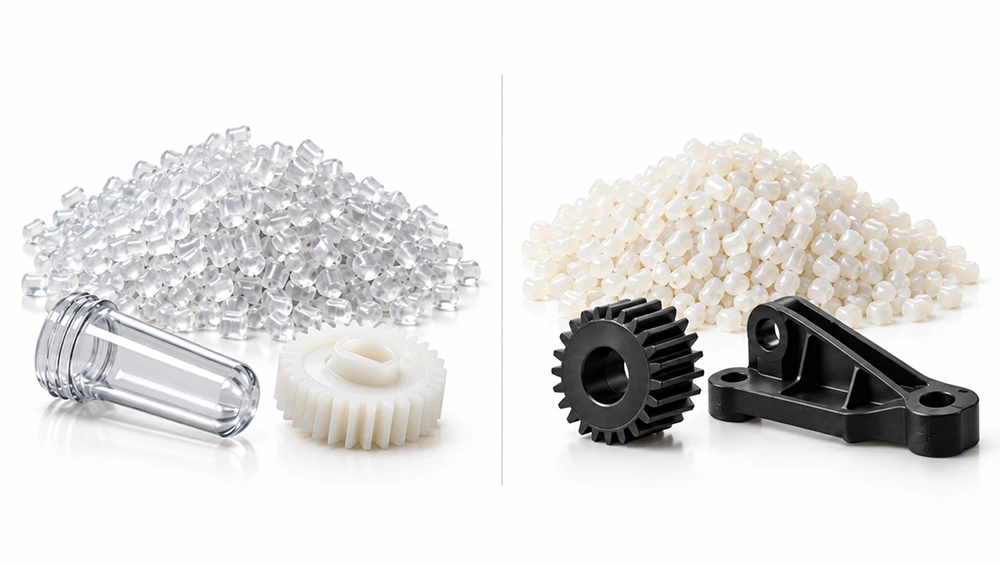
If you are choosing a plastic material for a charger housing, socket panel, automotive connector, or industrial control box, strength, appearance, and cost are not enough. As long as the part is close to electric current, heat sources, or batteries, the material’s burning behavior will directly affect product safety and certification requirements. A material selection reference table is included at the end.
So, what exactly are flame retardant plastics? How are different materials different? And how should you read UL 94 ratings? Let’s start with these questions and go through the materials, ratings, and applications of flame retardant plastics step by step, so you can make a basic judgment when choosing materials.
1. What Are Flame Retardant Plastics?
Basic Definition of Flame Retardant Plastics
Flame retardant plastics are plastics that either have a certain level of inherent flame resistance or, after flame retardants are added or the formulation is modified, can delay ignition, reduce the speed of flame spread, and self-extinguish more easily after being removed from the flame source.
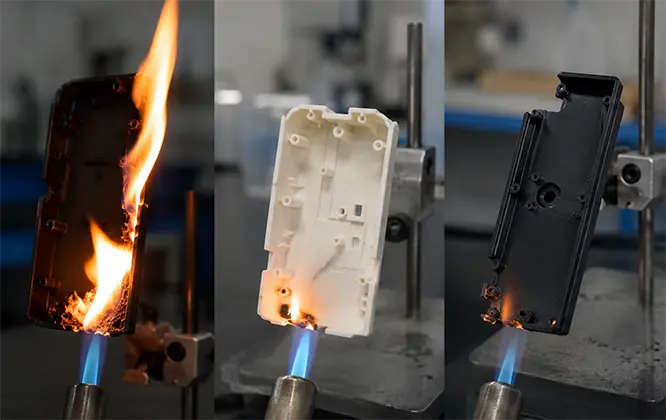
So, flame retardant plastics are not completely non-combustible plastics. Under a strong enough flame or continuous high temperature, they may still burn. Compared with ordinary plastics, however, they usually offer better control over burning, self-extinguishing behavior, and flame spread.
Halogen-Free and Halogenated Systems in Flame Retardant Plastics
Halogenated flame retardant systems usually have high flame retardant efficiency and can more easily achieve higher flame ratings, such as brominated epoxy resin and brominated polystyrene. Halogen-free flame retardant systems are more suitable for some electrical and electronic products, export products, and applications with environmental requirements. Common systems include phosphorus-based, nitrogen-based, phosphorus-nitrogen compound systems, aluminum hydroxide, and magnesium hydroxide.
Click here to learn about halogens: https://www.britannica.com/science/halogen
It should be noted that materials such as PVC, PTFE, and PVDF contain chlorine or fluorine in their own polymer structures and arHalogene halogen-containing polymers. ABS, PC, PA, PBT, and PP usually do not contain halogens themselves, but by adding halogenated or halogen-free flame retardants, they can be made into materials with different flame retardant systems.
2. What Is the Difference Between Flame Retardant Plastics and Flame Resistant Plastics?
Flame retardant plastics reduce burning risk through flame retardants or formulation modification. Flame resistant plastics put more emphasis on the material’s own resistance to flame or high temperature.
The two terms are often used interchangeably because, in actual purchasing and material descriptions, users care more about whether the material can meet flame retardant requirements. Many material pages also use terms such as flame retardant, flame resistant, and fire resistant at the same time.
3. What Are the Common Flame Retardant Plastic Materials?
Common base resins include ABS, PC, PC/ABS, PA, PBT, and PP, as well as high-performance plastics such as PPS, PEI, and PEEK.
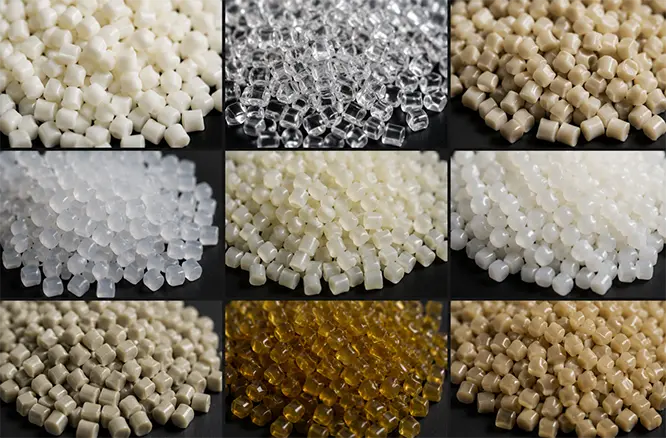
Comparison Table of Common Flame Retardant Plastic Materials
| Material | Typical Flame Rating | Main Features |
| Flame Retardant ABS | V-0 / V-1 / V-2 | Relatively low cost, easy to process, good appearance |
| Flame Retardant PC | Typically V-0 | High impact strength, good heat resistance, good dimensional stability |
| Flame Retardant PC/ABS | Typically V-0 | Balances toughness, processability, and appearance |
| Flame Retardant PA / Nylon | Typically V-0 | High strength and good wear resistance, but relatively high moisture absorption |
| Flame Retardant PBT | Typically V-0 | Good dimensional stability and electrical performance |
| Flame Retardant PP | V-0 / V-2 | Low density, low cost, good chemical resistance |
| PVC | Typically V-0 | Contains chlorine and has good inherent flame retardancy |
| PVDF | Typically V-0 | Contains fluorine, with good chemical resistance and flame retardancy, but higher cost |
| PTFE | Typically V-0 | Contains fluorine, with excellent heat resistance, chemical resistance, and flame retardancy, but requires special processing methods |
| Flame Retardant PPS | Typically V-0 | High heat resistance, strong chemical resistance, good dimensional stability |
| Flame Retardant PEI / PEEK | Typically V-0 | High heat resistance and high strength, but higher cost |
This table is only for initial reference. The same type of plastic may include both standard grades and flame retardant grades, so flame retardant performance cannot be judged by the material name alone.
The Impact of RoHS, REACH, and Other Regulations on Material Selection
Electrical and electronic products, export products, and some industrial products usually also need to consider RoHS, REACH, halogen-free requirements, UL Yellow Cards, and other requirements.
Especially in injection molding projects, the material must not only be moldable but also be able to provide the corresponding material documents. Otherwise, even if the plastic itself has flame retardant properties, it may still be unsuitable for the final product because the compliance documents are incomplete.
4. Introduction to UL 94 Flame Ratings
What Is UL 94?
UL 94 is a common flammability test standard for plastic materials. It is used to evaluate how plastics burn under specific test conditions.
UL 94 Rating Comparison Table
| UL 94 Rating | Test Direction | Single Afterflame Time | Total Afterflame Time | Is Flaming Dripping That Ignites Cotton Allowed? | Simple Explanation |
| HB | Horizontal burning | Judged by burning rate | — | Lower requirement | Basic horizontal burning rating |
| V-2 | Vertical burning | ≤30 s | ≤250 s | Allowed | Self-extinguishing, but with lower requirements |
| V-1 | Vertical burning | ≤30 s | ≤250 s | Not allowed | Stricter than V-2 |
| V-0 | Vertical burning | ≤10 s | ≤50 s | Not allowed | Common high flame rating |
| 5VB | 5V vertical burning | ≤60 s | — | Not allowed | Higher rating; plaque may burn through |
| 5VA | 5V vertical burning | ≤60 s | — | Not allowed | Higher rating; plaque must not burn through |
Note: Different sources may express the table details slightly differently. In actual projects, the material data sheet, UL Yellow Card, or specific test report should be used as the reference.
Key Factors Affecting Flame Ratings
Burning Characteristics of the Material Itself
Different plastics have different basic burning characteristics. Materials such as PP, PE, and POM are usually easier to burn. Materials such as PC, PPS, PEI, and PEEK are more likely to achieve better flame retardant performance.
Type and Addition Ratio of Flame Retardants
The type and addition ratio of flame retardants affect flame retardant performance. A higher addition ratio may improve flame retardancy, but it may also affect toughness, flowability, color, and cost.
The Impact of Product Wall Thickness on UL 94 Ratings
UL 94 ratings are usually related to test thickness. For example, a material data sheet may state “V-0 @ 1.5 mm” or “V-0 @ 3.0 mm”. Different thicknesses may result in different flame ratings.
Note: V-0 @ 1.5 mm means that this material can achieve a UL 94 V-0 flame rating on a 1.5 mm thick test specimen.
The Impact of Color, Glass Fiber, and Fillers on Flame Retardant Performance
Color, glass fiber reinforcement, mineral fillers, and other additives may all change flame retardant performance. Do not assume that the same material has the same rating in all colors and formulations.
The Same Plastic Does Not Necessarily Have the Same Flame Rating
“ABS”, “PC”, and “PA” are only material categories. They do not represent specific flame ratings. What really matters is the specific grade and test conditions. For example, standard ABS may not have a flame rating, while a specific flame retardant ABS grade may reach UL 94 V-0 @ 1.5 mm.
5. Main Applications of Flame Retardant Materials
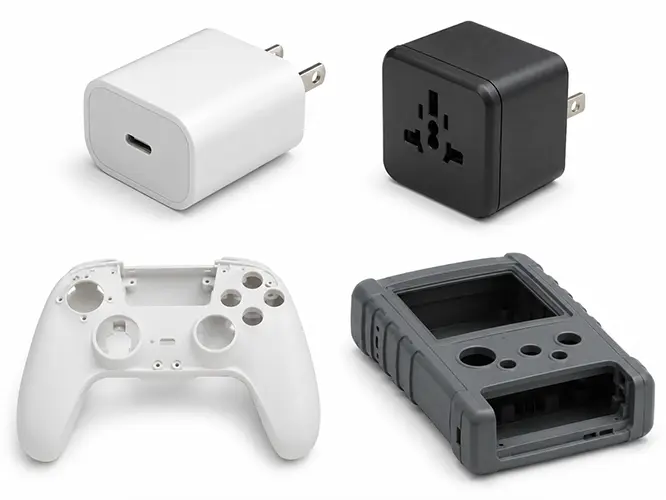
Electrical and Electronic Housings
Used in charger housings, power adapter housings, controller housings, instrument housings, and similar parts. The main purpose is to reduce the risk of flame spread during short circuits or overheating.
Connectors and Switch Components
Connectors, terminal blocks, switch housings, and similar parts are often close to electric current, so they usually need flame retardancy, dimensional stability, and electrical performance.
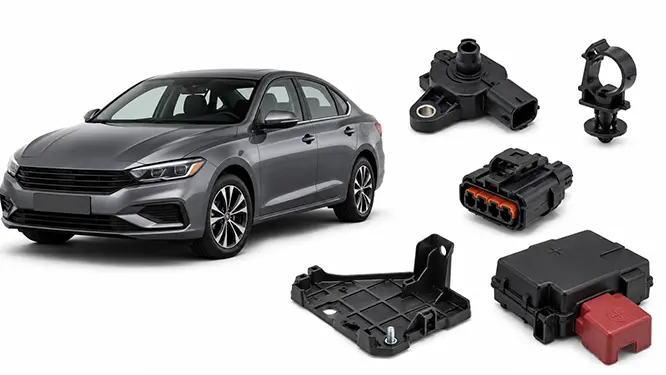
Automotive Electrical and Battery-Related Parts
Automotive sensor housings, wire harness fixtures, electrical connectors, battery-area parts, and similar components may use flame retardant plastics according to safety requirements.
Communication Equipment and Industrial Control Devices
Communication housings, server parts, industrial controllers, and internal parts of electrical cabinets usually focus on flame retardancy, heat resistance, and long-term stability.
Medical Device Housings and Internal Structural Parts
Medical device housings, testing instrument parts, and internal brackets sometimes need to balance flame retardancy, appearance, cleanliness, and compliance documents.
High-Temperature and High-Safety Parts
In aerospace, rail transit, high-temperature industrial equipment, and similar applications, high-performance flame retardant plastics such as PPS, PEI, and PEEK may be used.
FAQ
Q1: How Should You Understand Flame Retardant Information in a Material Data Sheet?
Focus on three points: UL 94 rating, test thickness, and material grade. Do not only look at “V-0”. Also check whether it is “V-0 @ 1.5 mm” or “V-0 @ 3.0 mm”.
Q2: What Are the Limitations of Flame Retardant Plastics?
They cost more, and some materials may affect toughness, flowability, color, and appearance. The higher the flame rating, the narrower the material options usually become.
Q3: Why Do More Products Require Halogen-Free Flame Retardant Materials?
Mainly because environmental regulations, export requirements, and brand specifications are becoming stricter. Halogen-free flame retardant materials are more suitable for some electrical and electronic products with higher environmental requirements.
Q4: Does UL 94 V-0 Mean the Product Is Completely Fireproof?
No. V-0 only means that the material specimen reaches the corresponding rating under specified test conditions. It does not mean the actual product will not burn in all fire scenarios.
Q5: Can Flame Retardant Plastics Be Used for Light-Colored or Transparent Parts?
Yes, but the material options are more limited. Flame retardants and colorants may affect color, transparency, and surface appearance, so the specific material grade needs to be confirmed.
Reference Table for Choosing Flame Retardant Plastics by UL 94 Rating
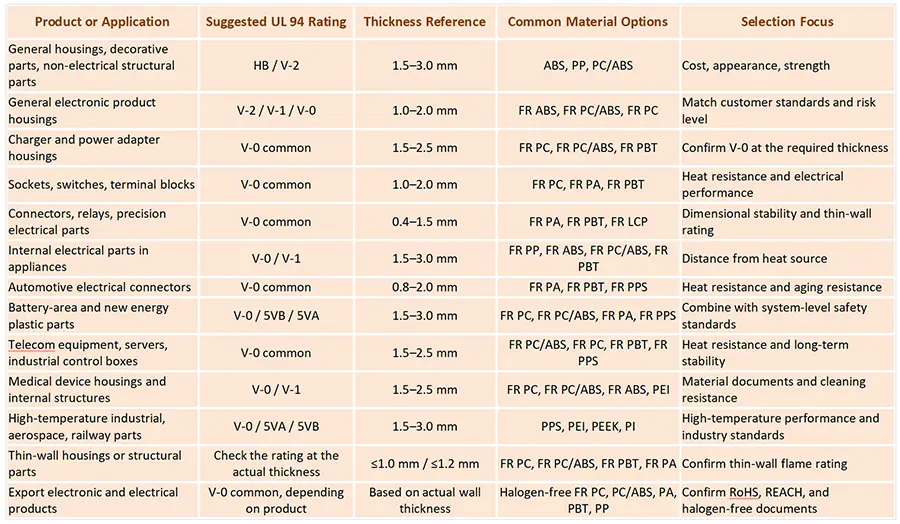
Usage note: The thickness reference is not a fixed design requirement. It is the test thickness that needs to be checked when selecting a material. For example, if the product wall thickness is close to 1.2 mm, do not only check whether the material has V-0 @ 3.0 mm. You need to confirm whether it can also achieve the target rating at 1.2 mm or a similar thickness.