PLA is easier to 3D print and has higher rigidity, while PETG generally offers better toughness, impact resistance, and heat resistance. Each material is suited to different applications. This article compares their material properties, manufacturing processes, costs, and environmental impact to help you choose the right material.
1. PLA vs PETG: Material Properties Compared
PLA and PETG are both thermoplastic polyesters, but they differ significantly in rigidity, toughness, heat resistance, and impact resistance.
| Property | PLA | PETG |
| Density (g/cm³) | 1.24 | 1.27 |
| Tensile Strength at Yield (MPa) | 62 | 50 |
| Tensile Modulus (MPa) | Not provided | 2,100 |
| Elongation at Break (%) | 3.5 | 130 |
| Notched Izod Impact Strength (J/m) | 16 | 101 |
| Glass Transition Temperature (°C) | 55–60 | 80 |
| Heat Deflection Temperature (°C) | 55 | 70 (0.455 MPa) |
| Water Absorption (%, 23°C, 24 h) | Not provided | 0.13 |
| Transparency | Can be transparent | High transparency |
| Chemical Resistance | Sensitive to acids, alkalis, and hydrolysis | Good resistance to many common chemicals |
| Weather Resistance | Limited for standard grades | Generally better than standard PLA |
Technical data sources: NatureWorks — Ingeo 3052D Technical Data Sheet
Eastman — Eastar 6763 Technical Data Sheet
*Some properties were measured under different test conditions, particularly heat deflection temperature, so direct comparisons should be made with caution. Actual properties vary depending on material grade, formulation, and processing conditions.
2. What Is PLA?
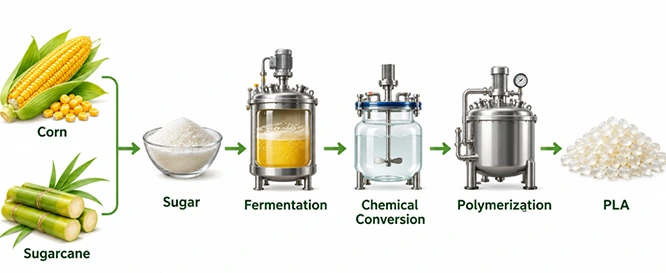
PLA (Polylactic Acid) is a bio-based thermoplastic polyester made primarily from sugars derived from renewable plant sources such as corn and sugarcane. These sugars undergo fermentation, chemical conversion, and polymerization.
PLA is available in various commercial grades based on molecular structure, crystallization behavior, and processing requirements. Examples include Ingeo 3052D for injection molding, 2003D for extrusion and thermoforming, and 4043D for film processing.
3. What Is PETG?
PETG (Polyethylene Terephthalate Glycol-modified) is a glycol-modified PET copolyester. By adjusting the monomer composition of the polyester, crystallization is suppressed, resulting in a typically amorphous material with different processing and physical properties from conventional semi-crystalline PET.
4. PLA vs PETG in Different Manufacturing Processes
PLA vs PETG Filament: Which Is Better for 3D Printing?
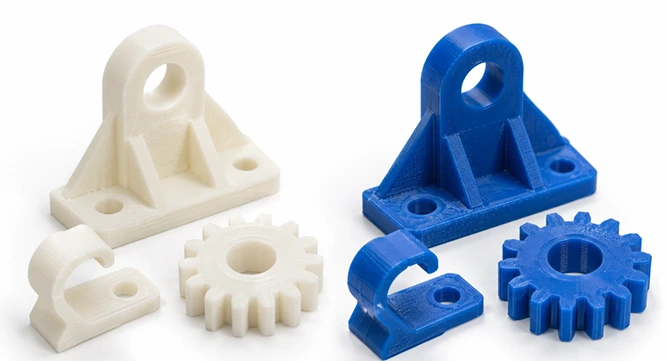
PLA and PETG are both widely used filaments for FFF/FDM 3D printing, but they differ in printing temperatures, bed adhesion, and final part performance. Their typical printing parameters are shown below:
| Printing Parameter | PLA Filament | PETG Filament |
| Nozzle Temperature | 185–235°C | 215–270°C |
| Bed Temperature | 50–60°C | 70–90°C |
| Printing Difficulty | Relatively easy | Easy to moderate |
| Warping Tendency | Low | Low, generally slightly higher than PLA |
| Stringing Tendency | Low | More noticeable |
| Layer Adhesion | Good | Generally stronger |
| Typical Printed Parts | Display models, decorative items, concept prototypes | Brackets, fixtures, functional prototypes |
Note: These temperatures represent common operating ranges and may not be optimal for every filament brand. Follow the filament manufacturer’s recommended settings.
PLA’s main advantage is its printing stability. It can produce models with clear details relatively easily. For beginners, display models, and rapid concept validation, PLA is often the more convenient choice.
PETG generally offers good interlayer adhesion and toughness, making it suitable for functional parts. However, it is prone to stringing, and its adhesion to the print bed can sometimes be too strong. Extra care is needed when using smooth PEI sheets.
PLA vs PETG in Injection Molding
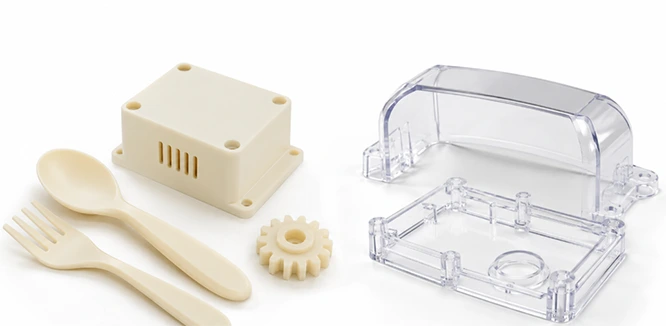
Both PETG and PLA are available in dedicated injection molding grades and can be processed using conventional injection molding equipment, but their processing requirements differ.
PETG typically requires higher melt temperatures. Material drying and mold temperature control directly affect the transparency, surface quality, and dimensional stability of molded parts.
PLA has a lower processing temperature but limited thermal stability. Moisture content, melt temperature, and residence time must be carefully controlled to minimize hydrolysis and thermal degradation. For PLA parts requiring improved heat resistance, crystallization control, along with appropriate mold temperatures and cooling conditions, must also be considered.
PLA vs PETG in Extrusion and Thermoforming
PETG is well established in transparent sheet extrusion and thermoformed packaging. It offers good melt strength, transparency, and formability, and is commonly used for display covers, trays, and medical packaging.
PLA is commonly used in bio-based packaging films, sheets, and certain disposable containers. Because standard PLA has relatively low heat resistance, heating temperatures and material crystallization must be controlled during thermoforming. Modified PLA grades are available for products requiring higher heat resistance or a more stable forming window.
5. PLA vs PETG: Cost and Environmental Impact
Cost
In the standard 3D printing filament market, PLA and PETG are generally priced similarly, although standard PLA is often cheaper. Prices also depend on the brand, material formulation, color, and purchase quantity. Specialty grades, such as high-speed PLA and reinforced PETG, can be considerably more expensive than standard products.
Environmental Impact
PLA is made from renewable biomass, and some certified PLA products can biodegrade under industrial composting conditions. However, standard PLA generally degrades slowly in natural environments or home composting systems and should not be discarded carelessly.
PETG is primarily derived from petrochemical feedstocks and does not have the same industrial compostability characteristics as PLA. It can, however, be reused through suitable mechanical recycling processes. Actual recycling options depend on local facilities, material sorting, and product contamination.
6. PLA vs PETG: Which Material Should You Choose?
Choose PLA: If your project prioritizes rigidity, ease of printing, bio-based feedstocks, and use at relatively low temperatures, PLA is generally the better choice. Typical examples include display models, concept prototypes, and certain disposable packaging products.
Choose PETG: If your product requires better toughness, impact resistance, transparency, or relatively higher heat resistance, PETG often has the advantage. Functional 3D-printed parts, transparent protective covers, and certain packaging containers are suitable applications for PETG.
Consider other materials: For prolonged exposure to high temperatures, heavy mechanical loads, or harsh chemical environments, engineering plastics such as ABS, PC, and PA may be worth evaluating. The appropriate grade should be selected based on specific operating conditions.
Frequently Asked Questions
Q1: Is PETG Stronger Than PLA?
It depends on how strength is defined. PLA generally has higher rigidity, and some grades also have higher tensile strength than PETG. PETG offers better toughness and impact resistance, making it generally less likely to fracture in a brittle manner under repeated bending or impact.
Q2: Is PLA Biodegradable?
Yes, but specific conditions are required. PLA products that meet industrial composting requirements generally need elevated temperatures, moisture, and microbial activity to biodegrade effectively. Standard PLA does not break down quickly in soil or natural bodies of water.
Q3: What Is PETG Filament?
PETG filament is a PETG plastic filament used in FDM/FFF 3D printing. Common diameters include 1.75 mm and 2.85 mm. It offers good toughness, interlayer adhesion, and moisture resistance.
Q4: Is PLA Toxic?
Pure PLA is generally considered to pose a low health risk under normal use conditions, but the safety of specific products depends on additives, processing methods, and usage conditions. PLA 3D printing may still release ultrafine particles and volatile compounds, so good ventilation is recommended.
Q5: What Is PLA Made Of?
PLA is primarily produced through the polymerization of lactic acid. Lactic acid is typically obtained by fermenting sugars from plant materials such as corn starch and sugarcane, followed by chemical processing to produce polylactic acid resin.