Why are some rubber and plastic materials very soft, while others feel almost as hard as rigid plastics? And what do ratings such as Shore A 60 and Shore D 70 mean on a product specification? Understanding the Shore hardness scale helps explain these differences. This guide covers the different Shore scales, typical hardness ranges of common materials, and how to choose the right hardness for your parts.
1. What Is Shore Hardness?
Shore hardness measures the hardness of non-metallic materials, such as rubber and plastics, based on how deeply an indenter penetrates their surface. A durometer measures this indentation and provides a reading, typically on a scale from 0 to 100. The higher the reading, the more resistant the material is to indentation. Different Shore hardness scales are used depending on the material’s hardness range and properties.
2. Shore Hardness Scale Chart
Different Shore hardness scales have their own measurement ranges. The chart below shows the approximate relationship between Shore A and Shore D hardness values.
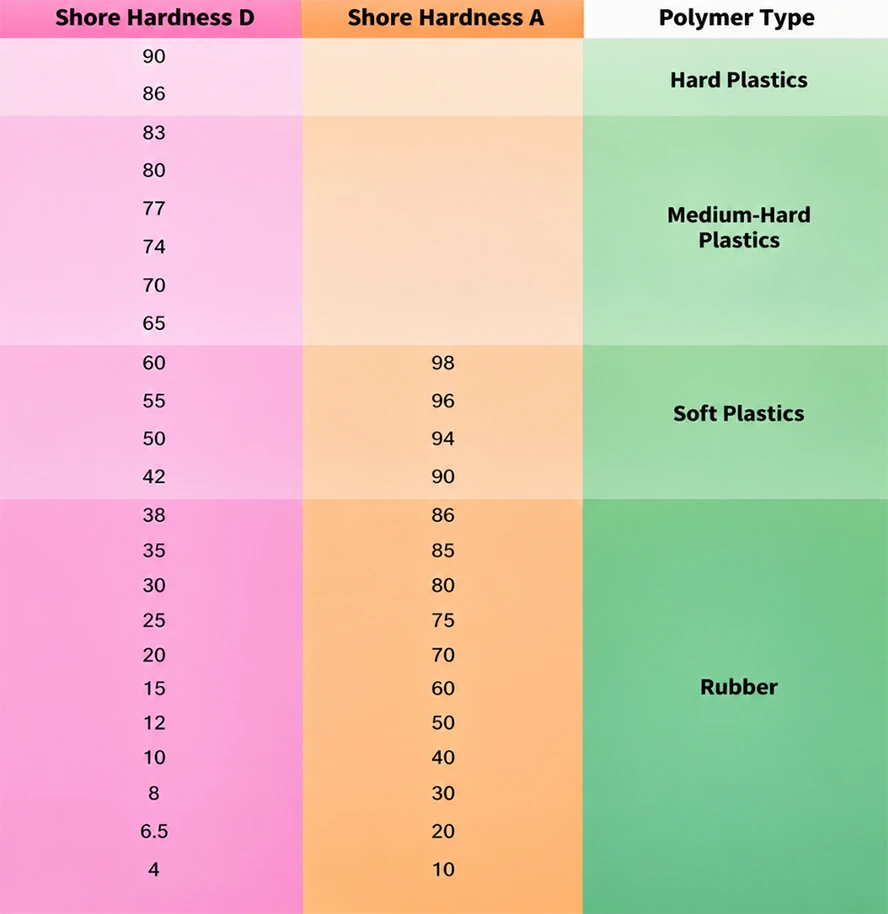
*Actual hardness varies with material type, formulation, and testing conditions. These values should not be treated as exact conversions.
3. Types of Shore Hardness Scales
Shore OO
Shore OO is mainly used for very soft materials, such as soft foams, gels, and sponge rubber. Its indenter design and test force are suited to measuring low-hardness materials.
Shore A
Shore A is one of the most commonly used hardness scales in industry. It is primarily used to measure rubber and elastomers, covering a wide range of soft to moderately hard elastic materials.
Shore D
Shore D is used to measure harder materials, including hard rubber, rigid elastomers, and certain plastics. It uses a different indenter geometry and test force than Shore A.
How to Choose the Right Shore Hardness Scale
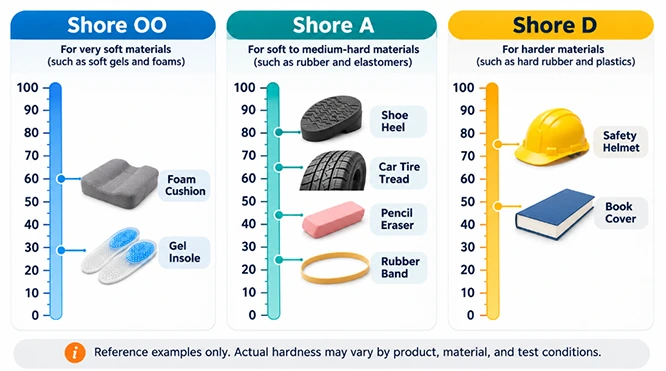
If you’re unsure which scale to use, start by comparing the material’s approximate hardness with familiar everyday objects in the chart below. Then select a suitable durometer for an initial test and adjust based on the reading:
Shore A below approximately 20: Consider switching to Shore OO.
Shore A above approximately 90: Consider switching to Shore D.
Shore D below approximately 20: Consider switching to Shore A.
4. Shore A vs Shore D vs Shore OO
Shore OO, A, and D use different indenter designs and test forces, making them suitable for different material hardness ranges. The table below highlights their main differences.
| Comparison | Shore OO | Shore A | Shore D |
| Indenter Shape | Spherical indenter | Truncated cone indenter | Pointed conical indenter |
| Indenter Tip | Spherical | Flat tip | Rounded conical tip |
| Spring Force | Low | Medium | High |
| Maximum Test Force | Approx. 1.11 N | Approx. 8.05 N | Approx. 44.5 N |
| Indentation Depth Range | 0–2.5 mm | 0–2.5 mm | 0–2.5 mm |
| Hardness Reading | 0–100 | 0–100 | 0–100 |
5. How Is Shore Hardness Measured?
Shore hardness is typically measured using a durometer. During testing, the indenter is pressed perpendicular to the material surface under a specified force and for a specified time. The instrument then displays a hardness reading based on the indentation depth.
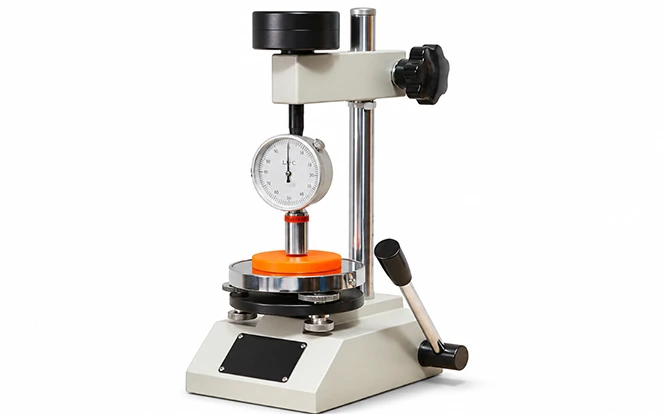
Basic Measurement Steps
① Prepare a flat material sample that meets the testing requirements.
② Position the durometer vertically so the indenter contacts the sample surface.
③ Apply the specified pressure and read the hardness value at the required time.
④ Take measurements at multiple locations according to the test standard and record the results.
Factors Affecting Measurement Results
Sample Thickness: If the sample is too thin, the underlying support may affect the indentation reading.
Surface Condition: Uneven surfaces or defects can cause inaccurate readings.
Test Time: Rubber and elastomers are viscoelastic, so the reading may change with indentation time.
Temperature: Temperature changes can affect a material’s softness and deformation behavior.
Measurement Location: Avoid sample edges and maintain the required spacing between test points.
Material Condition: Sample conditioning time, aging, and the testing environment can also influence the results.
Common Testing Standards
ASTM D2240: Specifies durometer hardness testing for rubber, thermoplastic elastomers, foams, gels, and certain plastics. It includes Shore OO, A, D, and other scales.
ISO 48-4:2018: Covers indentation hardness testing of vulcanized and thermoplastic rubber using Shore A, D, AO, and AM scales.
ISO 868:2003: Specifies indentation hardness testing for plastics and ebonite using Shore A and Shore D durometers.
These standards differ in their applicable materials and testing requirements. The appropriate standard should be selected based on the material type and product specifications.
6. Shore Hardness of Common Materials
Material hardness varies with the specific grade, formulation, and processing conditions. The table below provides typical hardness ranges for common materials as a reference for initial material selection.
| Material | Common Shore Scale | Typical Reference Range |
| Silicone Rubber | Shore A | 10A–80A |
| Thermoplastic Polyurethane (TPU) | Shore A / D | 60A–75D |
| Thermoplastic Elastomer (TPE) | Shore A / D | 20A–60D |
| Natural Rubber | Shore A | 30A–90A |
| Polyurethane Elastomer | Shore A / D | 50A–75D |
| Polypropylene (PP) | Shore D | Approx. 60D–75D |
| Polyoxymethylene (POM) | Shore D | Approx. 80D–85D |
| Nylon (PA) | Shore D | Approx. 75D–85D |
| PEEK | Shore D | Approx. 85D–90D |
7. How to Choose Materials Based on Shore Hardness
When selecting a material, start by considering the flexibility, elasticity, and structural support your part needs. This helps determine the appropriate hardness scale. The manufacturing process and actual operating conditions should also be taken into account.
Use Shore A for Parts That Need Flexibility, Elasticity, or Sealing
Shore A is suitable for flexible components, cushioning parts, seals, hoses, shoe soles, protective cases, and similar products. Common hardness values generally fall between 20A and 90A.
As a reference, rubber bands are around 20A, while rubber shoe soles are around 70A. Flexible silicone and TPU phone cases commonly fall within the 60A–90A range.
Use Shore D for Parts That Need Structural Support or Rigid Housings
Shore D is suitable for beams, brackets, housings, covers, guards, gears, hard rollers, and similar parts. Its hardness readings generally range from 20 to 100 in these applications.
Common engineering plastics such as POM, nylon, and PEEK are often characterized using Shore D hardness.
Use Shore OO for Extremely Soft, Highly Compressible, or Foam Materials
Shore OO is suitable for low-density foams, gels, very soft pads, and soft materials used in products that come into contact with the human body. If a material is so soft that its Shore A reading falls below 20 or cannot be measured reliably, Shore OO or another scale suited to soft materials can be considered.
Two Other Factors to Consider When Selecting Materials
Manufacturing Process
If you plan to use CNC machining, materials below Shore A 40 can be too soft, making them prone to deformation or sticking to cutting tools. This makes machining more difficult. In such cases, you may need to choose a harder material or switch to a process better suited to soft materials, such as injection molding, casting, or 3D printing.
Operating Conditions
Two rubber materials rated at 70A can differ significantly in wear resistance, oil resistance, and temperature resistance. Hardness only tells you how hard or soft a material is. You also need to check tensile strength, tear strength, aging resistance, chemical resistance, and other properties to ensure the material meets the actual operating requirements.
FAQs
Q1: What Does 70 Shore A Mean?
70 Shore A means the material has a hardness reading of 70 when tested with a Shore A durometer. This is commonly associated with relatively hard rubber and elastomers. The actual feel also depends on the material type and part geometry.
Q2: Which Is Harder, Shore A or Shore D?
Shore D is generally used for harder materials than Shore A, but their numerical readings cannot be compared directly. The two scales use different indenter shapes and test forces.
Q3: Can Shore Hardness Be Converted to Rockwell Hardness?
There is no universal conversion formula for all materials. The two methods use different testing principles and apply to different materials, so Shore hardness values cannot be directly converted to Rockwell hardness values.
Q4: Which Shore Hardness Scale Is Commonly Used for Silicone?
Silicone is typically measured using Shore A. For very soft silicone, Shore OO may also be considered depending on the material properties and testing requirements.
Q5: Does Higher Shore Hardness Mean a Stronger Material?
Not necessarily. Shore hardness measures resistance to indentation. It does not directly indicate tensile strength, impact resistance, or wear resistance. Other mechanical properties must also be considered when selecting materials.