In the periodic table, there is a group of elements that show some characteristics of both metals and nonmetals. These elements are known as metalloids. Although there are only a small number of them, metalloids play an important role in semiconductors, alloys, glass, and many other industrial applications because of their distinctive physical, electrical, and chemical properties.
1. What Are Metalloids?
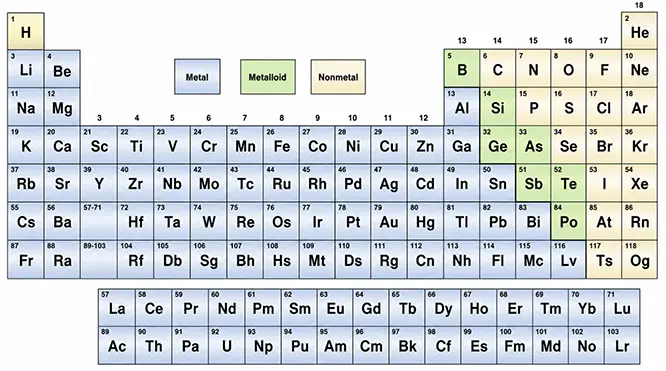
Metalloids are elements with properties that fall between those of metals and nonmetals. They are generally located along the “stair-step” boundary between metals and nonmetals on the periodic table.
What makes metalloids unusual is that they do not behave entirely like typical metals or typical nonmetals. For example, some metalloids have a metallic luster but are also relatively brittle. In terms of electrical conductivity, they generally fall somewhere between good conductors and insulators.
2. Which Elements Are Metalloids?
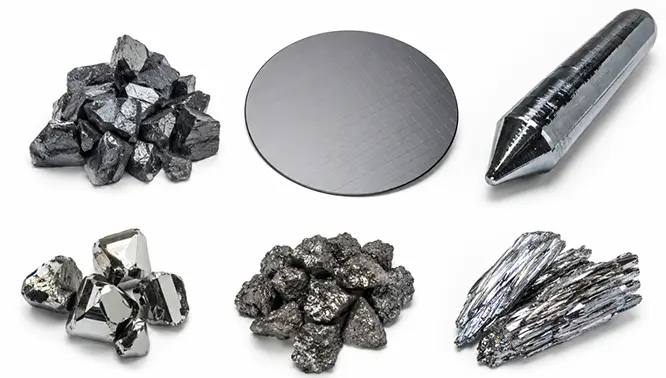
The following six elements are the most widely recognized metalloids:
| Element | Symbol | Atomic Number | Common Uses |
| Boron | B | 5 | Glass, alloys |
| Silicon | Si | 14 | Semiconductors |
| Germanium | Ge | 32 | Semiconductors, optics |
| Arsenic | As | 33 | Semiconductors |
| Antimony | Sb | 51 | Alloys, flame retardants |
| Tellurium | Te | 52 | Alloys, solar materials |
These six elements are the most commonly accepted metalloids. Selenium (Se), polonium (Po), and astatine (At) are also sometimes included, but their classification remains debated, and different sources may use slightly different definitions.
3. What Are the Main Properties of Metalloids?
Metalloids combine some characteristics of metals and nonmetals, but their exact properties vary from one element to another. The following are some of their most typical features.
1) Appearance and Physical Properties
Some metalloids have a metallic luster and may look similar to metals. Mechanically, however, they are generally brittle and are more likely to fracture under significant force, unlike many metals that offer good ductility.
Common metalloids are solid at room temperature. Their hardness, density, and melting points can vary considerably.
2) Electrical Conductivity
Electrical conductivity is one of the most important characteristics of metalloids.
Metalloids generally do not conduct electricity as well as typical metals, but they are more conductive than many nonmetals. Some show clear semiconducting behavior, and their conductivity can be influenced by factors such as temperature and impurity concentration.
3) Chemical Properties
The chemical behavior of metalloids also lies between that of metals and nonmetals.
They commonly form covalent bonds and may exhibit multiple oxidation states. Their behavior depends on the specific element and the substances involved in a reaction, so under some conditions they may act more like metals, while in others they behave more like nonmetals.
4. What Is the Difference Between Metalloids, Metals, and Nonmetals?
The main differences can be seen in several basic properties:
| Property | Metals | Metalloids | Nonmetals |
| Appearance | Usually have metallic luster | Some have metallic luster | Usually lack metallic luster |
| Electrical conductivity | Usually high | Moderate or semiconducting | Usually low |
| Ductility | Usually good | Usually brittle | Usually brittle when solid |
| General characteristics | Typical metallic properties | Between metals and nonmetals | Typical nonmetallic properties |
Metalloids are not simply “weaker metals.” Their defining feature is that they display a combination of metallic and nonmetallic characteristics, which allows them to meet certain application requirements that conventional metals or nonmetals may not handle as effectively.
5. What Are the Common Uses of Metalloids?
1) Semiconductors and Electronics
Semiconductors are one of the most important applications of metalloids.
Silicon is one of the primary semiconductor materials used in the modern electronics industry and is widely found in chips, transistors, integrated circuits, and sensors. Germanium also has semiconducting properties and is used in certain electronic and optical applications.
2) Alloys
Some metalloids can be added to metals as alloying elements to modify material properties.
For example, boron, antimony, and tellurium are used in different alloy systems. Depending on the material and the amount added, they can help improve properties such as strength, hardness, wear resistance, or machinability. Common examples of alloys containing metalloid elements include boron steel, lead-antimony alloys, and tellurium copper.
3) Glass and Ceramics
Compounds of boron and silicon are widely used in the glass and ceramics industries.
For example, borosilicate glass, which contains both boron and silicon, offers good resistance to thermal shock and is commonly used in heat-resistant glass and other industrial glass products. Silicon compounds are also important components of many glass and ceramic materials.

4) Energy and Other Industrial Applications
Beyond electronics, alloys, and glass, metalloids are also used in a range of industrial and energy-related applications.
For example, tellurium is used in certain solar cells and thermoelectric materials, while antimony compounds are commonly found in flame-retardant materials.
6. How Do Metalloids Affect Material Processing?
In practical manufacturing, metalloids are often not used as pure elements. Instead, they are commonly present as alloying elements or compounds. Even in small amounts, they can significantly affect a material’s hardness, strength, electrical conductivity, and machinability.
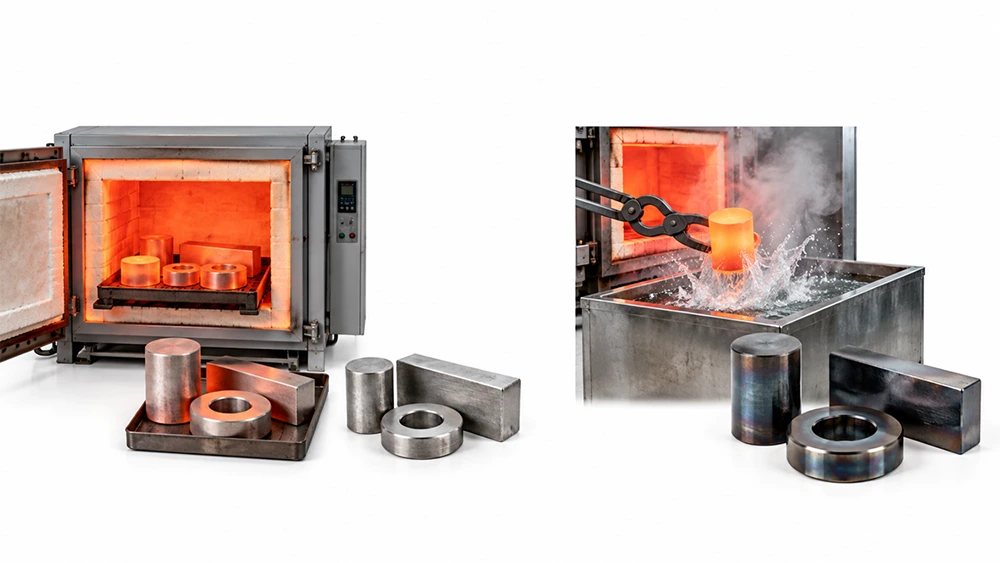
For example, tellurium in tellurium copper can improve the alloy’s cutting and machining performance, making it well suited for precision-turned parts and electrical components. Small additions of boron to boron steel can improve hardenability, resulting in higher strength and hardness. In some aluminum-silicon alloys, silicon content can also affect hardness, wear resistance, cutting performance, and cutting-tool wear during machining.
Conclusion
What makes metalloids truly important is not simply that they sit between metals and nonmetals, but that this intermediate behavior continues to create new possibilities in material design. As semiconductors, advanced alloys, and energy materials continue to develop, finding better ways to use these elements to improve material performance—and to meet increasingly complex manufacturing requirements—may become even more important.