
When purchasing non-stick pans and other cookware, you may have heard of Teflon coatings. But what exactly is Teflon? How can the same material be used both to manufacture plastic parts and as a coating on cookware? More importantly, is it safe for everyday use? Below, we will answer these questions one by one.
1. What Is Teflon (PTFE)?
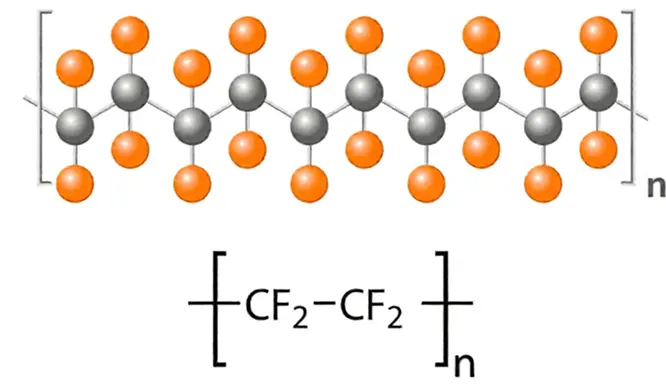
PTFE, commonly known as Teflon, is a fluoropolymer produced through the polymerization of tetrafluoroethylene monomers. Its repeating chemical structure can be written as (C₂F₄)ₙ. The carbon chain is surrounded by fluorine atoms, creating an exceptionally stable molecular structure. This structure is largely responsible for PTFE’s chemical resistance, low friction, and temperature resistance.
Strictly speaking, PTFE is the generic name of the material, while Teflon™ is a brand owned by Chemours. People often use “Teflon” as a general name for PTFE, but not every PTFE product belongs to the Teflon brand.
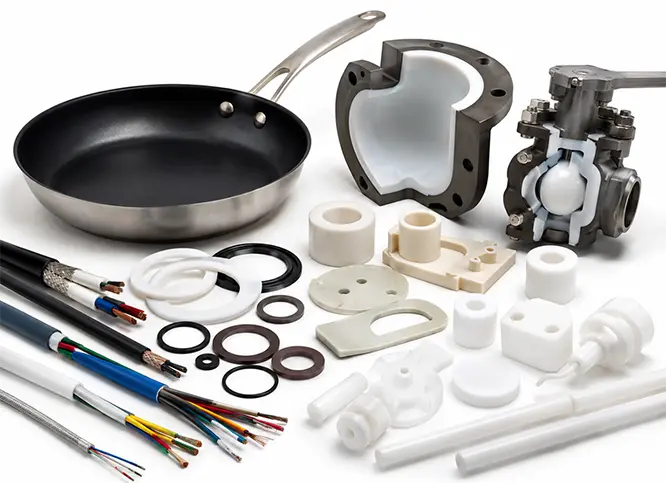
PTFE is a high-performance fluoroplastic, so it is not surprising that it can be manufactured into sheets, seals, insulating components, and other plastic parts. Through specialized coating and sintering processes, it can also be applied to metal surfaces as a coating. Water, oil, and food do not easily adhere to PTFE surfaces, which is the main reason it is widely used for non-stick cookware coatings.
2. Core Properties of PTFE
Extremely Low Coefficient of Friction
PTFE has one of the lowest coefficients of friction among plastics. According to typical data provided by Chemours, its dynamic coefficient of friction is approximately 0.05–0.10 when tested in accordance with ASTM D1894. The actual value can vary depending on the material grade, surface condition, load, and testing method.
PTFE also offers a certain degree of self-lubrication. However, low friction does not necessarily mean high wear resistance. Pure PTFE may still experience noticeable wear under long-term sliding or friction.
Excellent Chemical Resistance
PTFE remains highly stable when exposed to most acids, alkalis, solvents, and corrosive media. It is not easily dissolved, swollen, or chemically attacked. In testing conducted according to ASTM D543, Chemours rates the chemical and solvent resistance of PTFE as “excellent.”
Good Temperature Resistance
PTFE can remain stable across a wide temperature range of approximately −200°C to 260°C, and its typical melting point is around 327°C. However, heat resistance does not mean the material can be heated without limit. As temperature increases, its mechanical strength and dimensional stability gradually decline.
For this reason, PTFE-coated cookware is generally not expected to pose a health risk under normal use. However, if an empty pan is continuously heated until the temperature reaches approximately 360°C or higher, the PTFE coating may begin to decompose and release harmful fumes.
Excellent Electrical Insulation
PTFE has very high volume resistivity and low dielectric loss. Its typical volume resistivity exceeds 10¹⁸ Ω·cm, while its dielectric constant is approximately 2.1 at 1 MHz. These properties make it suitable for environments that require stable electrical insulation.
Extremely Low Water Absorption
PTFE absorbs almost no water. Its 24-hour water absorption rate is typically below 0.01%, so humid environments have relatively little effect on its dimensions or electrical performance.
Good Weather Resistance
PTFE offers strong resistance to ultraviolet radiation, oxidation, and outdoor environmental exposure. It does not easily age, crack, or lose its basic properties. Its actual service life, however, still depends on the material grade, component structure, and operating environment.
3. Common Applications of Teflon (PTFE)
| Common application | Main properties involved |
| Non-stick cookware coatings | Low surface energy, low friction, temperature resistance, and chemical resistance |
| Seals and gaskets | Chemical resistance, low friction, and low water absorption |
| Bushings and sliding components | Low friction and self-lubricating properties |
| Wire and cable insulation | Electrical insulation, temperature resistance, and low water absorption |
| Chemical equipment linings | Chemical resistance and temperature resistance |
| Machined components | Chemical resistance, low friction, and electrical insulation |
4. Limitations of Teflon (PTFE)
Lower Mechanical Strength Than Many Engineering Plastics
Pure PTFE is relatively soft, and its rigidity and load-bearing capacity are not particularly high. Its typical tensile strength is approximately 28 MPa, while its flexural modulus is around 496 MPa. For components exposed to high structural loads, filled PTFE or another engineering plastic with greater mechanical strength may be more suitable.
Susceptible to Creep Under Continuous Loads
When PTFE is subjected to pressure or a constant load for an extended period, it may gradually develop permanent deformation. This behavior is also known as “cold flow.” The effect generally becomes more pronounced at higher temperatures, so compression and dimensional changes should be considered when designing seals or load-bearing components.
Difficult to Bond
The low surface energy that gives PTFE its non-stick properties also makes it difficult for ordinary adhesives to form a strong bond with the material. When bonding is required, the surface usually needs chemical treatment, plasma treatment, or a mechanical fastening structure.
Relatively High Material and Processing Costs
Compared with common plastics such as PE and PP, PTFE generally has higher material and processing costs. Standard PTFE parts often require powder compression, sintering, and subsequent machining. This means more production steps, longer lead times, and lower material utilization than conventional injection-molded parts.
Standard PTFE Cannot Be Processed Like Ordinary Injection-Molding Plastics
Even after reaching its melting point, standard PTFE retains an extremely high melt viscosity. It cannot flow smoothly through a conventional injection molding machine like ABS, PP, or nylon.
PTFE is therefore commonly manufactured through compression molding, sintering, ram extrusion, or machining. When conventional injection molding is required, melt-processable fluoroplastics such as PFA or FEP may be considered instead.
Need an Injection-Moldable, High-Performance Fluoroplastic?
RJC Mold provides PFA injection molding services. With mature mold manufacturing capabilities, strict quality control, and an experienced engineering team, we help customers achieve stable production of precision PFA parts with excellent temperature and chemical resistance. Upload your 3D files now!
FAQ
Q1: Are Teflon and PTFE the Same Material?
They are often treated as the same material, but the two terms do not have exactly the same meaning. PTFE is the generic material name, while Teflon is a brand owned by Chemours.
Q2: Are PTFE Cookware Coatings Safe?
PTFE coatings are generally considered safe when cookware is used according to the manufacturer’s instructions. Avoid heating an empty pan for long periods or allowing the cookware temperature to reach approximately 360°C or higher.
Q3: Can PTFE Be Injection Molded?
Standard PTFE usually cannot be processed using conventional injection molding. It is typically manufactured through compression molding, sintering, extrusion, or machining. Melt-processable fluoroplastics such as PFA and FEP, however, can be injection molded.