
Whenever you’re machining, molding, or printing parts, knowing how each plastic acts in real world conditions saves money, time and stress. Here’s how I decide for myself and how you can too.
Note: A glossary is given at the end that defines all technical terms.
My Quick 60-second Decision Cheat Sheet
Whenever I have to pick between ABS vs PETG, three quick checks usually give me the answer.
End-Use Conditions
- I select PETG if the part will get exposed to chemicals, is for exterior use or needs to be clear and transparent
- I pick ABS if the part is for interior use, needs a smooth painted surface or if it must withstand heat and look good
Manufacturing & Process Factors
- Machining: I pick ABS when I want clean tapped threads, sharp cuts and a smooth surface finish.
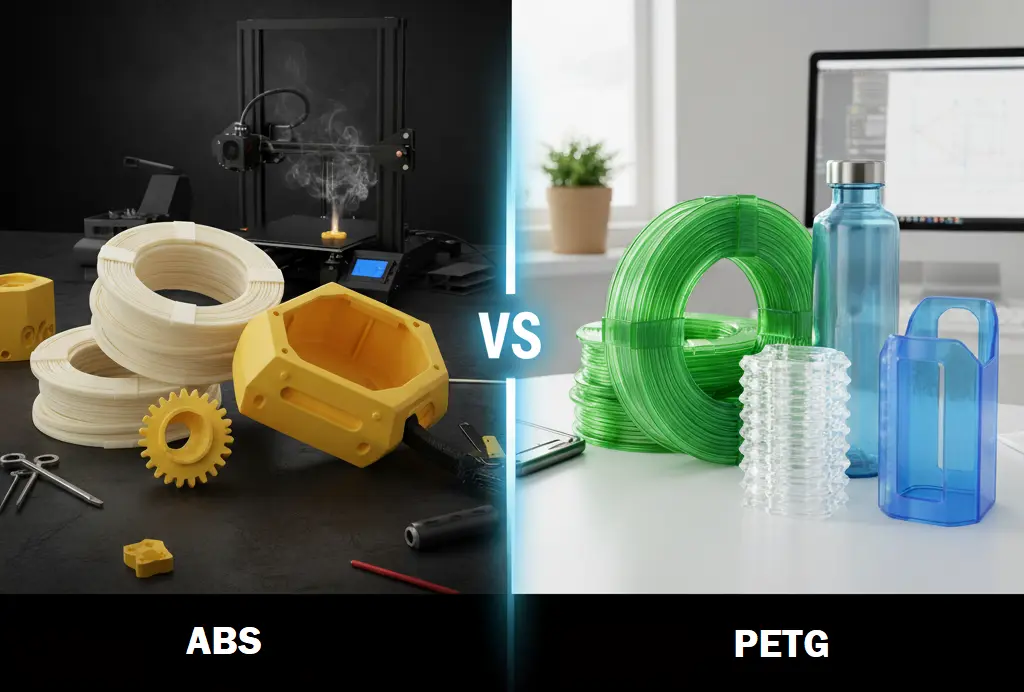
- 3D Printing: ABS gives high heat resistance, a professional look and easy post-processing when used in 3D printing. However it needs an enclosed printer to avoid warping. PETG on the other hand, prints with less trouble, holds up well outdoors and sticks layers well. But it does not handle heat very
- Injection Molding: Either plastic works for the cavity but each has a different behavior in the mold. I focus on drying needs, the surface texture, chemical compatibility and how each flows.
In my process, ABS is my pick for polished looks or when I need parts to handle heat. I pick PETG instead if a part must deal with UV, water or mild chemicals.
How Load and Temperature Shape Your Choice
- ABS is my go-to for mechanical shock, high, steady heat or jobs near electronics, engines or other hot spots.
- PETG works better if I want flexibility, impact resistance, weather durability or just solid toughness in changing conditions.
Material Basics—What You’re Really Choosing Between
- Basically ABS is a stiff, strong and amorphous thermoplastic. It takes paint and finishes well, is easy to machine and stands up to higher temperatures.
- PETG is PET with glycol added. It is clear, easy to form, has strong impact resistance and often lasts well against chemicals or weather.
How the Processing Route Shifts the Choice?
- Machining: ABS produces polished surfaces and cuts clean threads. PETG can be machined but it needs the right tools and feels softer.
- Injection molding: ABS is available in many grades and works well with texture and paint. PETG on the other hand resists chemicals, is clear and flows well.
- 3D printing: You can print with either plastic but they differ in finish, warping, heat resistance and how they handle the environment.
Strength Face-Off: PETG vs ABS

Many readers ask “Is ABS stronger than PETG?” or “How strong is PETG?” To give useful answers, consider the following points:
- Some studies have shown that certain grades of PETG have a higher tensile strength than ABS. This means PETG can stretch further before it breaks.
| Material | Tensile Strength (Yield) | Hardness | Ultimate Tensile Strength (Break) | Density |
| PETG | 50 MPa | Rockwell R ≈ 106 | 28 MPa | 1.27 g/cm³ |
| ABS | 39 to 45 MPa | Rockwell R ≈ 100 to 110 | 41 to 42 MPa | 1.03 to 1.06 g/cm³ |
- On the other hand when it comes to stiffness and temperature resistance—particularly under load or heat—then ABS generally performs better. For example the glass transition temperature of ABS is between 90 to 110 °C while for PETG it’s typically around 80 °C.
- In practical use: I pick PETG when I need a part that must bend, absorb shocks, or flex. However for parts that will handle steady loads, face heat, or need exact dimensions, I go with ABS.
To sum up, ABS can be stronger in terms of rigidity and heat resistance. However PETG, depending on the grade, may provide better durability and impact resistance.
Outdoor Durability & Chemical Exposure—ABS vs PETG
These two properties have a strong effect on material choice. Drawing from my own projects:
- Outdoor & UV exposure: PETG tends to last longer than standard ABS when exposed to weather and sunlight. ABS however needs special UV treatment or paint to match PETG’s performance outdoors.
- Chemical resistance: PETG is generally more resistant to alkalis, acids and cleaning agents. ABS often weakens when it touches some solvents
I once left a PETG bracket outside in hot, humid conditions for a year and it stayed in good shape. In comparison, an ABS bracket I painted developed cracks at the inner corners in less than a year due to UV exposure and heat.
Main Takeaway: PETG is generally the safer option for outdoor parts if you are not adding any UV protection or paint.
Machinability of ABS & PETG
Here is what I notice when I use drills, mills or CNC machines
- With ABS: I get clean chips, sharp threads and a smooth surface finish that is easy to paint. I select sharp carbide or HSS cutters, set a moderate speed and combine liquid with air mist for cooling.
- With PETG: I watch for smearing and chatter because the material has higher ductility. I choose polished cutters, run the machine at lower speeds, focus on removing chips and clamp the part securely. After machining I deburr the part carefully to avoid whitening or damaging the edges.
Dial-In Machining Parameters for PETG & ABS
| Parameter | PETG | ABS |
| Recommended Tooling | Sharp carbide tools, polished edges, high rake | Sharp HSS or carbide cutters, polished flutes |
| Feed per Tooth (fz) | 0.05-0.20 mm/tooth | 0.10-0.30 mm/tooth |
| Depth of Cut | Very light (≤ 1 mm/pass) | Light to medium (≤ 2 mm/pass) |
| Cutting Speed (Vc) | 150 to 300 m/min | 300 to 500 m/min |
My Opinion: I recommend ABS CNC machining for small-volume machined parts where finish quality is important such as those that will be textured, painted or those that require tight tolerances. Pick PETG if you need chemical resistance, clarity or outdoor durability. Just remember to adjust your feeds and tooling to match the material.
Injection Molding– ABS Compared to PETG
ABS must be dried thoroughly to remove moisture before molding and it needs specific mold temperatures. The material provides familiar finishes and textures and is sold in many grades like UV-stabilized, glass-filled and flame-retardant. I choose ABS when color, texture, post-painting or a strong enclosure are required.
PETG melts and molds at lower temperatures than some other polyesters. So it works better for clear parts or when chemical resistance is important. The material flows easily but I pay close attention to gate design for optical parts. Moreover I manage thickness transitions to prevent optical flaws or sinking.
Injection Molding Parameter for PETG & ABS
| Parameter | PETG | ABS |
| Mold Temperature | 20–60 °C | 60–80 °C |
| Injection Pressure | 80–140 MPa | 70–120 MPa |
| Drying Needed | Yes 2–4 hours at 65–75 °C | Yes, 2–4 hours at 80–90 °C |
| Melt Temperature | 220–260 °C | 210–250 °C |
| Shrinkage | 0.2–0.5% | 0.4–0.7% |
| Notable Processing Note | Dry well as it’s sensitive to moisture | Needs venting for gases |
Related blogpost: Tips For ABS Plastic Injection Molding.
3D Printing – ABS and PETG
While working on different projects, I have learned that ABS filaments are suitable for functional parts along with prototypes that need to handle heat and pieces that will be painted. To get a smooth look, I can easily sand, prime and finish ABS.
- Limitation: ABS parts may shrink or warp. In order to avoid cracking, I mostly use an enclosed build chamber.
PETG filament, in contrast, is easier to print with. It bonds layers strongly, is less prone to warping and stands up to sunlight, moisture and mild chemicals. When comparing “PETG vs ABS filament,” I often see PETG praised for its toughness and printability.
My Opinion: For outdoor projects or clear items like brackets, covers or display parts I pick PETG. ABS however, is preferred when the job needs a very polished surface or an internal fixture.
Related Blogpost: 3D Printing vs Injection Molding: Which Method Fits Your Project?
Supply Chain, Cost & Sustainability
When I compare availability and cost, ABS is usually easier for me to find in a wide range of grades and colors and it is slightly less expensive. However PETG is also becoming more common—particularly for clear sheets and food-safe uses. Both resins are recyclable, though PETG pulls ahead in packaging reuse. Still before choosing a material, I always check local recycling rules.
Where these Plastics Actually Show Up on the Factory Floor
| Requirement | My Pick | Reason |
| Mild heat, outdoor use, bracket or cover | PETG (or UV stabilized ASA & ABS) | Withstands weather better unless ABS is treated |
| Painted indoor housing, moderate heat ( approx 60 to 80 °C) | ABS | Handles heat well, has good finish, is easy to machine |
| Chemical splash, transparent guard, outdoor bracket | PETG | Clear, resistant to chemicals & weather |
| Short run molded part with chemical contact or optical requirement | PETG | Clear, flows well, durable with chemicals |
| Tight tolerance CNC prototype, small batch, tapped threads, | ABS | Ready for finishing , machines well |
From my experience, I use ABS for machine fixtures, enclosures, snap-fit designs or parts that need heat resistance, painting or texture. I turn to PETG for displays, clear guards, packaging or outdoor brackets because it is weather & chemicals resistant.
Lessons Learned– Pitfalls I’ve Run Into
Based on hands-on experience:
● ABS Material:
- When ABS sits under UV light without protection, it becomes brittle and yellow
- Failing to dry pellets or filament before printing or molding causes splay or voids to appear.
- Cracks can form after thermal cycling if the mold design includes sharp corners.
● PETG Material:
- Because PETG pulls in moisture, the quality of printing or molding can drop.
- If you machine PETG at the wrong speed or with dull tools, melting or smearing occurs and clean cuts are not obtained.
- Steep thickness change in mold design often leads to haze or sink marks—particularly in clear parts.
To Sum Up
What you choose depends on your project’s needs and the environment it will face. Pick ABS if you need heat resistance, strength and a smooth surface. Choose PETG instead for projects needing clarity, outdoor durability and chemical resistance. With careful planning and thoughtful design, both materials deliver reliable results.
If you need expert guidance and accurate production of ABS or PETG components then rely on RJC Mold. We are specialists in custom plastic manufacturing and molding.
Glossary of Technical Short Forms
- ABS – Acrylonitrile Butadiene Styrene
- PETG – Polyethylene Terephthalate Glycol-Modified
- PET – Polyethylene Terephthalate
- HSS – High-Speed Steel
- ASA – Acrylonitrile Styrene Acrylate
- MFR – Melt Flow Rate
- IV – Intrinsic Viscosity
- Vc – Cutting Speed
- fz – Feed per Tooth
Related Questions
What is the strength level of PETG?
PETG gives enough strength for a wide range of functional parts. It bonds layers effectively during 3D printing, resists impacts well and is reasonably resistant to chemicals and environmental factors.
Does ABS provide greater strength than PETG?
In many cases ABS provides more strength particularly where rigidity or heat resistance is important. PETG however may be the better option If the application needs better flexibility or impact resistance.
How durable is PETG when used outdoors?
PETG generally lasts longer outside than standard ABS unless the ABS is painted or UV-stabilized. The actual lifespan depends on factors like pigment or material grade, mechanical loads, UV light and weather. Therefore it is recommended to test the material in real conditions.
Can PETG handle high temperatures?
PETG can tolerate moderate heat. Its glass-transition temperature usually falls between 70 and 80 °C, depending on the specific type. For long mechanical loads or close use near heat sources, ABS is often a more reliable material.