
The Young’s modulus of common unreinforced plastics is approximately 0.15–4.20 GPa. A higher value means the material is less likely to undergo elastic deformation under the same load, while a lower value generally indicates that the material bends more easily.
However, the elastic modulus of a plastic is not a fixed number. Even within the same material family, it can vary with grade, temperature, moisture content, crystallinity, and molding direction. This article compares typical modulus values for common plastics and explains the testing methods, influencing factors, and practical role of modulus in plastic part design.
1. Elastic Modulus Comparison of Common Plastics
The following values represent typical data for common unreinforced grades at approximately 23°C. PA6 and PA66 are shown in the dry condition, while PVC-U refers to unplasticized rigid PVC.
| Material | Young’s Modulus Range (GPa) | Typical Young’s Modulus (GPa) | Density (g/cm³) | Specific Modulus E/ρ (10⁶ m²/s²) |
| LDPE | 0.15–0.35 | 0.25 | 0.92 | 0.27 |
| HDPE | 0.80–1.50 | 1.10 | 0.95 | 1.16 |
| PP | 1.20–1.80 | 1.60 | 0.90 | 1.78 |
| ABS | 1.80–2.60 | 2.20 | 1.05 | 2.10 |
| PC | 2.20–2.60 | 2.40 | 1.20 | 2.00 |
| PMMA | 2.40–3.30 | 3.05 | 1.19 | 2.56 |
| PA6 (Dry) | 2.70–3.50 | 3.40 | 1.13 | 3.01 |
| PA66 (Dry) | 2.80–3.30 | 3.10 | 1.13 | 2.74 |
| POM | 2.60–3.10 | 2.90 | 1.41 | 2.06 |
| PET | 2.00–3.00 | 2.40 | 1.38 | 1.74 |
| PBT | 2.30–2.70 | 2.40 | 1.30 | 1.85 |
| PVC-U | 2.40–4.10 | 3.00 | 1.40 | 2.14 |
| PPS | 3.50–4.20 | 4.00 | 1.35 | 2.96 |
| PEEK | 3.60–4.00 | 4.00 | 1.30 | 3.08 |
How to Interpret the Modulus Ranges
A plastic does not have one universal modulus value. General-purpose, impact-modified, flame-retardant, and filled grades use different formulations, so their stiffness also varies. The range reflects differences among common grades, while the typical value is intended for quick comparison.
2. What Is the Elastic Modulus of Plastic?
The elastic modulus of a plastic, also known as Young’s modulus, measures the material’s resistance to elastic deformation. It describes how readily a material strains when stress is applied within its elastic range. A higher modulus means the material is more resistant to deformation, while a lower modulus means it bends or stretches more easily.
Stress, Strain, and Young’s Modulus
The Young’s modulus of a plastic is derived from two basic measurements in a tensile test: stress and strain.
Stress indicates how much load the material is carrying. It is calculated as follows:
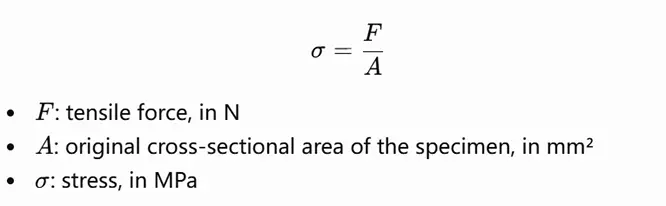
Strain indicates the proportional deformation of the material under load. It is calculated as follows:
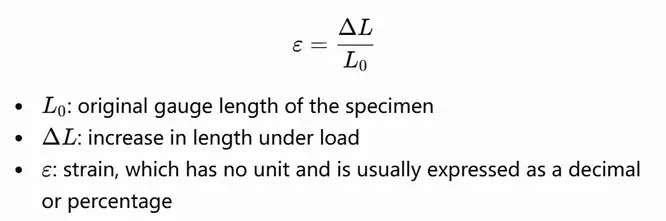
Young’s modulus is calculated as: 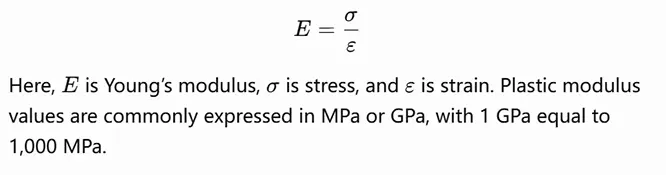
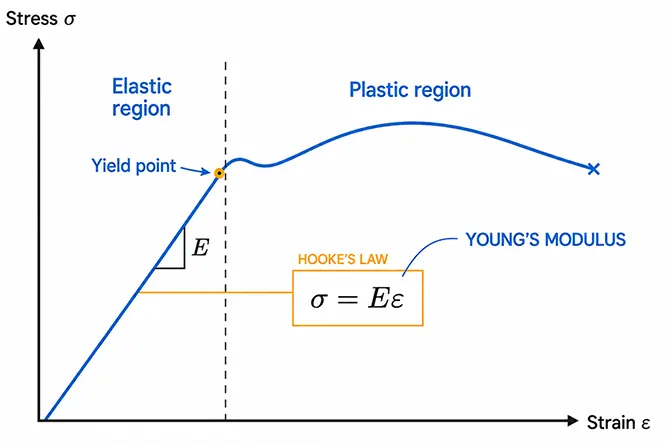
On a stress–strain curve, Young’s modulus is the slope of the initial elastic region. The steeper the slope, the more difficult the material is to stretch. Once the load exceeds the yield point, the material enters the plastic deformation region. The resulting deformation can no longer be fully recovered, and Young’s modulus is not calculated from this part of the curve.
What Do High and Low Modulus Mean?
A high-modulus material deforms less under the same load, making it suitable for brackets, gears, and precision housings. A low-modulus material bends more readily and may be better suited to flexible connections or structures that require elastic movement.
A higher modulus only means greater stiffness. It does not necessarily mean greater strength. For example, PMMA generally has a higher modulus than PC, but PC is usually much more impact resistant.
3. Why Can the Same Plastic Have Different Elastic Modulus Values?
Material Grade and Formulation
Copolymerization, impact modification, flame retardants, mineral fillers, and glass-fiber reinforcement can all change the modulus of a plastic. Data comparisons must therefore be based on the specific grade rather than only the polymer name.
Temperature and Moisture Content
Most plastics become softer as temperature rises, so room-temperature modulus values cannot directly represent high-temperature performance.
PA6 and PA66 are also moisture-sensitive. For example, BASF’s unreinforced PA6 grade Ultramid® Vision B3K UN has a tensile modulus of 3.1 GPa in the dry condition, but only 1.0 GPa after conditioning. This shows that moisture absorption can significantly reduce the stiffness of nylon parts.
Crystallinity
Semi-crystalline plastics such as PP, PA, POM, PBT, and PEEK are affected by crystallinity. Mold temperature, cooling rate, and part wall thickness can all change the crystalline structure, so the performance of a standard test specimen may differ from that of an actual injection-molded part.
Strain Rate and Test Conditions
Plastics are viscoelastic. Different loading speeds, test temperatures, specimen conditions, and modulus calculation ranges can therefore produce different results.
Injection Molding Conditions and Molding Direction
During injection molding, polymer chains and glass fibers tend to align with the melt-flow direction, causing the elastic modulus to vary by direction. Gate position, flow path, and cooling conditions can therefore affect part stiffness and may also increase the risk of deformation or warpage.
4. How Is the Elastic Modulus of Plastic Tested?
ASTM D638 and ISO 527 Tensile Testing
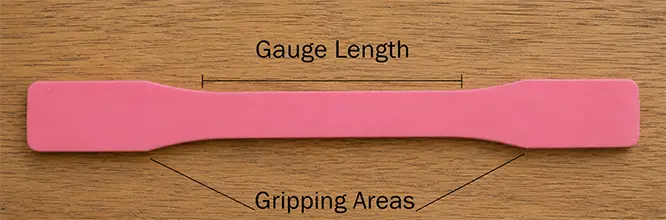
In a tensile test, a dumbbell-shaped specimen is gradually stretched while the stress–strain curve is recorded. The tensile modulus, which is the Young’s modulus discussed in this article, is then calculated from the initial part of the curve.
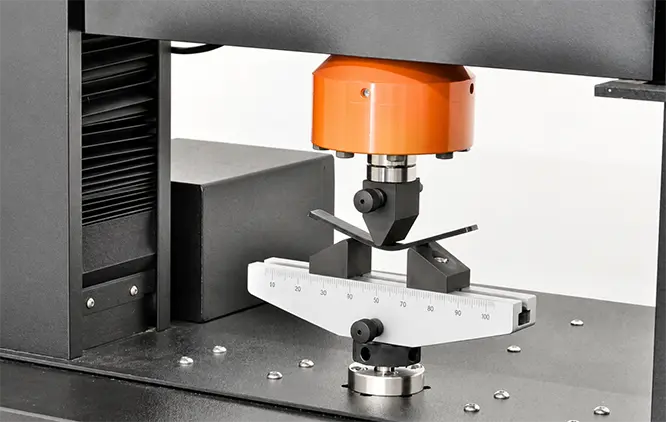
ASTM D790 Flexural Testing
In a flexural test, a rectangular specimen is supported at two points and loaded from the center to determine its flexural modulus. This method is more suitable for comparing panels, housings, and beam-like structures, but flexural modulus should not be used interchangeably with tensile modulus.
ASTM D638 is used to measure the tensile properties of reinforced and unreinforced plastics, while ASTM D790 uses a three-point loading method to evaluate flexural properties.
Dynamic Mechanical Analysis
Dynamic mechanical analysis measures how storage modulus and loss modulus change with temperature or frequency. It is more useful for evaluating plastics under vibration, elevated temperatures, or cyclic loading.
5. Practical Applications of Elastic Modulus in Plastic Part Design
Snap-Fits
A snap-fit must bend during assembly and recover afterward. If the modulus is too low, the feature may lack sufficient recovery force or retention. If the modulus is high but the allowable strain is limited, whitening or cracking may occur.
We once used elastic-modulus analysis to help a customer solve a snap-fit problem in an electronic device housing.
The original design used ABS, with a snap arm length of 16 mm, a thickness of 1.8 mm, and an assembly deflection of 1.6 mm. During trial assembly, the snap was difficult to press into place, and whitening appeared at the root. Based on a cantilever-beam calculation, the original root strain was approximately 1.7%, while the theoretical assembly force was about 10 N.
We then increased the snap arm length to 22 mm, reduced the thickness to 1.5 mm, enlarged the root radius from R0.4 to R1.0, and adjusted the undercut and lead-in angle. After optimization, the theoretical strain fell to approximately 0.7%, and the assembly force dropped to about 2.3 N. The snap could then be assembled smoothly, recovered normally, and no longer showed whitening.
RJC Mold can review the material grade, assembly deflection, and 3D structure during DFM analysis before mold manufacturing, helping reduce snap-fits that are too stiff, fail to recover, or crack during mold trials.
Brackets and Cantilever Structures
Bracket deflection depends on material modulus, wall thickness, span, and support position. Adding ribs or increasing section height is often more effective than making a small increase in material modulus.
Gears and Transmission Parts
When the material modulus is too low, gear teeth can deform elastically, affecting meshing accuracy and load distribution. POM provides good dimensional stability; PA offers wear resistance, but its stiffness changes after moisture absorption; PEEK performs well at high temperatures, although it is considerably more expensive.
Screw Bosses and Assembly Features
Modulus affects deformation after screw tightening and the retention of clamping force. However, boss wall thickness, hole dimensions, thread interference, and root radii must also be controlled.
Housings and Panels
If the housing material has insufficient modulus, pressing may cause local indentation, joint opening, or assembly noise. Ribs, flanges, curved surfaces, and internal supports are often more effective than simply switching to a higher-modulus material.
FAQ
Q1: Which common plastic has the highest elastic modulus?
Among the unreinforced plastics in the table, PPS and PEEK are relatively high, with a typical Young’s modulus of about 4 GPa.
Q2: Does the elastic modulus of nylon decrease after moisture absorption?
Yes. Moisture makes nylon more flexible but significantly reduces its stiffness.
Q3: Does a higher elastic modulus mean a plastic is stronger?
No. Modulus describes stiffness, while strength describes the stress a material can withstand before yielding or breaking.
Q4: Can modulus values from a material data sheet be used directly in part calculations?
Not always. The specific grade, temperature, moisture condition, test standard, and molding direction must also be considered.
Q5: How much can glass-fiber reinforcement increase the modulus of a plastic?
Using PA6 as an example, an unreinforced grade may have a modulus of approximately 3.1 GPa, while dry PA6-GF30 can reach about 9.5 GPa—roughly three times higher.