Straight cooling channels and conformal cooling channels each have their advantages and are suited to different mold structures and production requirements. The cooling stage typically accounts for a significant portion of the injection molding cycle. Cooling system design directly affects production efficiency, part dimensional stability, and product quality. Understanding the structural characteristics, performance differences, and applications of these two cooling methods helps determine a more suitable mold cooling solution.
1. What Are Straight Cooling Channels?
Straight cooling channels are the most common cooling structures in conventional injection molds. They are typically formed by drilling straight passages inside the mold core and cavity, allowing cooling water to circulate and remove heat generated during the molding process.
Structure and Working Principle
Straight cooling channels are typically arranged along the longitudinal or transverse direction of the mold. Depending on the mold structure, they can be drilled in parallel, perpendicular, or staggered configurations. Multiple channels can be connected through cross-drilled holes, plugs, and external piping to form a complete cooling circuit.
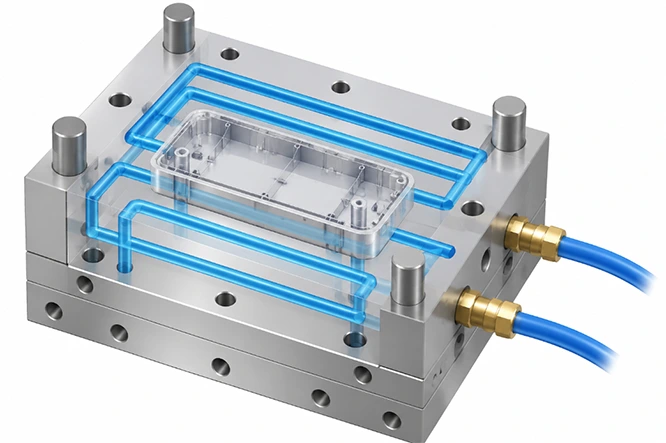
As cooling water flows through the mold, it absorbs heat transferred from the plastic part through the mold steel and carries that heat out of the mold. Channel position, diameter, spacing, and water flow rate all affect overall cooling performance.
Main Advantages
Simple Manufacturing: Primarily produced through conventional machining processes such as drilling. The technology is well established, and machining costs are relatively low.
Easy Maintenance: The channel structure is relatively simple, making cleaning, inspection, and maintenance easier.
Wide Applicability: Generally meets cooling requirements for plastic parts with simple geometries and relatively uniform wall thicknesses.
Shorter Manufacturing Lead Time: No complex internal channel fabrication is required, making mold machining and repair relatively straightforward.
Limitations
Limited Layout Flexibility: Drilling direction and machining depth restrict channel placement, making it difficult to follow complex cavity contours.
Uneven Cooling: Deep cavities, thick-walled sections, and complex curved surfaces may be located too far from the cooling channels, creating localized hot spots.
Dimensional Stability Risks: Differences in cooling rates across different regions can increase the risk of differential shrinkage and part warpage.
2. What Are Conformal Cooling Channels?
Conformal cooling channels are cooling structures designed according to the geometric contours of the mold cavity. Unlike conventional straight channels, they can follow curved, spiral, or other complex paths, allowing the cooling passages to better conform to the internal geometry of the mold.
Structure and Working Principle
Conformal cooling channels are designed based on the three-dimensional geometry of the part and mold. The channels maintain a relatively consistent distance from the cavity surface. With an optimized layout, cooling water can cover complex areas more effectively and improve temperature distribution within the mold.
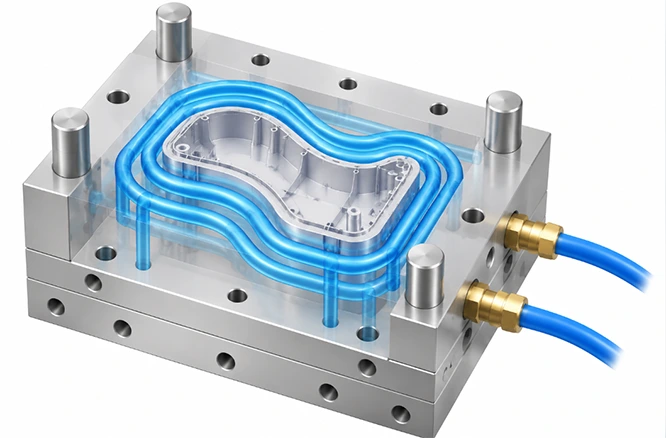
Complex, continuous internal channels are generally difficult to produce through conventional drilling. Metal additive manufacturing has therefore become an important manufacturing method. Laser Powder Bed Fusion (LPBF), for example, uses metal powder to build mold inserts layer by layer, allowing complex internal cooling channels to be produced.
Main Advantages
Improved Temperature Uniformity: Channels can follow complex cavity contours, reducing inadequate cooling in certain areas.
Shorter Cooling Time: Better channel positioning helps improve local heat transfer and reduce the cooling time required in hot spot areas.
Improved Dimensional Stability: More uniform cooling helps reduce differential shrinkage and warpage, improving part dimensional consistency.
Adaptability to Complex Structures: Provides greater flexibility in cooling channel layouts for deep cavities, complex curved surfaces, and locally thick-walled sections.
Limitations
Higher Manufacturing Costs: Metal additive manufacturing equipment and additional post-processing operations are usually required, increasing mold manufacturing costs.
Difficult Internal Cleaning: Internal channels may have rough surfaces and residual metal powder, making cleaning and maintenance more difficult.
Flow Resistance: Curved paths and changes in channel cross-section can increase pressure losses. Channel dimensions and flow paths need to be properly designed.
Structural Strength Requirements: Channel layouts must avoid internal structures such as ejector pins and screws while ensuring that the mold insert has sufficient strength and service life.
Case Study: Conformal Cooling Channels Designed to Avoid Ejector Pins
A conformal cooling system is used in an automotive key fob mold. As shown below, the cooling channels follow the cavity contours, winding around multiple ejector pin holes while connecting to the cooling circuit through vertical passages.
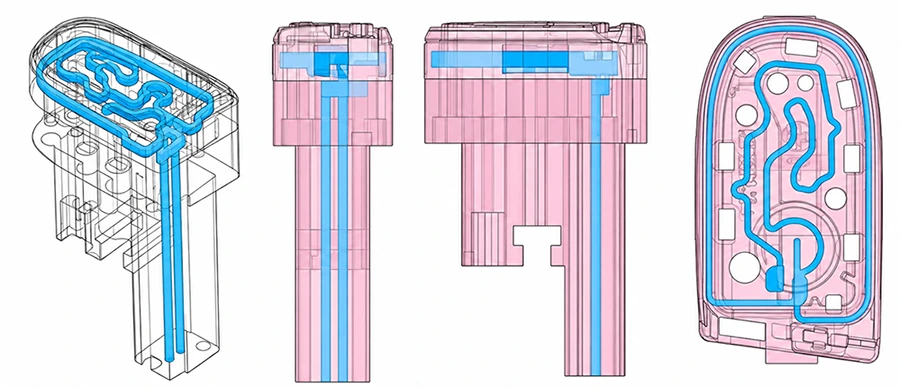
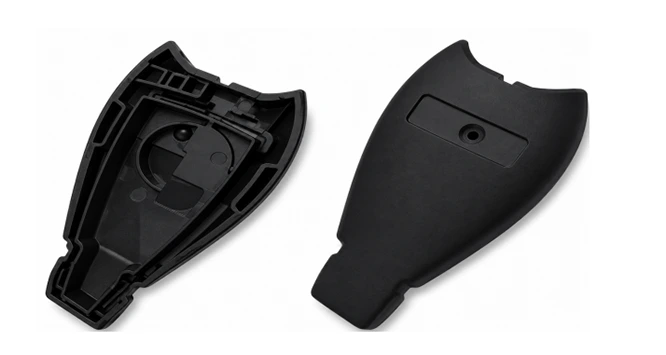
This layout makes full use of the internal space of the mold core. It allows the cooling channels to avoid the ejector pin structures while remaining as close as possible to the part-forming areas.
3. Key Differences Between Straight and Conformal Cooling
The two cooling methods differ significantly in channel structure, manufacturing processes, cooling performance, and cost.
| Comparison | Straight Cooling Channels | Conformal Cooling Channels |
| Channel Structure | Straight drilled passages | Follow cavity contours |
| Manufacturing Method | Conventional drilling | Metal additive manufacturing, etc. |
| Design Flexibility | Lower | Higher |
| Temperature Uniformity | Limited by channel layout | Easier to optimize |
| Cooling Efficiency | Meets conventional requirements | More advantageous for complex structures |
| Manufacturing Cost | Lower | Higher |
| Maintenance Difficulty | Lower | Relatively higher |
| Applications | Conventional geometries | Complex curved surfaces and localized hot spots |
The actual performance of conformal cooling depends on channel design, cooling water flow rate, pressure, mold material, and injection molding process parameters. More complex channel structures do not necessarily deliver higher cooling efficiency.
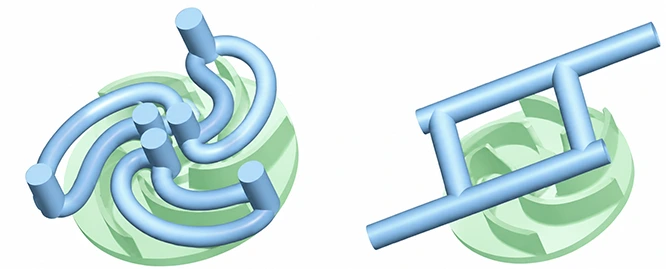
4. How to Choose the Right Cooling Channels?
The choice of cooling channels should be based on part geometry, cooling requirements, mold manufacturing costs, and production requirements.
When Should You Choose Conventional Straight Cooling?
Simple Geometry: Flat parts and conventional housings with regular geometries, where cooling channels are easy to arrange.
Uniform Wall Thickness: Cooling requirements are similar across different regions, with no significant hot spots.
Sufficient Space: The mold core and cavity have enough room for drilled cooling channels without interfering with ejector pins or other internal structures.
Cost Considerations: Conventional cooling channels already meet the cooling requirements, eliminating the need for additional metal 3D printing costs.
When Is Conformal Cooling Worth Considering?
Complex Geometry: Deep cavities, deep ribs, and complex curved surfaces that are difficult to reach with conventional drilled channels.
Localized Hot Spots: Areas such as cavity bottoms, thick-walled sections, boss roots, and rib intersections where heat tends to accumulate.
High Precision Requirements: Large thin-walled parts and precision components require better control of cooling differences to reduce warpage and differential shrinkage.
High Production Efficiency Requirements: In high-volume production, shorter cooling cycles can bring significant productivity gains.
Why Can a Hybrid Cooling Design Be More Practical?
In actual mold design, conformal cooling does not need to be used in every area. Straight and conformal cooling channels can be combined according to the cooling requirements of different regions.
For example, conventional drilled channels can be used in most areas of the mold, while conformal cooling inserts are applied to complex cores, localized hot spots, or areas where straight channels are difficult to position.
This hybrid approach combines the advantages of both cooling methods, improving cooling performance in critical areas while controlling additive manufacturing costs and maintenance requirements.
Conclusion
Straight cooling channels are suitable for molds with regular geometries and conventional cooling requirements, while conformal cooling is better suited to complex cavities and localized hot spots. Both channel types can also be combined in complex molds.
Channel spacing, the distance from the cavity surface, and cooling water flow rate all affect cooling performance. Cooling design should prioritize areas with insufficient cooling while also considering mold strength and manufacturing costs.