


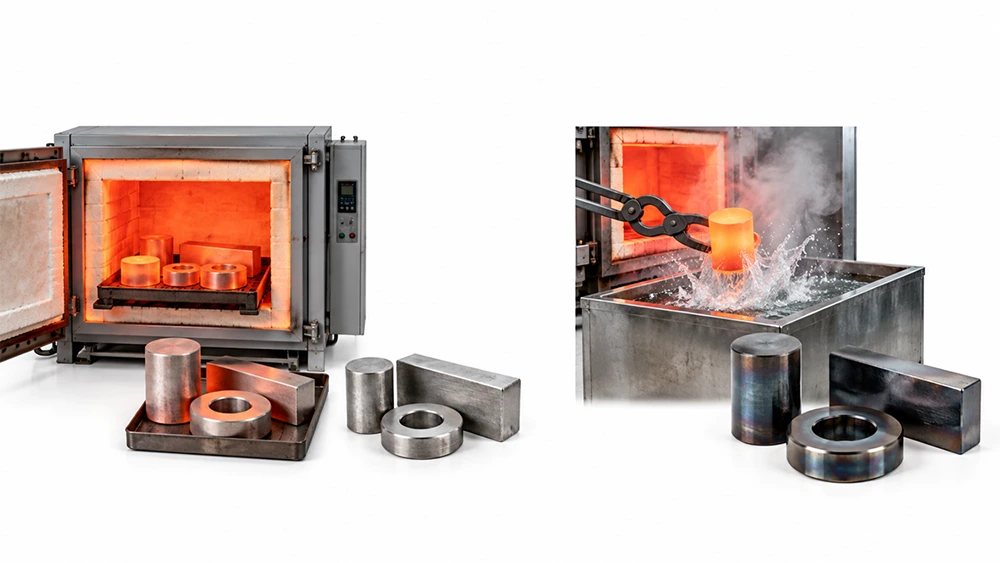
Annealing and quenching are two common metal heat treatment processes that differ in their cooling methods, purposes, and effects on material properties. Annealing is typically used to reduce hardness and improve ductility, while quenching can increase the hardness and wear resistance of suitable steels. This article explores their key differences, advantages, disadvantages, and practical applications.
1. What Is Annealing?
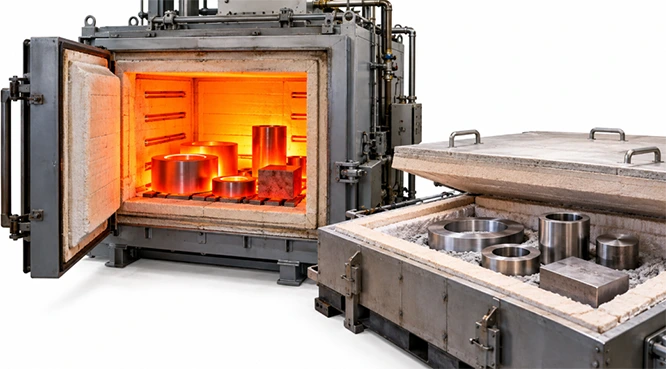
Annealing is a heat treatment process in which metal is heated to a specific temperature, held for a certain period, and then cooled slowly or at a controlled rate.
The main purposes of annealing are to reduce material hardness, increase ductility, improve machinability, and, under appropriate conditions, relieve internal residual stresses. For certain steels, annealing can also modify the grain structure and produce a more uniform microstructure.

2. What Is Quenching?
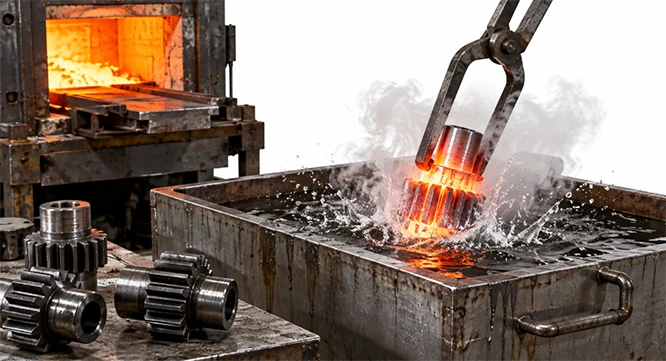
Quenching is a heat treatment process in which metal is heated to a specified temperature, held for a certain period, and then rapidly cooled using a medium such as water, oil, a polymer solution, or gas.
In hardenable steels, rapid cooling promotes the transformation of austenite into hard martensite, increasing hardness and wear resistance. However, quenching can also increase brittleness and residual stresses. Steel components typically require subsequent tempering to adjust their hardness, toughness, and overall mechanical properties.

3. Key Differences Between Annealing and Quenching
The main difference between annealing and quenching lies in their cooling rates and how they affect the metal’s microstructure and properties.
| Comparison | Annealing | Quenching |
| Primary Purpose | Soften the material and improve ductility and machinability | Achieve a specific microstructure and increase the hardness of hardenable steels |
| Heating Process | Heating and holding based on the material and type of annealing | Heating and holding based on the material and quenching requirements |
| Cooling Rate | Generally slow or controlled cooling | Rapid cooling |
| Cooling Method | Furnace cooling or other controlled cooling methods | Cooling in water, oil, polymer solutions, or gas |
| Hardness | Generally decreases | Generally increases in hardenable steels |
| Ductility and Toughness | Generally improves ductility | Ductility and toughness may decrease in hardened steels |
| Residual Stress | Can reduce residual stresses | May introduce significant residual stresses |
| Distortion Risk | Generally lower | Generally higher |
| Typical Applications | Softening before machining and restoring properties after cold working | Hardening gears, tool steels, and wear-resistant components |
Annealing primarily improves machinability, while quenching focuses on increasing the hardness of hardenable steels. The actual results depend on the material grade and heat treatment parameters.
4. Advantages and Disadvantages of Annealing and Quenching
Advantages and Disadvantages of Annealing
Advantages:
Improved Machinability: Reduces the hardness of certain materials, making cutting, drilling, and milling easier.
Increased Ductility: Improves the material’s ability to deform, making it suitable for further cold working or forming.
Reduced Residual Stress: Proper annealing can relieve internal stresses and improve dimensional stability.
Disadvantages:
Reduced Strength: Some annealing treatments decrease hardness and strength, making the material unsuitable for applications that require high hardness in its final condition.
Longer Production Time: Heating, holding, and cooling add time to the manufacturing process, particularly when slow cooling is required.
Possible Surface Changes: Poor furnace atmosphere control can lead to oxidation or decarburization.
Advantages and Disadvantages of Quenching
Advantages:
Increased Hardness: Can significantly increase the hardness of suitable hardenable steels.
Improved Wear Resistance: Suitable for mechanical components that must withstand friction and wear.
Adjustable Final Properties: Subsequent tempering allows manufacturers to achieve the required balance of hardness and toughness.
Disadvantages:
Risk of Distortion and Cracking: Temperature differences and microstructural transformations during rapid cooling can cause dimensional changes, warping, or even cracking.
Increased Brittleness: Hardened steels that have not been properly tempered are generally more brittle.
Strict Process Control: Heating parameters, quenching media, and subsequent treatments must be carefully selected to ensure component quality.
5. Common Applications of Annealing and Quenching
Applications of Annealing
Annealing is widely used in bearing manufacturing, sheet metal processing, automotive component production, and precision machining. Common applications include bearing rings, cold-rolled sheets, stamped parts, and steel blanks. In these manufacturing processes, annealing is often performed before or between operations such as machining, stamping, and drawing.
Typical Example: 52100 Bearing Steel Rings
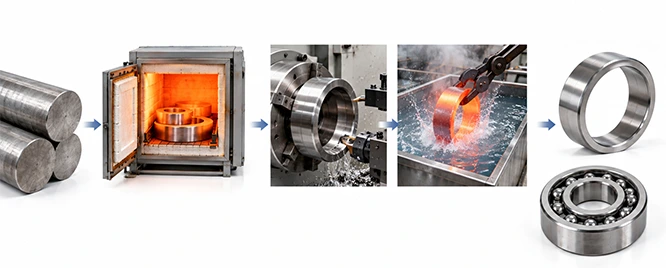

52100 bearing steel has a high carbon content and good hardenability, but it can be difficult to machine efficiently without proper treatment. When manufacturing bearing rings, spheroidize-annealed steel is commonly used. This process produces finely dispersed, spherical carbides, reducing hardness and improving machinability.
After annealing, the material can be CNC turned to machine the inner bore, outer diameter, and end faces of the bearing rings. The components then undergo quenching, tempering, and precision grinding to meet the required hardness, wear resistance, and dimensional accuracy.
Applications of Quenching
Quenching is widely used in automotive drivetrains, industrial machinery, mold manufacturing, and cutting tool production. Typical components include drive shafts, gears, bearings, cutting tools, and mold components. Depending on the operating conditions, manufacturers may use through-hardening, localized induction hardening, or other suitable hardening processes.
Typical Example: 4140 Alloy Steel Drive Shaft
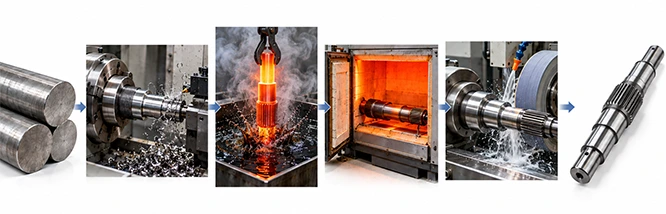

4140 alloy steel is commonly used to manufacture drive shafts subjected to torque and cyclic loads. To meet strength and toughness requirements, some drive shafts undergo quenching and tempering.
Manufacturing begins with CNC turning to rough-machine the shaft, leaving additional stock on critical mating surfaces for finishing. The component is then heated to an appropriate austenitizing temperature, held for the required time, and oil-quenched to produce a hard microstructure. Tempering follows to adjust its strength and toughness.
After heat treatment, critical areas such as bearing seats are finish-turned or cylindrically ground to meet final dimensional and surface finish requirements.
6. FAQs
Q1: Can Annealing and Quenching Be Used on the Same Part?
Yes. Some steel components are annealed first to improve machinability, then quenched and tempered to achieve the required hardness and strength. The specific sequence depends on the material and performance requirements.
Q2: Can Quenching Cause Distortion in CNC Machined Parts?
Yes. Temperature differences and microstructural transformations during rapid cooling can generate residual stresses, causing bending or dimensional changes. Proper control of cooling conditions and heat treatment parameters helps reduce distortion.
Q3: How Does Heat Treatment Affect the Dimensional Accuracy of CNC Machined Parts?
Heat treatment can cause dimensional changes that affect final tolerances. For precision parts, accuracy can be maintained by leaving sufficient finishing allowance, planning the machining sequence, and performing final machining and dimensional inspection.
Q4: Can All Metals Be Hardened by Quenching?
No. Carbon steels and certain alloy steels can form martensite during quenching, increasing hardness. Heat-treatable aluminum alloys such as 6061 and 7075 generally require solution heat treatment, quenching, and subsequent aging to achieve the desired strength.
Q5: Which Is More Expensive, Annealing or Quenching?
There is no universal answer. Annealing may require longer cooling times, while quenching may involve tempering and additional finishing operations. The actual cost depends on the material, part size, production volume, and processing requirements.