Nylon has some water resistance, but it is not completely waterproof. As a commonly used engineering plastic, nylon can absorb moisture from its surroundings, which affects its dimensions, stiffness, and mechanical properties. Understanding these changes helps reduce potential problems when selecting materials and manufacturing parts.
1. Is Nylon Waterproof?
Nylon is generally not considered a completely waterproof material. It has some resistance to water, but it can absorb moisture from its surroundings.
To understand this, it is important to distinguish between three terms:
Waterproof: A material’s ability to prevent water from passing through it and maintain its protective performance under specified conditions.
Water-Resistant: A material’s ability to withstand a certain level of water exposure, although this does not mean that water is completely prevented from entering.
Water Absorption: The ability of a material to absorb and retain moisture.
*Nylon fabrics and engineering plastics behave differently. For clothing, tents, and other textiles, waterproof performance mainly depends on fabric construction and surface coatings. For engineering plastics such as PA6 and PA66, the main concern is how moisture absorption affects material dimensions and properties.
2. Why Does Nylon Absorb Water?
Nylon belongs to the polyamide family and contains amide groups in its molecular structure. These groups are polar and can form hydrogen bonds with water molecules, giving nylon its moisture-absorbing properties.
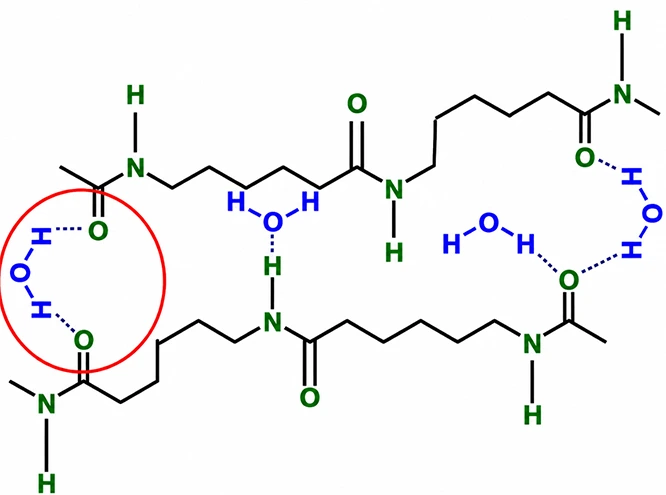
When water molecules enter the material, they affect the interactions between polymer chains, causing a certain degree of swelling and plasticization.
Nylon’s water absorption is also affected by environmental conditions:
Humidity: The higher the relative humidity, the more moisture nylon generally absorbs, until it gradually reaches equilibrium.
Temperature: Temperature affects the diffusion rate of water molecules and the moisture absorption process.
Immersion Time: Prolonged contact with water allows nylon to continue absorbing moisture, gradually approaching its saturation level.
In addition, the thickness and shape of the part, as well as the material’s crystallinity, can affect the rate of water absorption.
3. Which Absorbs More Water, PA6 or PA66?
PA6 and PA66 are two commonly used engineering nylon materials. In general, PA6 has a slightly higher equilibrium moisture absorption rate than PA66, although the actual values depend on the material grade and test conditions.
The following data are based on BASF Ultramid material technical data:
| Property | PA6 (B3K) | PA66 (A3K) |
| Equilibrium moisture absorption at 23°C / 50% RH | 2.6–3.4% | 2.5–3.1% |
| Water absorption at saturation in water at 23°C | 9–10% | 8–9% |
Data source: %C2%AE_B3K_Product_Data_Sheet_Asia_PacificEurope_English.pdf” >Ultramid B3K (PA6) Product Data Sheet; %C2%AE_A3K_Product_Data_Sheet_Asia_PacificEurope_English.pdf” >Ultramid A3K (PA66) Product Data Sheet.
Equilibrium moisture absorption and saturated water absorption refer to different test conditions and should not be confused. The values above are typical data for specific unreinforced material grades and do not represent all PA6 and PA66 products.
4. How Does Water Absorption Affect Nylon Parts?
For engineering plastic parts, moisture absorption changes not only the material itself but also the dimensional accuracy and actual performance of the finished parts.
Dimensional Changes
When nylon absorbs moisture, it swells, causing its dimensions to increase. For precision mating parts, this change can affect assembly clearances and fit accuracy.
Reduced Stiffness
Moisture acts as a plasticizer, reducing nylon’s stiffness and elastic modulus and making the material more flexible. This is particularly important for structural parts that need to maintain high rigidity.
Changes in Mechanical Properties
Moisture absorption affects nylon’s tensile properties, yield behavior, and impact performance. In general, conditioned nylon tends to have lower stiffness and strength, while its elongation and toughness may increase.
Dimensional Stability and Machining Accuracy
Moisture absorption causes nylon to swell, affecting part dimensions and assembly performance. For manufacturing processes such as injection molding and CNC machining, changes in material moisture content need to be taken into account.
5. How to Reduce Moisture-Related Problems in Nylon Parts?
Nylon’s moisture absorption cannot be completely eliminated, but its effects can be reduced through proper material selection, process control, and part design.
Choose the Right Material
Select PA6, PA66, or glass fiber-reinforced nylon based on the part’s operating environment and dimensional requirements.
PA6 GF30 and PA66 GF30 contain approximately 30% glass fiber. Glass fiber increases material stiffness and reduces overall moisture absorption and the dimensional changes caused by moisture. However, reinforced nylon still absorbs water, and fiber orientation can affect dimensional stability in different directions.
Control Material Drying
Before injection molding, nylon pellets should be dried according to the conditions specified by the material supplier to control their moisture content. Some BASF Ultramid PA6 and PA66 grades recommend drying at approximately 80°C for 4 hours. Actual drying parameters should always follow the data sheet for the specific grade.
Optimize Part Design
For precision mating parts, moisture-related dimensional changes should be considered when setting clearances and tolerances. For complex structures, dimensional expansion in different directions also needs to be taken into account.
Control Processing and Inspection Conditions
Whether injection molding or CNC machining is involved, the moisture condition of nylon materials needs to be considered.
Before injection molding, the material should be dried according to the supplier’s requirements, and molding conditions should be properly controlled.
For CNC machining, the effect of the material’s conditioning state on machining dimensions needs to be considered.
For parts with tight dimensional requirements, inspection temperature, humidity, and material condition should also be standardized to ensure that measurement results match actual operating conditions.
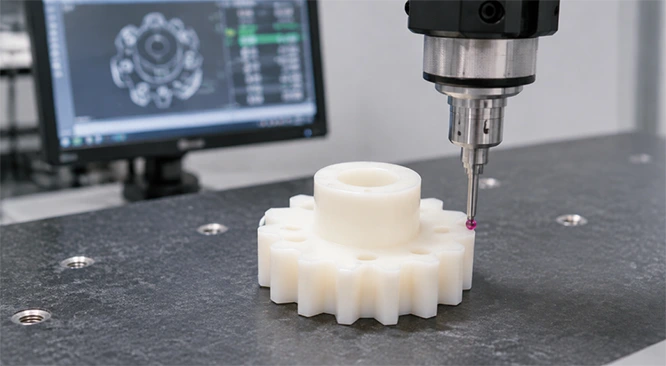
When molding PA6 parts, we often encounter cases where products meet dimensional requirements immediately after coming off the machine but become oversized after being stored for some time due to moisture absorption. To address this, we use strict quality control, material condition management, and dimensional inspection to ensure that parts continue to meet customer tolerance requirements after conditioning.
6. Is Nylon Still Suitable for Use in Wet Environments?
Yes, but the material should be selected based on actual operating conditions.
For general mechanical and structural parts, PA6 and PA66 can usually meet the requirements of moderately humid environments. However, if parts are exposed to water for extended periods, require high dimensional stability, or have tight fitting tolerances, moisture-induced swelling and changes in mechanical properties need to be evaluated.
For applications with higher moisture-resistance requirements, glass fiber-reinforced nylon can also be considered, along with other engineering plastics such as POM, PBT, and PPS. The final material selection should take into account the operating environment, mechanical loads, temperature, and dimensional tolerances.
Conclusion
Nylon offers good engineering performance, but its moisture absorption affects part dimensions, stiffness, and mechanical properties. PA6 and PA66 have different water absorption characteristics, while glass fiber reinforcement can further improve dimensional stability. For injection-molded and CNC-machined parts, considering material moisture conditions and the actual operating environment is essential to maintaining product performance and dimensional accuracy.