In high-volume injection molding, increasing the number of cavities is a common way to boost output. However, as cavity count increases, mold size and machine requirements may also increase. A stack mold offers another approach: multiple cavity levels are arranged along the mold-opening direction, increasing the number of parts produced per cycle without excessively increasing the mold’s lateral dimensions.
1. What Is a Stack Mold?
A Stack Mold is an injection mold with two or more levels of cavities. Unlike a conventional mold, where the cavities are arranged on a single parting surface, a stack mold places multiple cavity levels along the mold-opening direction. As a result, one mold can have two or more parting surfaces.
Take a simple 4-cavity mold as an example. A conventional 4-cavity mold produces 4 parts in each injection molding cycle, while a two-level Stack Mold can have 4 cavities on each level, producing 8 parts per cycle.
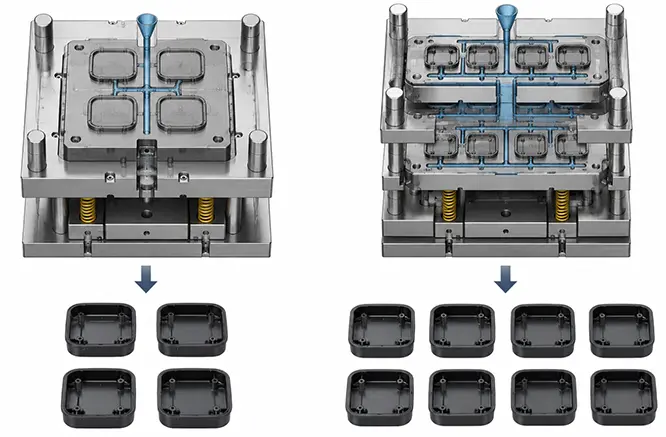
Two-level designs are the most common, although three or even more levels can be used depending on part size, mold structure, and production requirements.
2. How Does a Stack Mold Work?
The basic molding process of a Stack Mold is not fundamentally different from that of a conventional mold. It still goes through injection, packing, cooling, mold opening, and ejection.
The main differences lie in the internal mold structure and the way the mold opens.
① At the beginning of injection, molten plastic flows through the runner system into the cavities on different levels. Stack molds are typically equipped with a hot runner system to distribute the melt more evenly to each cavity level.
② Once the cavities are filled and the parts have cooled, the mold begins to open. Because the mold contains a center section, the moving half is not the only component that moves. The center section also travels in a controlled manner, allowing two or more parting surfaces to open.
③ The molded parts are then released and ejected from each cavity level. The mold closes again and begins the next injection molding cycle.
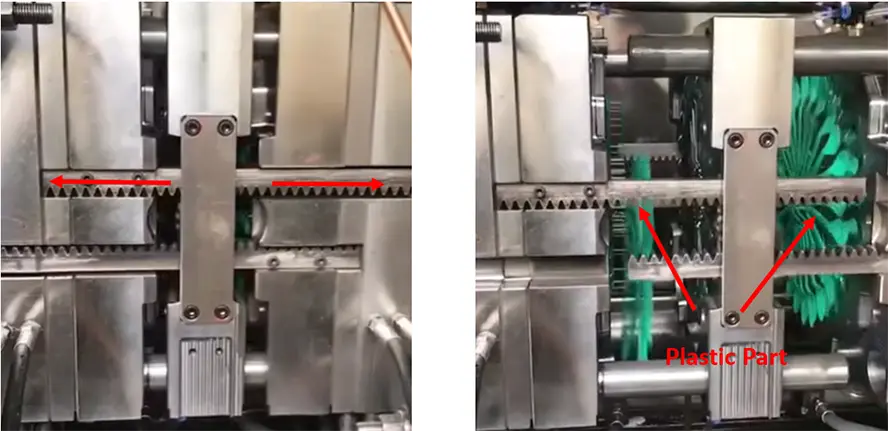
In other words, the core idea behind a Stack Mold is not to change the injection molding process itself, but to use multiple cavity levels so that more parts can be molded within a single cycle.
3. What Is the Difference Between a Stack Mold and a Conventional Mold?
The most obvious difference between the two lies in how the cavities are arranged.
| Comparison | Conventional Injection Mold | Stack Mold |
| Number of parting surfaces | Usually 1 | 2 or more |
| Cavity arrangement | Located on a single level | Arranged in multiple levels along the mold-opening direction |
| Parts produced per cycle | Relatively fewer | Can be significantly increased |
| Mold structure | Relatively simple | More complex |
| Mold cost | Relatively lower | Higher |
| Suitable production volume | Suitable for low- to high-volume production | Better suited for high-volume production |
From a selection standpoint, neither mold type is inherently better than the other. Conventional molds have a mature structure and a broader range of applications, while the value of a Stack Mold becomes more apparent in high-volume projects. Whether a stack mold is worth using ultimately depends on whether the additional tooling investment can be justified by the production efficiency gained later.
4. Benefits of Stack Molds
Higher Production Efficiency
This is the most direct advantage of a stack mold.
Adding more cavity levels does not necessarily mean that injection molding cycle time will increase proportionally. With a properly designed mold and stable filling and cooling conditions, a stack mold can increase overall production efficiency while maintaining a similar production cycle.
Lower Cost per Part
The initial manufacturing cost of a stack mold is higher. In stable, high-volume production, however, the greater output per cycle can spread equipment operating costs, labor, and production time across more parts.
When demand is high enough, this can reduce the cost per part.
Better Utilization of the Injection Molding Machine
A Stack Mold can increase cavity count without simply increasing the mold’s lateral footprint.
For projects where the injection molding machine has already been selected, this approach can allow the same machine to produce more parts per cycle, improving overall equipment utilization.
Reduced Need for Additional Production Equipment
If the capacity of a conventional mold cannot meet production demand, a manufacturer may need to add another mold or injection molding machine.
For projects that are well suited to stack molding, increasing the output of a single machine can sometimes reduce the need for additional production cells, saving part of the investment in equipment and factory space.

5. Limitations of Stack Molds
More cavities do not automatically make a stack mold better. Its more complex structure also comes with several clear limitations.
First, stack molds generally cost more to manufacture than conventional molds. The center section, synchronized opening mechanism, and hot runner system all add complexity to mold design and machining.
Second, multiple cavity levels place higher demands on runner balance and mold movement control. If filling is not properly balanced between different levels, part quality may vary from one cavity to another.
A Stack Mold also places greater demands on the injection molding machine. Because more cavities need to be filled during each cycle, the machine must have sufficient shot capacity. At the same time, a multi-level mold typically requires a larger mold-opening stroke and more installation space when fully opened.
In addition, as mold structure becomes more complex, maintenance, repair, and debugging also tend to become more difficult.
6. When Should You Use a Stack Mold?
A Stack Mold is generally better suited for products with high demand, a relatively stable design, and long-term continuous production requirements.
Common examples include:
- Bottle caps, jar lids, and other closure parts
- Food packaging boxes and thin-wall containers
- Disposable medical plastic parts
- Household products and consumer-product housings
- Small plastic parts with relatively simple structures
- Other thin-wall products requiring high-volume production
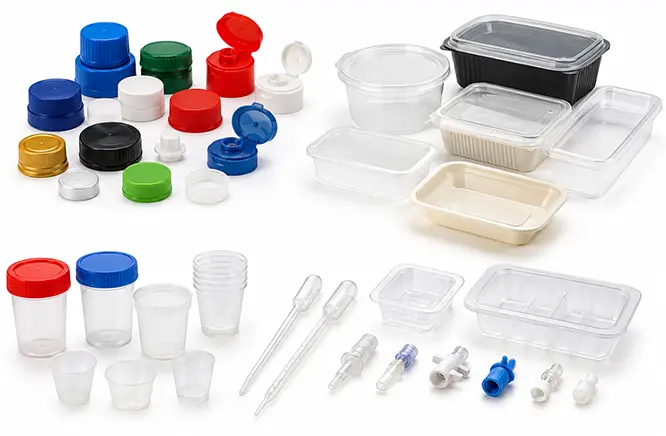
These products often have relatively low profit margins per part but are manufactured in very large quantities. As a result, increasing the number of parts produced in each injection molding cycle can have a greater impact on reducing unit cost.
In addition to the product type, whether a Stack Mold is suitable also depends on the project itself. If the product design is already stable, annual demand is high, and production is expected to continue for a long period, the higher tooling investment is easier to spread across large-volume production.
By contrast, if demand is relatively low, the product design is still being changed frequently, or the product has a short life cycle, a conventional multi-cavity mold is usually more flexible and makes it easier to control upfront costs.
Conclusion
Stack molding is a mature solution for high-volume production, but it is not necessary for every injection molding project. The decision should be based on the part structure, production plan, machine capabilities, and overall cost rather than simply pursuing more cavities or higher output.