Injection molding involves injecting molten plastic into a mold, where it cools and forms a finished part. Die casting uses high pressure to inject molten metal into a mold, where it solidifies into a metal component. Both processes are suitable for mass-producing complex parts, but they differ significantly in materials, performance, costs, and applications. This article compares their key differences and explains how to choose the right manufacturing process.
1. Key Differences Between Injection Molding and Die Casting
Both processes can produce complex parts with precise dimensions, but material properties and processing conditions determine where each is best suited.
| Comparison Factor | Injection Molding | Die Casting |
| Materials | Plastics such as ABS, PC, PA, PPS, and PEEK | Metal alloys such as aluminum, zinc, and magnesium |
| Processing Temperature | Generally lower | Generally higher |
| Mold Materials | Tool steel and some aluminum alloys | Primarily heat-resistant tool steel |
| Tooling Cost | Depends on part design and production requirements | Generally higher, but varies by project |
| Part Weight | Generally lighter | Generally heavier |
| Strength and Stiffness | Depends on plastic type and reinforcement | Generally higher stiffness |
| Heat Resistance | Depends on the plastic grade | Generally better suited to high-temperature environments |
| Thermal Conductivity | Conventional plastics have low thermal conductivity | Metals generally have better thermal conductivity |
| Electrical Insulation | Most plastics provide good electrical insulation | Metals are electrically conductive |
| Corrosion Resistance | Most engineering plastics offer good corrosion resistance | Depends on the alloy and surface treatment |
| Dimensional Accuracy | High precision is achievable | High precision is achievable |
| Design Flexibility | Suitable for integrating snap-fits, ribs, and other features | Suitable for complex metal structures |
| Production Efficiency | Suitable for mass production | Suitable for mass production |
| Post-Processing | Gate removal, painting, assembly, etc. | Deburring, CNC machining, surface finishing, etc. |
| Typical Applications | Electronic housings, connectors, plastic structural components | Heat sinks, metal housings, automotive brackets |
2. Can Injection Molding Replace Metal Die Casting?
Yes, but it depends on the part’s performance requirements. High-performance engineering plastics such as glass-fiber-reinforced PA, PPS, and PEEK can replace certain conventional metal components.
Replacing metal with plastic offers several advantages:
Weight Reduction: Engineering plastics have lower densities, making them suitable for lightweight structural designs.
Electrical Insulation: Suitable for electronic housings, electrical connectors, and similar components.
Corrosion Resistance: Many engineering plastics offer good chemical resistance and eliminate the need for metal corrosion protection treatments.
Structural Integration: Snap-fits, reinforcing ribs, and mounting bosses can be molded directly into the part, reducing assembly steps.
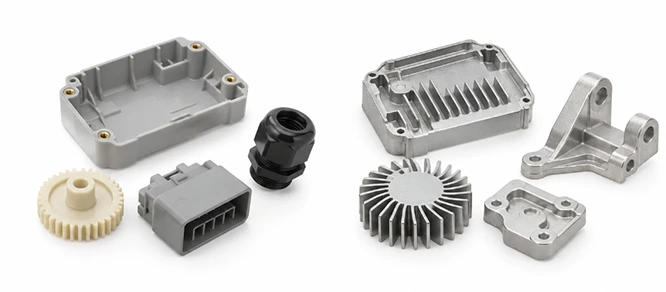
However, metals still offer clear advantages in applications requiring high stiffness, efficient heat dissipation, or sustained loads at elevated temperatures.
It’s also important to note that replacing metal usually requires redesigning the part. Wall thickness, reinforcing ribs, connection features, long-term loads, and operating temperatures all need to be reassessed.
3. How to Choose Between Injection Molding and Die Casting
The choice of manufacturing process primarily depends on the functions the product needs to perform.
If a product requires lightweight construction, electrical insulation, and integrated complex features, injection molding is often a practical choice, provided the plastic meets the operating requirements.
Die casting is generally better suited to products that need high stiffness, good thermal conductivity, or electromagnetic shielding from a metal enclosure.
In actual product development, balancing cost and functionality is equally important. Let’s look at a practical case to see how manufacturing costs can be controlled while meeting the product’s functional requirements.
Case Study: Industrial Electronic Equipment Housing
A customer developing an industrial control device initially planned to use a die-cast aluminum housing to ensure structural strength and heat dissipation. However, the costs of tooling, CNC post-machining, and surface finishing exceeded the budget. The customer wanted to reduce costs but was concerned that a plastic housing might not meet the performance requirements.
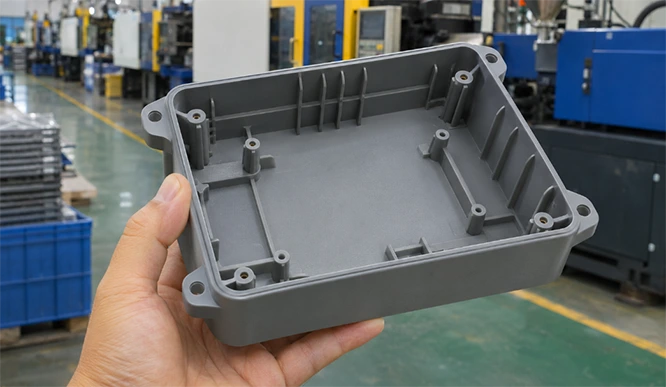
After evaluating the design, we found that the housing was not responsible for the device’s primary heat dissipation. We proposed replacing the die-cast aluminum with flame-retardant PC/ABS engineering plastic and made several design adjustments:
Material Selection: We selected flame-retardant PC/ABS to balance impact resistance, electrical insulation, and flame-retardancy requirements.
Structural Optimization: We added reinforcing ribs, adjusted local wall thicknesses, and integrated mounting bosses directly into the injection-molded part.
Cost Control: We reduced the CNC post-machining and metal surface finishing operations required by the original design.
Based on the illustrative cost estimate, the new solution was projected to save approximately $46,000, reducing overall manufacturing costs by about 32%.
FAQs
Q1: Can Plastic Be Die Cast?
Generally, no. Die casting is primarily used for metal alloys such as aluminum, zinc, and magnesium, while thermoplastics are typically processed through injection molding. The two processes use different materials and operate under different mold conditions.
Q2: Can Injection Molding and Die Casting Use the Same Mold?
Generally, no. Die casting molds must withstand the high temperatures and thermal cycling associated with molten metal. Their gating, venting, and temperature-control systems differ significantly from those used in plastic injection molds.
Q3: What Is Casting?
Casting is a manufacturing process in which liquid material is poured or injected into a mold and allowed to solidify. Common methods include sand casting, investment casting, and die casting. Die casting is a type of casting that typically uses high pressure to inject molten metal into a metal mold.
Q4: Can Die-Cast Metal Parts Be Welded?
Yes, but weldability depends on the alloy, internal porosity, and welding process. Porosity in conventional die-cast parts can affect weld quality, while high-vacuum die-cast parts with low porosity generally offer better welding conditions.
Q5: Do Die-Cast Parts Require CNC Machining?
Not all die-cast parts require CNC machining. Features such as threaded holes, precision mating surfaces, or tight dimensional tolerances often require secondary machining. Simpler parts may meet their requirements after die casting and routine finishing alone.